IBS and Your Period: Why Symptoms Can Shift
IBS symptoms may flare before or during a period, but a cycle-related pattern doesn’t mean IBS has caused a hormone imbalance.
Some studies find that people with IBS report more pain, bloating, diarrhea, or constipation around menstruation, though the pattern isn’t the same for everyone. These studies describe symptoms across cycle phases; they don’t show that IBS changes estrogen or progesterone levels. A brief cycle-and-bowel log can help you see whether your own symptoms repeat and what else may be contributing. 3 4
What research says about symptoms across the cycle
If your IBS seems worse before or during your period, that pattern has been reported in research. But studies don’t all agree, and symptoms can vary from one person to another.
A review of studies found that some women with IBS reported more symptoms before or during menstruation, while other studies found no clear effect of cycle timing. In one study of 102 premenopausal women with IBS, constipation was reported more often in the luteal phase, the time before a period, than during menstrual bleeding. Bloating was common across all the phases researchers examined. These findings describe one group; they can’t predict what will happen in your cycle. 3 4
The studies generally rely on symptom reports or diaries, and their designs and results vary. Medications taken for period pain, including nonsteroidal anti-inflammatory drugs, and hormonal contraceptives weren’t consistently accounted for in earlier studies. That makes it harder to separate a cycle effect from other influences. 4
A symptom pattern isn’t proof of a hormone problem
It’s plausible that cycle-related biology affects digestion or how strongly gut sensations are felt. The review discusses possible roles for changing gut transit and prostaglandins around menstruation, but says the mechanisms aren’t settled. A proposed explanation isn’t the same as showing that a hormone is out of balance. 4
Most importantly, these studies examine bowel symptoms across the cycle. They don’t establish that IBS itself changes your estrogen or progesterone levels. If your symptoms reliably shift with your period, that tells you about a timing pattern, not what your hormone levels are.
Look for a repeatable pattern, not a perfect cycle
If you’d like to understand your own symptoms, make a simple record alongside your period dates. Note bowel changes, pain, and bloating, plus anything that could complicate the picture, such as period-pain medicines or hormonal contraception. Comparing notes across cycles may help show whether the same symptoms tend to recur at a similar time. It won’t diagnose the cause, but it can make the pattern clearer. Medication use matters because it may influence symptoms and was not consistently controlled in earlier research. 4
IBS itself can involve abdominal pain, bloating, diarrhea, constipation, or a mix of bowel changes, and symptoms may come and go. 1 If the pattern is new, persistent, or substantially different from your usual IBS, don’t assume the calendar explains it. Bleeding from the rectum or unexplained weight loss are also reasons to seek medical evaluation. 2
When period-linked bowel symptoms may need another explanation
IBS isn’t the only possible explanation for bowel symptoms that track with menstruation. A systematic review found that endometriosis and IBS diagnoses can occur together, but shared symptoms and study limitations make it difficult to tell whether some symptoms reflect IBS, endometriosis, or both. 5
If period-related pain or bowel symptoms are disrupting your life, it’s reasonable to raise both the timing and the symptoms with a clinician. The useful question isn’t just “Is this hormonal?” It’s whether the pattern fits your known IBS, whether anything has changed, and whether another condition could also be contributing.
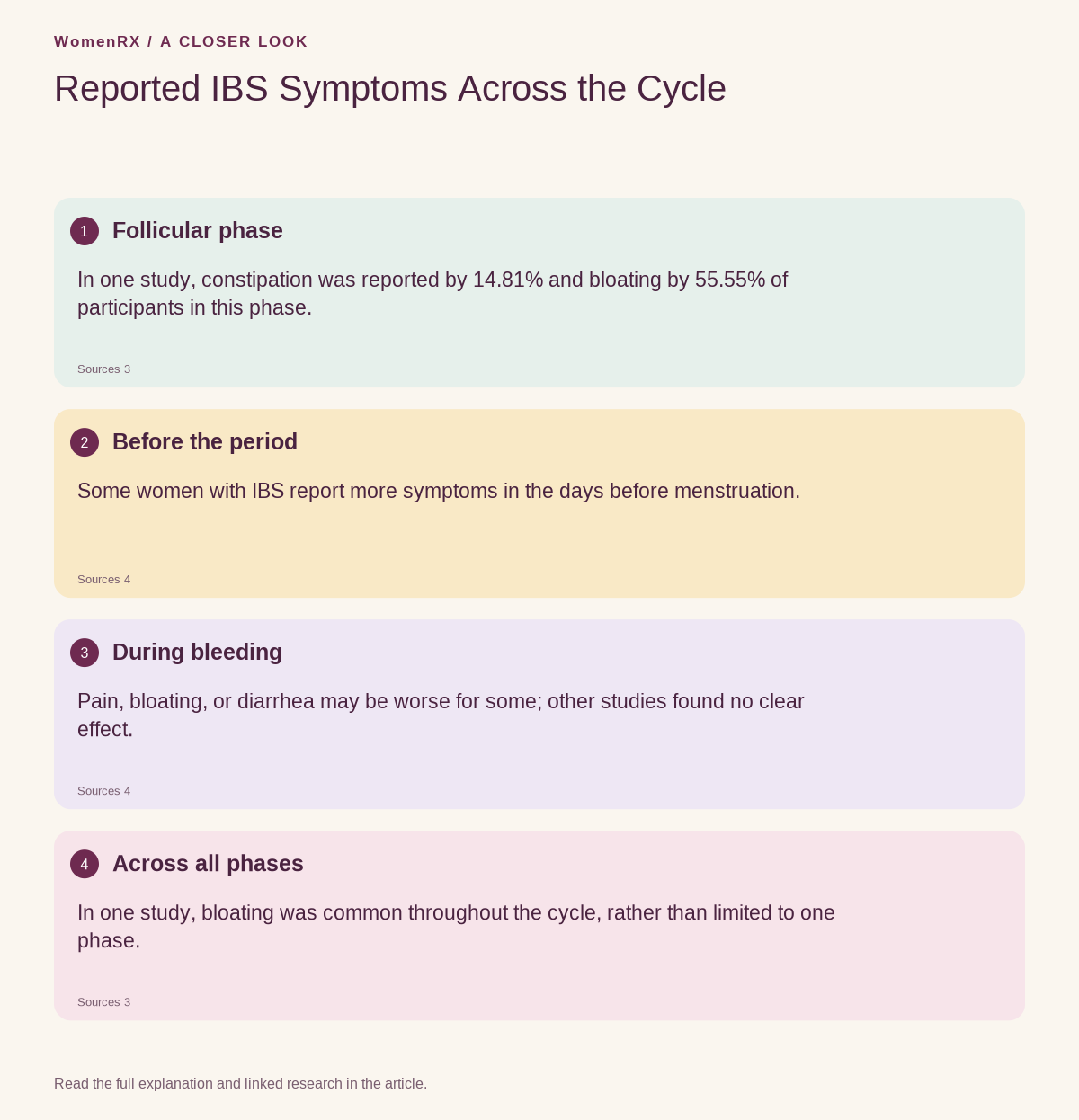
Reported IBS Symptoms Across the Cycle
Follicular phase: In one study, constipation was reported by 14.81% and bloating by 55.55% of participants in this phase.3
Before the period: Some women with IBS report more symptoms in the days before menstruation.4
During bleeding: Pain, bloating, or diarrhea may be worse for some; other studies found no clear effect.4
Across all phases: In one study, bloating was common throughout the cycle, rather than limited to one phase.3
Read the figure as text
Studies describe possible symptom shifts, not a universal pattern or a way to diagnose the cause.- Follicular phase: In one study, constipation was reported by 14.81% and bloating by 55.55% of participants in this phase.3
- Before the period: Some women with IBS report more symptoms in the days before menstruation.4
- During bleeding: Pain, bloating, or diarrhea may be worse for some; other studies found no clear effect.4
- Across all phases: In one study, bloating was common throughout the cycle, rather than limited to one phase.3
More questions, answered
Does IBS cause a hormone imbalance?
The cycle studies discussed here report bowel symptoms at different times of the menstrual cycle; they don’t show that IBS causes estrogen or progesterone levels to become abnormal. 3 4
Can period-related bowel symptoms be something other than IBS?
Yes. IBS and endometriosis can be diagnosed together, and their symptoms may overlap. A repeating cycle pattern alone can’t identify the cause. 5
Sources you can check
- Irritable Bowel Syndrome | IBS | MedlinePlusAccessed 2026-09-25Return to first citation
- Symptoms of IBS (irritable bowel syndrome) - NHSAccessed 2026-09-25Return to first citation
- Irritable Bowel Syndrome and the Menstrual Cycle.Pati GK, Kar C, Narayan J, Uthansingh K, Behera M, Sahu MK, Mishra D, Singh A. · Cureus · 2021Return to first citation
- Symptomatology of irritable bowel syndrome and inflammatory bowel disease during the menstrual cycle.Bharadwaj S, Barber MD, Graff LA, Shen B. · Gastroenterology report · 2015Return to first citation
- A systematic review and meta-analysis of the associations between endometriosis and irritable bowel syndrome.Saidi K, Sharma S, Ohlsson B. · European journal of obstetrics, gynecology, and reproductive biology · 2020Return to first citation