Can IBS Go Away Without Medication?
IBS symptoms can settle or flare, and the most useful non-drug approach depends on whether pain, bloating, constipation, or diarrhea is troubling you most.
There’s no established cure for IBS, but symptoms can improve, sometimes for long stretches. Food changes, stress management, and other non-drug approaches aim to make symptoms more manageable, not permanently reverse the condition. Start with the pattern you’re trying to change: an approach that helps constipation may be a poor fit for diarrhea, while a restrictive diet asks more of you than a small food adjustment.123

Feeling better isn’t the same as being cured
IBS can bring abdominal pain or cramps, bloating, and constipation, diarrhea, or both. Symptoms often come and go. That means a quieter month is worth enjoying, but it doesn’t prove IBS has disappeared for good. The goal of management is fewer or less disruptive symptoms, not a test of whether you’ve managed to “fix” your gut.23
There isn’t one IBS diet because there isn’t one IBS symptom pattern. Food may affect how quickly things move through your gut or how much gas you notice; gut sensitivity and stress may also play a part. Those are reasons to choose an approach based on what happens to you, rather than cutting out every food that appears on an IBS list.13
Match the food change to the bowel problem
If constipation is the main problem: Soluble fiber is a more relevant place to start than avoiding fiber altogether. Oats, carrots, peeled potatoes, and linseeds are among the foods the NHS suggests for constipation in IBS, along with enough fluid to help keep stools softer. Pay attention to whether the change helps you pass stool and whether pain and bloating improve; bowel frequency is only part of the picture.17
If diarrhea is the main problem: Advice intended for constipation may not fit. The NHS suggests cutting back on some high-fiber foods, such as whole grains, nuts, and seeds, when trying to prevent diarrhea, and drinking water if diarrhea continues. That isn’t a reason to eliminate all fiber, especially if your bowel habits alternate.12
If meals seem to set off bloating or pain: A brief record of meals, symptoms, and bowel habits may help you spot a repeatable pattern before you remove foods. For example, if bloating repeatedly follows a particular meal, that gives you a more focused question than “Which entire food group should I give up?” A healthy, balanced diet remains the starting point; if controlling symptoms requires avoiding many foods, get help rather than letting the list keep growing.14
Where a low-FODMAP diet fits
A low-FODMAP diet reduces certain fermentable carbohydrates. In a systematic review of adult IBS studies, it improved overall symptom severity compared with control diets. That supports it as a symptom-management option, not a cure or a guarantee that it will work for you. The review did not report a women-specific result.6
It’s also more involved than simply finding a permanent list of “safe” foods. The approach described in the review begins with a restrictive phase, followed by reintroduction to identify which carbohydrate groups matter to the individual. The review describes improvement during an initial 6- to 8-week phase before reintroduction; that’s a description of the approach, not a reason to remain on the restrictive phase indefinitely. The authors raise unresolved questions about long-term nutritional adequacy and the gut microbiome and recommend working with a specialized dietitian.6
The practical burden counts, too. In interviews with 17 Australian adults who had taken part in a dietitian-led low-FODMAP intervention, participants described substantial planning and mental effort. This small qualitative study cannot tell us how often people benefit, but it helps explain why a more targeted first change may be easier to live with.5
Food isn’t the only lever
Stress management is another non-drug way people with IBS may control symptoms. That doesn’t mean stress caused your IBS or that pain is “just stress.” Gut sensitivity, movement through the bowel, and stress are among the factors linked with symptoms, so it makes sense to consider both food patterns and what’s happening around a flare.23
If you have IBS with constipation and symptoms persist after first-line medication treatment, ask whether a brain-gut behavioral approach belongs in your care plan. Brain-gut behavioral therapies are discussed as part of an integrated approach for persistent IBS with constipation, although the material here does not establish which particular therapy will work best for an individual.7
Know when the IBS explanation needs another look
IBS can include pelvic pain, so its presence alone doesn’t identify a separate condition. But don’t automatically label new or concerning pelvic symptoms as an IBS flare. IBS is diagnosed with attention to the possibility of other conditions.24
If you have menstrual cycles, you can note whether bowel symptoms seem to change around your period alongside meals and bowel habits. Treat that as a question about your own pattern, not as a defining sign of IBS or proof of what’s causing the symptoms.12
Get prompt medical assessment for unexplained substantial weight loss, rectal bleeding or bloody diarrhea, or a new hard lump or swelling in your abdomen. If diet changes aren’t helping, or you need to avoid many foods to get through the day, that’s also a good reason to revisit the plan. You don’t have to keep making it more restrictive on your own.14
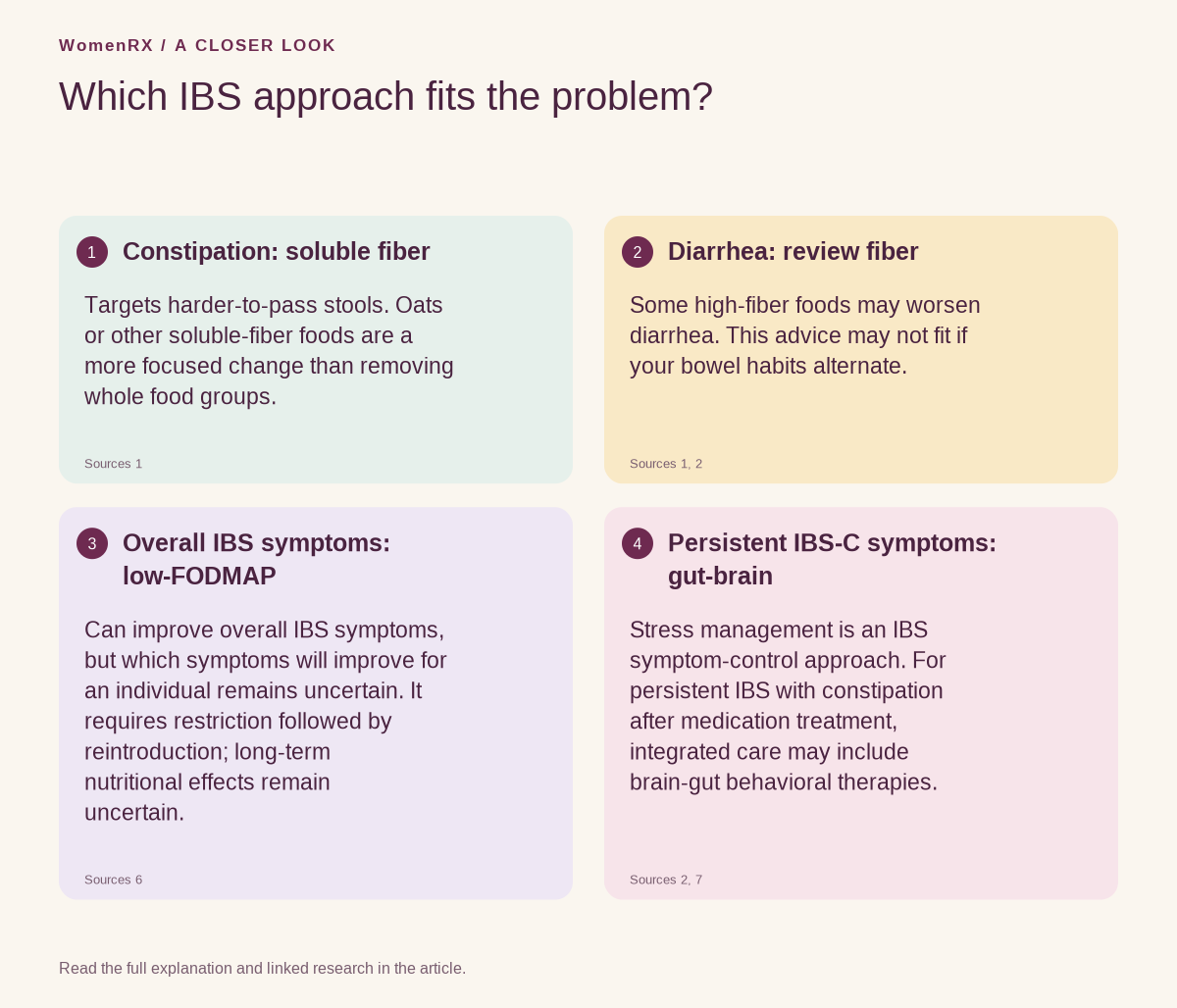
Which IBS approach fits the problem?
Constipation: soluble fiber: Targets harder-to-pass stools. Oats or other soluble-fiber foods are a more focused change than removing whole food groups.1
Diarrhea: review fiber: Some high-fiber foods may worsen diarrhea. This advice may not fit if your bowel habits alternate.12
Overall IBS symptoms: low-FODMAP: Can improve overall IBS symptoms, but which symptoms will improve for an individual remains uncertain. It requires restriction followed by reintroduction; long-term nutritional effects remain uncertain.6
Persistent IBS-C symptoms: gut-brain: Stress management is an IBS symptom-control approach. For persistent IBS with constipation after medication treatment, integrated care may include brain-gut behavioral therapies.27
Read the figure as text
Compare the symptom you want to change with the effort and limits of each non-drug option.- Constipation: soluble fiber: Targets harder-to-pass stools. Oats or other soluble-fiber foods are a more focused change than removing whole food groups.1
- Diarrhea: review fiber: Some high-fiber foods may worsen diarrhea. This advice may not fit if your bowel habits alternate.12
- Overall IBS symptoms: low-FODMAP: Can improve overall IBS symptoms, but which symptoms will improve for an individual remains uncertain. It requires restriction followed by reintroduction; long-term nutritional effects remain uncertain.6
- Persistent IBS-C symptoms: gut-brain: Stress management is an IBS symptom-control approach. For persistent IBS with constipation after medication treatment, integrated care may include brain-gut behavioral therapies.27
More questions, answered
Should I cut out gluten or dairy for IBS?
Not automatically. A review of low-FODMAP research notes limited evidence for gluten-free or lactose-free elimination diets for IBS without a separate reason, such as celiac disease or lactose intolerance. A repeatable symptom pattern is more useful than removing both food groups just in case.6
Can I have IBS if I switch between constipation and diarrhea?
Yes. Some people with IBS have constipation, some have diarrhea, and others alternate between the two. That’s one reason not to treat advice for either bowel pattern as a permanent rule when yours changes.2
Sources you can check
- Diet, lifestyle and medicines for IBS (irritable bowel syndrome) - NHSAccessed 2026-09-25Return to first citation
- Irritable Bowel Syndrome | IBS | MedlinePlusAccessed 2026-09-25Return to first citation
- What is IBS (irritable bowel syndrome) - NHSAccessed 2026-09-25Return to first citation
- Symptoms of IBS (irritable bowel syndrome) - NHSAccessed 2026-09-25Return to first citation
- Exploring the Experiences and Expectations of a Structured Low Fermentable Oligo-, Di-, Monosaccharide and Polyol Diet in People with Irritable Bowel Syndrome: A Qualitative Investigation.Manning LP, Tuck CJ, Biesiekierski JR, Willcox JC. · Journal of the Academy of Nutrition and Dietetics · 2026Return to first citation
- Efficacy of a low-FODMAP diet in adult irritable bowel syndrome: a systematic review and meta-analysis.van Lanen AS, de Bree A, Greyling A. · European journal of nutrition · 2021Return to first citation
- Irritable Bowel Syndrome with Constipation: Diagnosis and Multisymptom Management Beyond Abdominal Pain and Bowel Movement Frequency: A Review.Shah ED, Sharma A, Curren N, Laitman AP, Staller K. · Advances in therapy · 2026Return to first citation