When Bowel Symptoms May Fit IBS
IBS usually involves recurring abdominal pain alongside changes in bowel habits; bloating or constipation by itself doesn’t establish the pattern.
Recurring abdominal pain together with constipation, diarrhea, or a swing between the two can fit IBS, especially when symptoms come and go. There’s no single test that confirms IBS, so an assessment looks at the symptom pattern and may use selected tests to check for other causes. Menstrual timing can affect bowel symptoms, but it doesn’t diagnose IBS. 1 2 5
The pattern matters more than one symptom
IBS can cause abdominal cramps or pain, bloating, constipation, diarrhea, or alternating constipation and diarrhea. Symptoms may come and go, with better days and flare-ups. Pain is a key part of the pattern: bloating alone or constipation alone doesn’t tell you that you have IBS. 1 2 3
For example, recurring cramps alongside periods of hard, difficult-to-pass stools, loose stools, or both may be a reason to ask about IBS. That pattern can fit, but symptoms alone don’t prove the cause. Abdominal pain can come from different organs, and IBS has no single confirming test. 1 4
What an assessment can involve
A useful starting point is explaining how the pain and bowel changes recur together, and whether symptoms change over time. IBS symptoms can fluctuate; some people notice triggers such as food or drink, while other flare-ups have no obvious trigger. 2 3
A clinician may consider tests to check for other conditions. MedlinePlus lists blood tests, stool tests, and imaging among possible tests, and notes that a sigmoidoscopy or colonoscopy may also be used. These are possibilities, not a required package for everyone; there isn’t one specific test for IBS. 1
The point of testing is to assess other explanations when appropriate, not to prove IBS with a single result. Which tests make sense depends on the situation. If you’re seeking care, describe both the pain and the bowel changes rather than mentioning only bloating or constipation. 1 3
Menstrual timing can overlap
Bowel symptoms may worsen before or during a period. A review of studies found increased IBS symptoms during menstruation in both women with IBS and healthy women, and it also describes cyclical gastrointestinal symptoms in people with inflammatory bowel disease. So a period-linked flare can be real, but it isn’t specific to IBS. 5 7
In one small study, 29 women already diagnosed with IBS reported worse pain and bloating and more frequent bowel movements during menstruation; rectal sensitivity also increased during that phase. That finding helps explain why symptoms might shift across a cycle, but it doesn’t show that cycle-linked symptoms identify IBS. 6
If you notice a cycle pattern, it can be useful to mention it as part of the overall picture. The main question remains whether abdominal pain recurs alongside bowel changes, and whether another cause needs to be considered.
When not to assume it’s IBS
Seek prompt medical help for sudden, sharp abdominal pain. Inability to pass stool, especially when you’re also vomiting, is another reason to get immediate help. For milder abdominal pain that lasts a week or more, MedlinePlus advises contacting a healthcare provider. 4
IBS is common and can be uncomfortable, but a familiar label shouldn’t replace an assessment when symptoms are new, persistent, or concerning. A pattern can suggest IBS; it can’t rule out every other cause on its own. 1 4
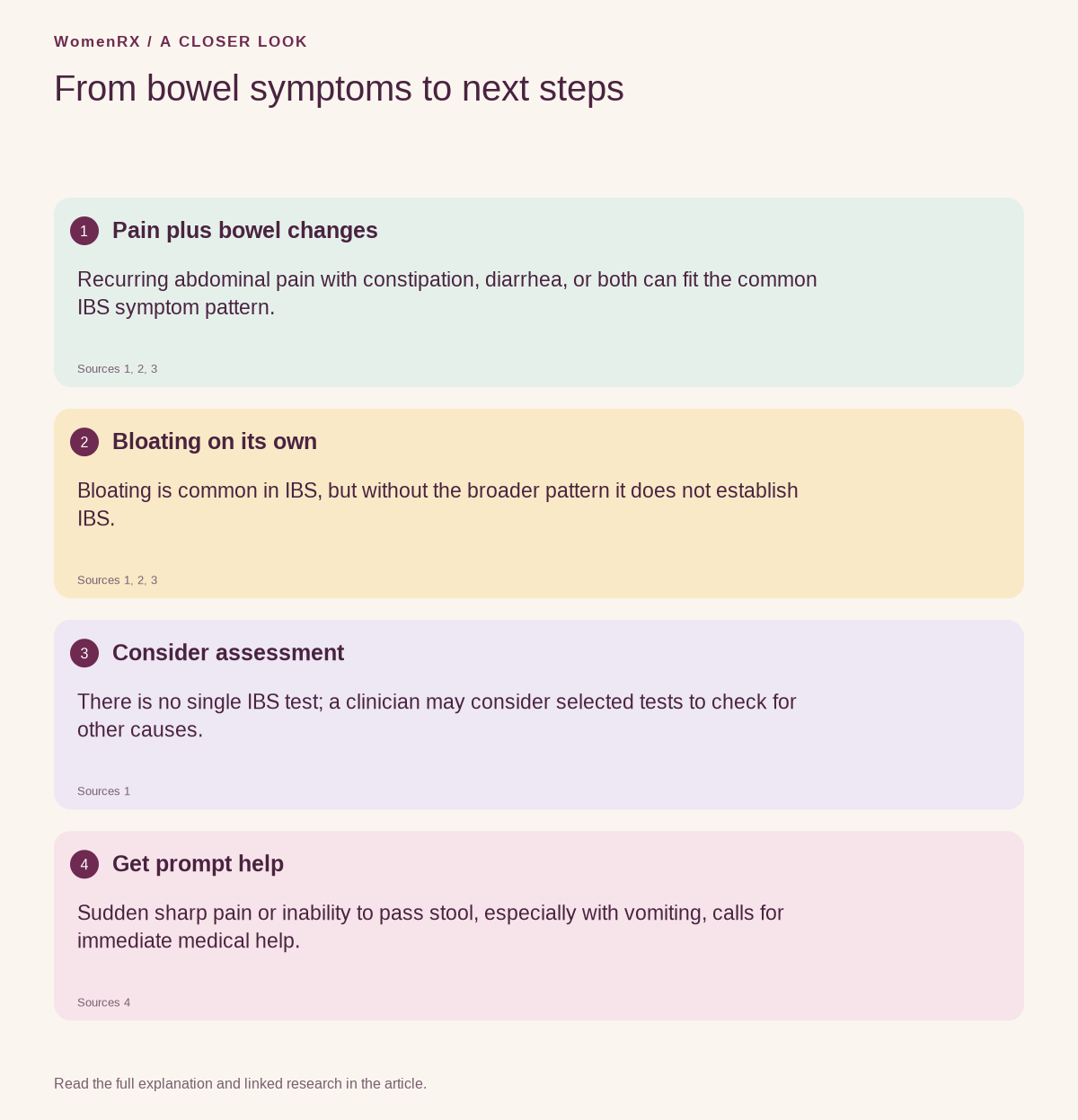
From bowel symptoms to next steps
Pain plus bowel changes: Recurring abdominal pain with constipation, diarrhea, or both can fit the common IBS symptom pattern.123
Bloating on its own: Bloating is common in IBS, but without the broader pattern it does not establish IBS.123
Consider assessment: There is no single IBS test; a clinician may consider selected tests to check for other causes.1
Get prompt help: Sudden sharp pain or inability to pass stool, especially with vomiting, calls for immediate medical help.4
Read the figure as text
A symptom pattern can suggest IBS, but the next step depends on whether pain recurs with bowel changes and whether concerning symptoms are present.- Pain plus bowel changes: Recurring abdominal pain with constipation, diarrhea, or both can fit the common IBS symptom pattern.123
- Bloating on its own: Bloating is common in IBS, but without the broader pattern it does not establish IBS.123
- Consider assessment: There is no single IBS test; a clinician may consider selected tests to check for other causes.1
- Get prompt help: Sudden sharp pain or inability to pass stool, especially with vomiting, calls for immediate medical help.4
More questions, answered
Does bloating alone mean I have IBS?
No. Bloating can occur with IBS, but the typical symptom picture also includes abdominal pain and changes in bowel habits. Bloating by itself doesn’t establish IBS. 1 2 3
Can menstrual-cycle bowel changes mean IBS?
They can occur in people with IBS, but menstrual-cycle-related bowel symptoms have also been reported in healthy women and in people with inflammatory bowel disease. Cycle timing alone can’t identify the cause. 5 7
Sources you can check
- Irritable Bowel Syndrome | IBS | MedlinePlusAccessed 2026-09-25Return to first citation
- What is IBS (irritable bowel syndrome) - NHSAccessed 2026-09-25Return to first citation
- Symptoms of IBS (irritable bowel syndrome) - NHSAccessed 2026-09-25Return to first citation
- Abdominal Pain | MedlinePlusAccessed 2026-09-25Return to first citation
- Symptomatology of irritable bowel syndrome and inflammatory bowel disease during the menstrual cycle.Bharadwaj S, Barber MD, Graff LA, Shen B. · Gastroenterology report · 2015Return to first citation
- The menstrual cycle affects rectal sensitivity in patients with irritable bowel syndrome but not healthy volunteers.Houghton LA, Lea R, Jackson N, Whorwell PJ. · Gut · 2002Return to first citation
- Meta-analysis: do irritable bowel syndrome symptoms vary between men and women?Adeyemo MA, Spiegel BM, Chang L. · Alimentary pharmacology & therapeutics · 2010Return to first citation