How to Shift a Sleep Schedule That’s Drifted
If you’re sleeping later than you want, start with a wake time you can sustain and enough room for sleep.
If you sleep well on later hours but struggle with an earlier schedule, timing may be the main obstacle. Choose a feasible wake-time goal, protect enough time for sleep, and work toward the goal in manageable steps rather than abruptly setting an early alarm. Scheduled sleep-wake times and individually timed light are used for persistent delayed sleep timing; they aren’t a one-size-fits-all protocol.21
What changed: your sleep, or the time you can sleep?
A late bedtime isn’t automatically a sleep disorder. Start with what happens when tomorrow’s schedule doesn’t force an early alarm. If you fall asleep readily at a later hour and sleep well until a later morning, your sleep timing may be the main issue. If you struggle to fall asleep even at that later hour, or wake repeatedly, moving the clock earlier may not address what’s keeping you awake. Delayed sleep-wake phase disorder is often confused with insomnia because both can make a desired bedtime feel impossible.2 Frequent waking and daytime sleepiness can also point to other sleep problems.5
Then look at what sets your hours. For example, sleeping later after several nights of late social plans is a different planning problem from trying to sleep after a night shift. Travel across time zones can also put sleep at odds with the local clock. Shift work and jet lag are recognized causes of circadian sleep-wake problems.5 The pattern matters more than blaming yourself for a single late night.
Build around a feasible sleep window
If your days are fairly predictable and you want to sleep earlier, decide first what wake time you need and when you can realistically make room for sleep. Most adults need about seven to nine hours a night, though individual needs vary.5 An earlier alarm without an earlier chance to sleep may leave you short on sleep rather than move your body clock.
A useful starting point is to compare your current pattern with the routine you’re trying to reach. Here’s an illustrative planning method, not a tested pace for changing your sleep schedule: if you usually sleep from 1 a.m. to 9 a.m. and hope to sleep from 11 p.m. to 7 a.m., you might first see whether midnight to 8 a.m. is a workable intermediate window. Choose a modest next change that still leaves enough opportunity for sleep, and repeat it until it fits your days before considering another move. If you aren’t getting sleepy any earlier, don’t keep advancing the alarm at the cost of sleep. If work fixes your wake time, or caregiving makes the proposed window impossible, plan around the sleep opportunity you actually have rather than treating the example as a deadline. These clock times illustrate how to compare windows, not how far or how often anyone should shift.
Scheduled sleep-wake times are one component of treatment for delayed sleep timing.2 In interviews with 11 young adults with delayed sleep-wake phase disorder, participants described gradually tailoring a demanding treatment protocol and their daily routines to their needs to reduce its burden.1 Their experiences do not establish that gradual self-directed schedule changes work for adults generally.
Use light as part of that plan, not as an afterthought. Morning bright-light therapy is one approach used for sleep disorders; treatment for delayed sleep-wake phase disorder may also combine individually timed bright light, reduced evening light, sleep scheduling, and sometimes melatonin.51 In everyday terms, the part you can plan around is a repeatable morning routine and less light late in the evening. That doesn’t mean a bright-light device or melatonin taken at a guessed hour will move your clock in the right direction. A systematic review of controlled studies found that light interventions helped advance delayed sleep timing on average, but the studies covered different conditions and approaches, not one routine guaranteed to work for everyone.4 If your schedule is substantially out of step with work or family demands, getting help with when to use light makes more sense than guessing with a device. Delayed-phase treatment timing is individualized.1
When a regular target doesn’t fit your life
A changing shift schedule can repeatedly change when sleep is possible. Instead of measuring success against the same early-morning wake time every day, identify the sleep opportunities your shifts actually allow. That won’t resolve circadian misalignment on its own, but it shows why advice built for a steady daytime job may not fit. Research on light-based interventions has found that few studies personalized plans around people’s daily routines, even though those routines affect whether a plan is workable.3
If the change followed travel, ask whether the trouble began with the time-zone change rather than a long-standing tendency to fall asleep late. Jet lag and shift work can both disturb sleep timing, but that history calls for a different conversation than a persistent late schedule at home.5
Caregiving interruptions matter too. For example, a postpartum parent may have a chance to go to bed at a consistent time but be woken repeatedly to care for a baby. That is not the same problem as sleeping soundly on a consistently late schedule. Interrupted sleep can affect sleep quality even when the hours set aside for bed look adequate.5 If pregnancy or postpartum responsibilities interrupt your sleep, use the sleep opportunity you actually have when choosing a target, rather than assuming you can control every waking.
Know when the timing explanation isn’t enough
If you reliably sleep well on your own later hours but repeatedly cannot fall asleep or wake at the times your life requires, describe that pattern when seeking sleep care. A sleep diary can help show the difference between when you tried to sleep, when sleep came, and when you had to get up; diaries are used in identifying delayed sleep timing.2 If instead you wake often, remain sleepy despite enough time for sleep, or someone notices loud snoring or gasping, those details deserve attention in their own right.5
The aim isn’t to force every woman into the same bedtime. It’s to find out whether the obstacle is a shifted clock, too little sleep opportunity, or sleep that stays difficult even when the timing works. From there, you can choose a repeatable change that fits the hours you actually have.
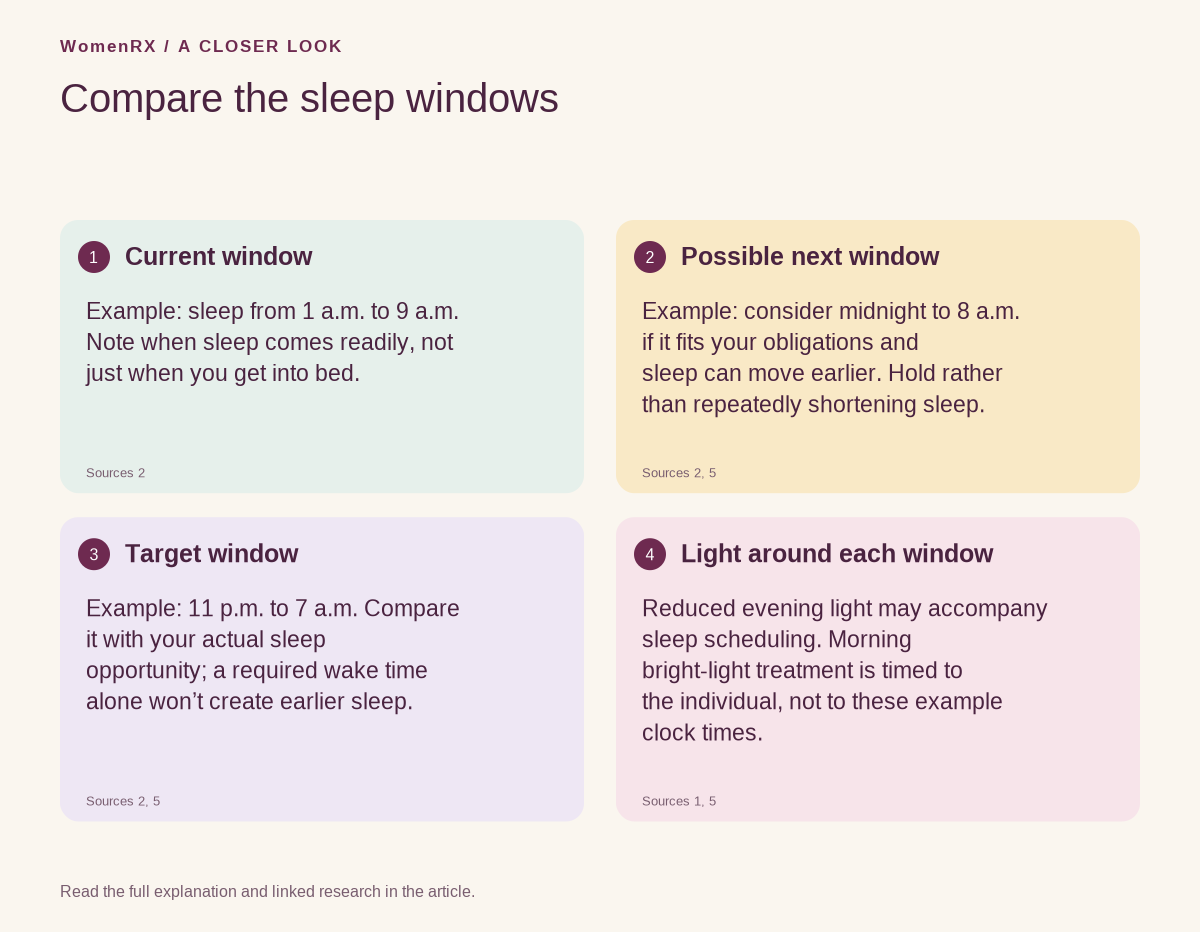
Compare the sleep windows
Current window: Example: sleep from 1 a.m. to 9 a.m. Note when sleep comes readily, not just when you get into bed.2
Possible next window: Example: consider midnight to 8 a.m. if it fits your obligations and sleep can move earlier. Hold rather than repeatedly shortening sleep.25
Target window: Example: 11 p.m. to 7 a.m. Compare it with your actual sleep opportunity; a required wake time alone won’t create earlier sleep.25
Light around each window: Reduced evening light may accompany sleep scheduling. Morning bright-light treatment is timed to the individual, not to these example clock times.15
Read the figure as text
These example clock times show how to check whether an intermediate routine leaves room for sleep. They aren’t a recommended pace or a light-treatment schedule.- Current window: Example: sleep from 1 a.m. to 9 a.m. Note when sleep comes readily, not just when you get into bed.2
- Possible next window: Example: consider midnight to 8 a.m. if it fits your obligations and sleep can move earlier. Hold rather than repeatedly shortening sleep.25
- Target window: Example: 11 p.m. to 7 a.m. Compare it with your actual sleep opportunity; a required wake time alone won’t create earlier sleep.25
- Light around each window: Reduced evening light may accompany sleep scheduling. Morning bright-light treatment is timed to the individual, not to these example clock times.15
More questions, answered
Will going to bed much earlier fix a delayed body clock?
Not necessarily. With delayed sleep-wake phase disorder, a person may sleep easily at a later hour but struggle to fall asleep at the desired earlier one. Treatment commonly combines scheduled sleep-wake times with timed approaches such as light, rather than relying on an earlier bedtime alone.21
Sources you can check
- How do youth with Delayed Sleep-Wake Phase Disorder experience a chronobiological treatment protocol? An interview study.Wilhelmsen-Langeland A, Dundas I, Pallesen S, Bjorvatn B, Nordhus IH, Saxvig IW. · Frontiers in sleep · 2025Return to first citation
- Delayed sleep-wake phase disorder.Barnes KA. · JAAPA : official journal of the American Academy of Physician Assistants · 2025Return to first citation
- Adherence and acceptability of light therapies to improve sleep in intrinsic circadian rhythm sleep disorders and neuropsychiatric illness: a systematic review.Faulkner SM, Dijk DJ, Drake RJ, Bee PE. · Sleep health · 2020Return to first citation
- Light therapies to improve sleep in intrinsic circadian rhythm sleep disorders and neuro-psychiatric illness: A systematic review and meta-analysis.Faulkner SM, Bee PE, Meyer N, Dijk DJ, Drake RJ. · Sleep medicine reviews · 2019Return to first citation
- Sleep Disorders | MedlinePlusAccessed 2026-09-25Return to first citation