Why Your Weight May Change During Perimenopause
Changing periods and a changing waistline can happen together, but sleep, aging, medicines, and daily life may also be part of the picture.
Perimenopause may be part of a weight or body-shape change, but it rarely offers a complete explanation on its own. Hormonal fluctuations can overlap with disrupted sleep and changes in appetite, while aging, medicines, and daily circumstances may also matter. A scale cannot show whether a change reflects fat, muscle, or water, so the pattern and what else has changed are worth considering together. 453
A changing cycle is one clue, not the whole answer
If your periods are becoming irregular and your clothes fit differently, it’s reasonable to wonder whether the two are connected. Perimenopause is the transition while cycles are changing, not the same stage as life after menstrual periods have ended. Research on weight during this transition points to overlapping influences rather than one predictable hormonal effect for every woman. 45
That distinction matters because “weight gain” can describe several different experiences. You might notice a higher number on the scale, a change around your waist, or less strength even though your weight is similar. The scale includes muscle, bone, fat, and water; it cannot tell you which has changed. Waist circumference offers different information because carrying more fat around the abdomen is associated with greater heart disease and type 2 diabetes risk. 3
Sort the changes by what you’re noticing
If sleep changed first: Night waking can leave you tired and short on energy the next day. Sleep disruption is common during the menopausal transition, and research has linked poor sleep with greater hunger and appetite. That link does not prove a particular night of poor sleep caused weight gain. Stress, medicines, and other sleep disorders can also disturb sleep, whether or not you’re in perimenopause. 512
If your shape changed more than the number: A change in where you carry weight is not identical to gaining weight overall. Midlife changes in fat distribution are among the factors discussed in research on perimenopausal weight, but a waist change alone cannot identify its cause. It is worth describing the change as you experience it, rather than assuming the scale tells the full story. 43
If the change followed a shift in your routine: Work hours, family demands, stress, and opportunities to be active can change at the same time as your cycles. A review of perimenopausal weight describes these life circumstances alongside biological predispositions and behavior, with their interaction likely more informative than any one factor alone. This is a reason to look at what changed in your days, not a reason to blame yourself. 4
If you started or changed a medicine: Some medicines can affect weight, and medicines can also contribute to insomnia. The timing is useful information to bring to an appointment. It does not mean the medicine is necessarily responsible or that you should stop it on your own. 31
Give sleep its own attention
Sleep is a useful place to start because it affects how you feel even if your weight never changes. For example, if you’re waking repeatedly and struggling to concentrate by afternoon, that pattern deserves attention in its own right. Insomnia can be related to stress, a medical condition, a medicine, or another sleep problem. Snoring or interrupted breathing during sleep may point to a different issue than difficulty falling asleep. 12
Regular sleep and wake times and a chance to wind down before bed are practical starting points for insomnia. If sleep trouble persists despite changes to your sleep habits, ask about possible causes and treatment rather than treating it only as a weight issue. 12
What makes an appointment more useful
You do not need to arrive with a theory about your hormones. A few concrete details can help sort the possibilities: whether the change was gradual or sudden; whether it is mainly your weight, waist, appetite, sleep, or strength that feels different; how your periods have changed; and whether a medicine or major routine change came before it. Those details help separate a possible transition-related pattern from something else that needs attention. 341
A useful question might be: “My cycles have become irregular, and I’ve noticed a change around my waist. How should we assess that alongside my sleep, medicines, and health history?” If you are gaining or losing weight without trying, particularly if the change is sudden and unexpected, bring it up rather than assuming perimenopause explains it. 3
For day-to-day care, focus on habits that support health and energy, not a promise to reverse a supposed perimenopausal weight-gain rule. Good nutrition and physical activity can support weight management, while maintaining muscle and strength becomes especially relevant with age. The best next step depends on which change you are actually experiencing. 3
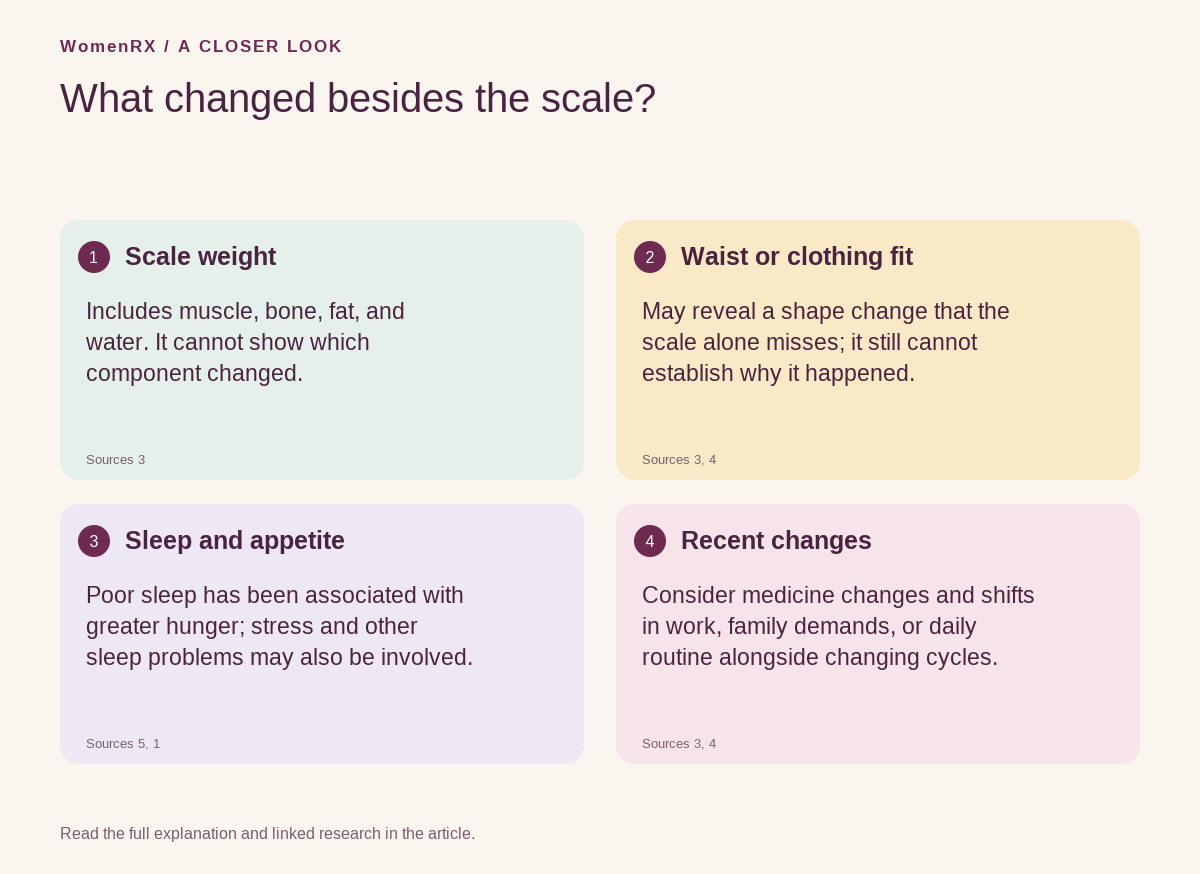
What changed besides the scale?
Scale weight: Includes muscle, bone, fat, and water. It cannot show which component changed.3
Waist or clothing fit: May reveal a shape change that the scale alone misses; it still cannot establish why it happened.34
Sleep and appetite: Poor sleep has been associated with greater hunger; stress and other sleep problems may also be involved.51
Recent changes: Consider medicine changes and shifts in work, family demands, or daily routine alongside changing cycles.34
Read the figure as text
These observations answer different questions; none identifies a cause by itself.- Scale weight: Includes muscle, bone, fat, and water. It cannot show which component changed.3
- Waist or clothing fit: May reveal a shape change that the scale alone misses; it still cannot establish why it happened.34
- Sleep and appetite: Poor sleep has been associated with greater hunger; stress and other sleep problems may also be involved.51
- Recent changes: Consider medicine changes and shifts in work, family demands, or daily routine alongside changing cycles.34
More questions, answered
Can poor sleep explain a bigger appetite?
It may be one contributor. Research discussed in a review of the menopausal transition links poor sleep with greater hunger and appetite, but that association cannot establish why one person’s appetite changed. If sleep is repeatedly disrupted, it is worth addressing as its own concern. 51
Does a steady weight mean my body composition has not changed?
No. Body weight combines muscle, bone, fat, and water, so the same scale reading cannot show whether their proportions have changed. If your waist or strength feels different, say so even if your weight is steady. 3
Sources you can check
- Insomnia | MedlinePlusAccessed 2026-09-25Return to first citation
- Insomnia - NHSAccessed 2026-09-25Return to first citation
- Body Weight: MedlinePlusAccessed 2026-09-25Return to first citation
- Perimenopausal obesity.Keller C, Larkey L, Distefano JK, Boehm-Smith E, Records K, Robillard A, Veres S, Al-Zadjali M, O'Brian AM. · Journal of women's health (2002) · 2010Return to first citation
- Eggs as a Nutrient-Rich Food with Potential Relevance to Sleep Metabolic Health, and Well-Being During the Menopausal Transition: A Narrative Review.Convit L, Nicola CM, Urwin CS, Roberts SSH, Tan SY, Hoffmann SM, Condo D, Daly RM, Hamilton DL, Snipe RMJ. · Nutrients · 2025Return to first citation