Weight Gain During Perimenopause: What May Be Changing
Your weight can stay similar even as fat distribution and lean mass shift, and not every midlife change is caused by perimenopause.
Perimenopause doesn’t make weight gain inevitable. But body composition can change even when the scale barely moves: a 2026 review describes increased visceral fat and loss of lean mass during this transition, sometimes without a major increase in weight. Total weight, fat distribution and muscle are different parts of the picture, and age, sleep, activity and health can overlap with hormonal changes. 2

The scale and your body composition aren’t the same thing
The scale measures total weight; it doesn’t show how much of that weight is fat, muscle or other tissue. That distinction matters in perimenopause. A 2026 review reports that visceral fat can increase and lean mass can decrease during this stage, even without a major rise in total weight. In other words, a similar scale reading doesn’t necessarily mean your body composition has stayed the same. 2
The reverse is also true: a change in total weight doesn’t tell you what changed. Weight, where fat is carried and how much lean mass you have are related, but they’re not interchangeable measures. A 2022 review of the menopause transition likewise treats weight, body composition and fat distribution as separate patterns to consider. 6
These findings describe possible patterns, not a prediction for every woman. They don’t mean that every change in body shape or weight during perimenopause is caused by menopause, or that weight gain is inevitable.
Why more than one influence may be involved
Hormonal changes are part of the transition, but they happen alongside aging and other changes in daily life and health. Research reviews of the menopause transition discuss shifts in energy intake and expenditure, sleep health and body composition. A proposed model focused on perimenopause also considers sleep, activity, eating patterns, stress and mood as factors that may interact. That model suggests possible pathways; it doesn’t prove that any one factor caused a particular person’s change. 4 6
Health context can matter too. For example, a study following women with and without HIV found that associations between menopausal stage and weight or waist trajectories differed between the groups after accounting for age. Most stage-related estimates reported in the study weren’t statistically significant, so it’s a reminder that results from one group don’t give a reliable forecast for everyone. 5
Make sense of the pattern, not just one number
If you’re trying to understand what’s changing, it can help to keep separate notes on weight, waist measurement and strength or activity over time. These observations won’t identify the cause or measure your body composition, but they can make your concern more specific. For example, you may notice that your weight seems steady while your waist measurement or strength is changing.
It can also be useful to note what else changed around the same time, such as sleep, activity, eating routines or a health issue. The point isn’t to find a single culprit. It’s to describe the pattern clearly enough to decide what question you want answered.
A small interview study in Ireland found that 17 perimenopausal participants described differing experiences of weight and body shape. It can’t represent all women, but it reinforces that there isn’t one standard experience of these changes. 3
Keep strength in the conversation
Weight isn’t the only useful measure to discuss in midlife. NICE recommends explaining the importance of maintaining muscle mass and strength through physical activity during menopause. That advice keeps the focus on function and strength as well as the scale, without assuming that your weight has to change. 1
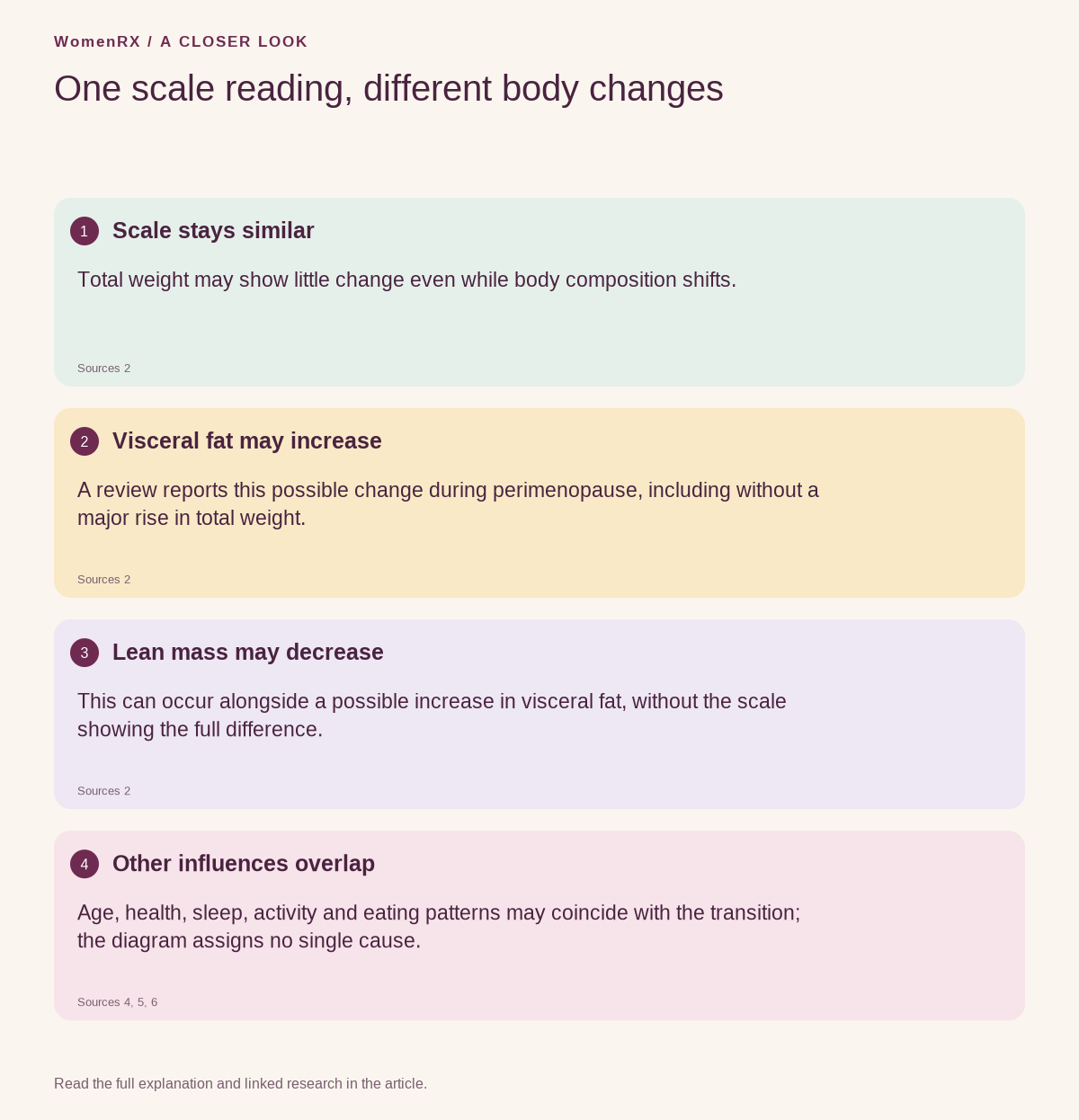
One scale reading, different body changes
Scale stays similar: Total weight may show little change even while body composition shifts.2
Visceral fat may increase: A review reports this possible change during perimenopause, including without a major rise in total weight.2
Lean mass may decrease: This can occur alongside a possible increase in visceral fat, without the scale showing the full difference.2
Other influences overlap: Age, health, sleep, activity and eating patterns may coincide with the transition; the diagram assigns no single cause.456
Read the figure as text
An illustrative example of how total weight and body composition can move differently. It shows a possible pattern, not a prediction for an individual.- Scale stays similar: Total weight may show little change even while body composition shifts.2
- Visceral fat may increase: A review reports this possible change during perimenopause, including without a major rise in total weight.2
- Lean mass may decrease: This can occur alongside a possible increase in visceral fat, without the scale showing the full difference.2
- Other influences overlap: Age, health, sleep, activity and eating patterns may coincide with the transition; the diagram assigns no single cause.456
More questions, answered
Should I pay attention to strength as well as weight?
Yes. Weight alone doesn’t show how much lean mass you have, and NICE specifically highlights maintaining muscle mass and strength through physical activity during menopause. 1 2
Sources you can check
- Recommendations | Menopause: identification and management | Guidance | NICEAccessed 2026-09-25Return to first citation
- Perimenopause and metabolic vulnerability: hormones, body composition and lifestyle changes.Lobato VA, Minari TP, Pisani LP. · Climacteric : the journal of the International Menopause Society · 2026Return to first citation
- Experiences of weight and body shape changes during perimenopause.Murphy MB, Lane A, Cuskelly G, Heavey PM. · Women & health · 2025Return to first citation
- Mechanisms of improved body composition among perimenopausal women practicing Meditative Movement: a proposed biobehavioral model.James DL, Larkey LK, Evans B, Sebren A, Goldsmith K, Ahlich E, Hawley NA, Kechter A, Sears DD. · Menopause (New York, N.Y.) · 2023Return to first citation
- Body Composition Changes Over the Menopausal Transition in Women With and Without Human Immunodeficiency Virus.Abelman RA, Nguyen TTJ, Ma Y, Bacchetti P, Messerlian G, French AL, Sharma A, Minkoff H, Plankey M, Grunfeld C, Tien PC. · Clinical infectious diseases : an official publication of the Infectious Diseases Society of America · 2023Return to first citation
- Body composition and cardiometabolic health across the menopause transition.Marlatt KL, Pitynski-Miller DR, Gavin KM, Moreau KL, Melanson EL, Santoro N, Kohrt WM. · Obesity (Silver Spring, Md.) · 2022Return to first citation