Body-Shape Changes in Perimenopause: What Is Known and What to Check
A changing waist can reflect more than a change on the scale, and the menopause transition is only one part of the explanation.
Waist or body-composition changes can happen during the menopause transition, but they aren’t inevitable, and appearance alone can’t identify the cause. In a longitudinal study of women, fat gain accelerated and lean mass declined around the transition, even though the rate of weight gain did not accelerate. Aging, energy balance, and lifestyle may overlap with this pattern. 2 4
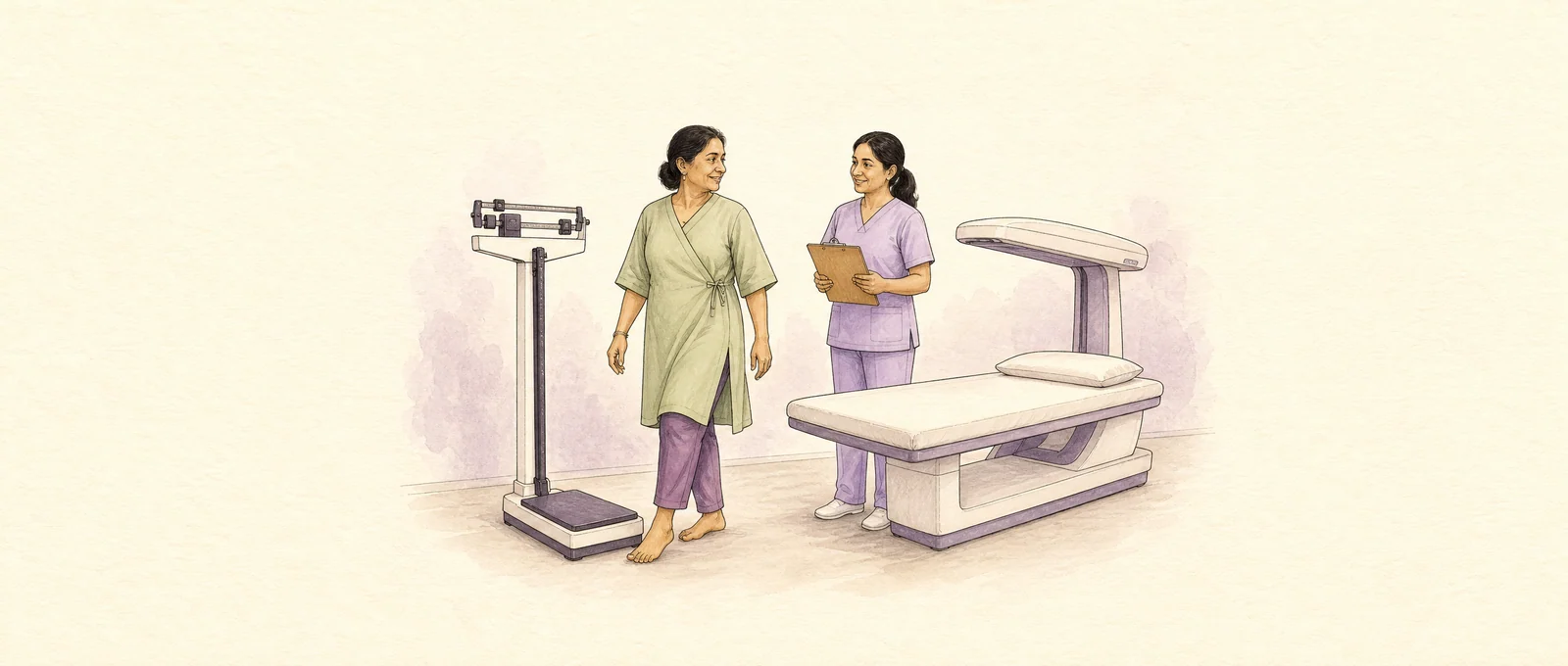
A fuller waist during perimenopause can be unsettling, but appearance alone can’t tell you why it’s happening. Research suggests that changes in fat and lean mass can coincide with the menopause transition. That doesn’t mean every woman will gain abdominal fat, or that a change in shape proves hormones are the cause.
Weight, waist, and body composition answer different questions
Body weight is the combined weight of fat, muscle, bone, and water. It can show that your total weight changed, but not which component changed. BMI has a similar limitation: it doesn’t distinguish fat from muscle or bone. Waist circumference adds a different measurement, but it doesn’t explain what caused a change or precisely show how much fat is inside the abdomen. 1
This is why the scale and your clothes can seem to tell different stories. A study that measured women’s body composition over time found changes in fat and lean mass around the menopause transition, while the overall weight pattern followed a different course. A scale alone wouldn’t reveal that mix. 2
What researchers observed around the transition
In the Study of Women’s Health Across the Nation, researchers repeatedly measured body composition as women moved through menopause. Fat and lean mass were already changing before the transition. At its start, the rate of fat gain doubled and lean mass began to decline. Those patterns continued until about two years after the final menstrual period, then slowed. By contrast, weight gain did not speed up at the start of the transition, and the average weight trajectory became flat after it. These are patterns in a group, not a prediction for an individual woman. 2
The distinction matters: a waist can change even when the scale doesn’t suddenly start rising faster. But the study’s timing doesn’t establish that menopause hormones alone caused any one person’s change. A 2025 review describes uncertainty about the relative roles of hormonal shifts, regular aging, energy balance, and lifestyle. 4
There isn’t one body-shape pattern shared by all women. In one observational study that followed Black and White women through menopause, abdominal-fat patterns differed between the groups. The analysis included 94 women, 25 Black and 69 White. Its findings shouldn’t be treated as a forecast for an individual or generalized to women from other racial and ethnic groups. They do reinforce that a single, inevitable “menopause belly” story is too simple. 3
What a change can tell you, and what it can’t
Having more body fat around the abdomen than the hips may be associated with higher risk of heart disease and type 2 diabetes. That makes waist size one useful piece of health information, not a diagnosis or explanation for why your shape changed. Your overall health history and other risk factors matter too. 1
It can help to separate the questions: Has your weight changed, has your waist changed, or both? Has the change been gradual or sudden? Those differences don’t reveal the cause, but they offer more context than appearance alone. Activity, energy balance, aging, and the menopause transition can overlap, and the research doesn’t neatly separate their effects for every individual. 4
If you’re gaining or losing weight unexpectedly and suddenly, MedlinePlus advises discussing it with a health care provider because an unintentional change can signal a medical problem. For a gradual change, it’s reasonable to bring it up if it concerns you or you want to understand how it fits with your overall health. 1
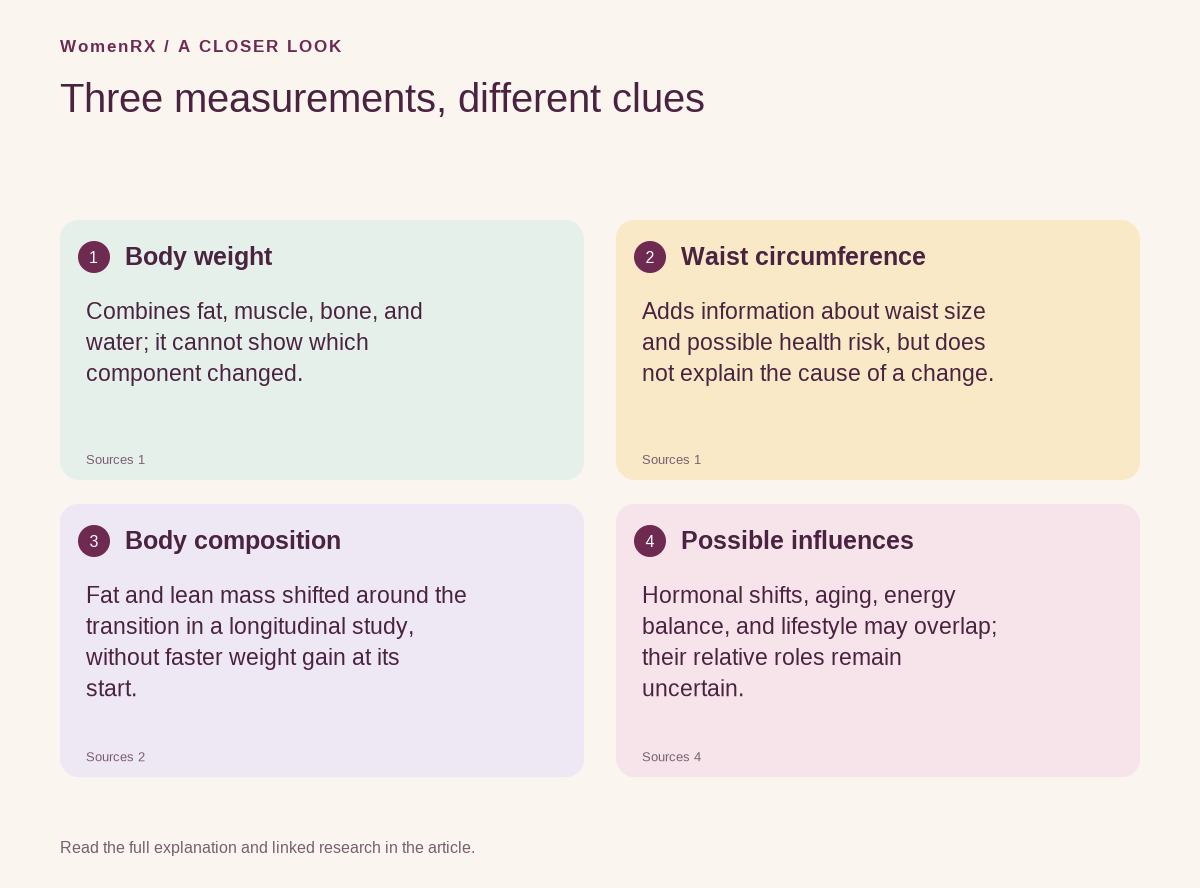
Three measurements, different clues
Body weight: Combines fat, muscle, bone, and water; it cannot show which component changed.1
Waist circumference: Adds information about waist size and possible health risk, but does not explain the cause of a change.1
Body composition: Fat and lean mass shifted around the transition in a longitudinal study, without faster weight gain at its start.2
Possible influences: Hormonal shifts, aging, energy balance, and lifestyle may overlap; their relative roles remain uncertain.4
Read the figure as text
Weight, waist size, and body-composition measures describe different aspects of change. None alone identifies its cause.- Body weight: Combines fat, muscle, bone, and water; it cannot show which component changed.1
- Waist circumference: Adds information about waist size and possible health risk, but does not explain the cause of a change.1
- Body composition: Fat and lean mass shifted around the transition in a longitudinal study, without faster weight gain at its start.2
- Possible influences: Hormonal shifts, aging, energy balance, and lifestyle may overlap; their relative roles remain uncertain.4
More questions, answered
Can my waist change even if my weight doesn’t?
Yes. Weight combines fat, muscle, bone, and water, so the number on the scale can’t show which components changed. In a longitudinal study, fat and lean mass shifted around the menopause transition without an accelerated rate of weight gain. 1 2
Sources you can check
- Body Weight: MedlinePlusAccessed 2026-09-25Return to first citation
- Changes in body composition and weight during the menopause transition.Greendale GA, Sternfeld B, Huang M, Han W, Karvonen-Gutierrez C, Ruppert K, Cauley JA, Finkelstein JS, Jiang SF, Karlamangla AS. · JCI insight · 2019Return to first citation
- Racial differences in body composition and cardiometabolic risk during the menopause transition: a prospective, observational cohort study.Marlatt KL, Redman LM, Beyl RA, Smith SR, Champagne CM, Yi F, Lovejoy JC. · American journal of obstetrics and gynecology · 2020Return to first citation
- Menopause and Body Composition: A Complex Field.Juppi HK, Karppinen JE, Laakkonen EK. · Seminars in reproductive medicine · 2025Return to first citation