Eczema and Hormonal Changes: What Is Known?
Some women notice eczema worsening around their period or during pregnancy, but the timing alone doesn’t tell you what caused a flare.
Some women with atopic dermatitis report worsening around menstruation or during pregnancy, though the evidence doesn’t show that hormones caused those flares. 4 The reported findings don’t address postpartum or menopausal eczema. A short record of symptoms, timing, and other changes can help you discuss a recurring pattern without putting eczema care on hold.
What the research can tell you
Eczema often changes over time. Its causes aren’t fully understood, but genetic and environmental factors likely play a part. So if your skin flares before a period, the timing is worth noticing without assuming you’ve found the cause. 1
In one interview study of women with atopic dermatitis, 31 of 97 (32%) reported worsening related to their menstrual cycle. Among the 23 participants who had experienced at least one pregnancy, 14 (61%) reported worsening during pregnancy. Those numbers describe what women in this study noticed. They don’t predict what will happen during your next cycle or pregnancy. 4
The interviews cannot establish that changing hormone levels caused the reported flares. The reported findings address menstrual-cycle and pregnancy-related worsening, not postpartum or menopausal eczema. A change in your skin during either stage deserves attention, but these pregnancy and cycle findings can’t explain it. 4
Make a pattern useful without treating it as proof
If you suspect a connection, keep the record simple enough that you’ll actually use it. For each flare, note when it starts and eases, where it appears, how bothersome the itch is, and whether it disrupts sleep or daily activities. Itch and effects on daily life are among the patient-reported outcomes used in adult atopic dermatitis trials; your notes aren’t a clinical score, but they can describe what matters to you. 3
Add cycle dates if you menstruate. If relevant, note whether you’re pregnant, recently postpartum, or in perimenopause. Record other changes at the same time, such as a new skin-care product or a change in treatment use. These are clues to discuss, not a list of proven triggers.
One flare near a period could be a coincidence. Repeated timing gives you a more specific question for a treatment review: Is there a pattern here, and is my current eczema plan controlling the symptoms that bother me? You don’t have to settle the hormone question before addressing the flare.
Keep treating the eczema in front of you
Dry, itchy skin can become more irritated when you scratch it, which can leave it itchier still. Skin care, creams, medicines, and other treatments can be part of eczema care, whether or not you notice a life-stage pattern. If your usual plan isn’t controlling the itch or rash, bring that up rather than waiting to collect more cycle notes. 1
Pregnancy calls for a separate treatment conversation. Medicine choices can change during pregnancy, but stopping a medicine you need may also carry risks. If you’re pregnant or planning pregnancy, review your specific eczema treatment before starting or stopping a medicine. 2
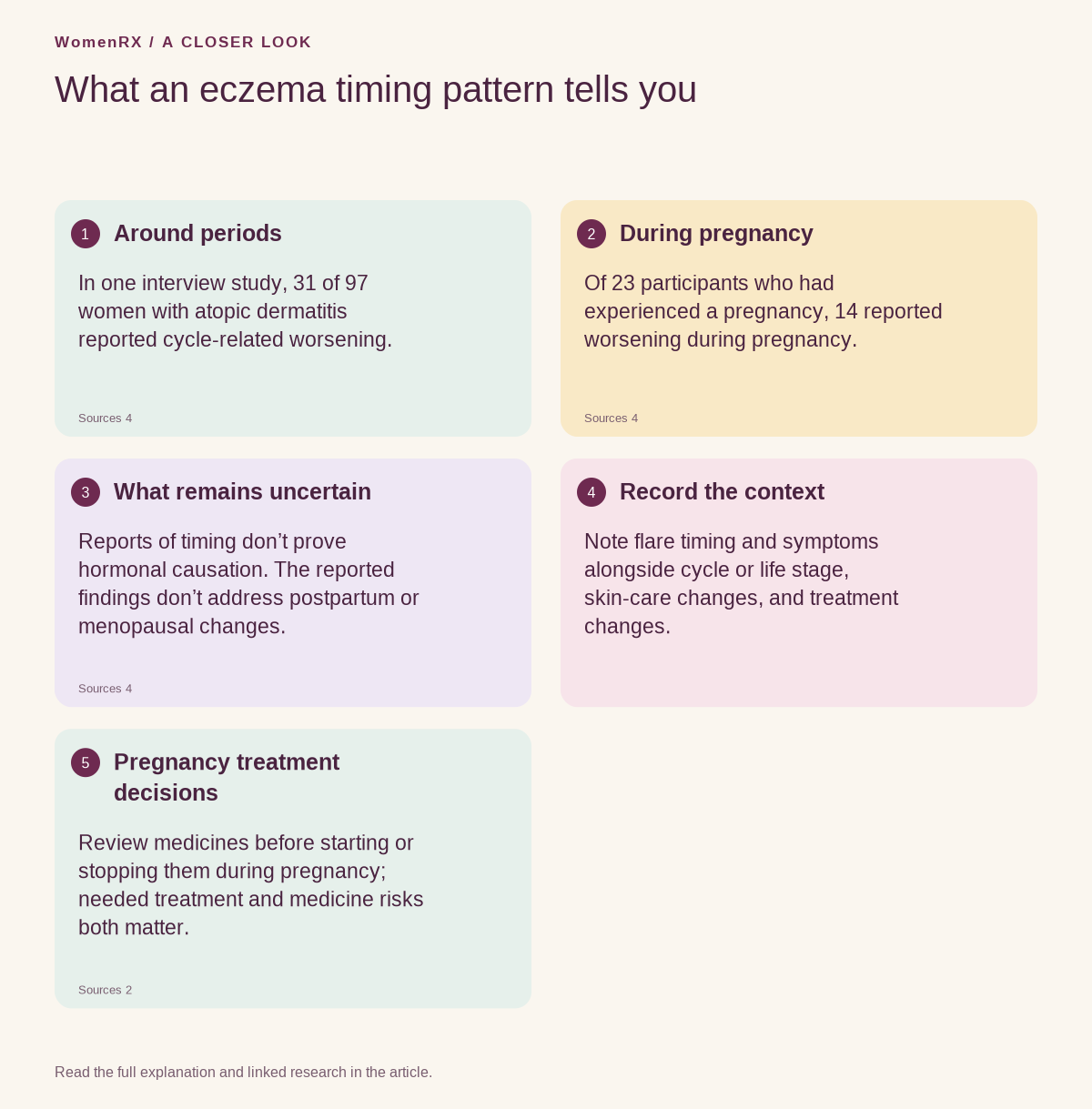
What an eczema timing pattern tells you
Around periods: In one interview study, 31 of 97 women with atopic dermatitis reported cycle-related worsening.4
During pregnancy: Of 23 participants who had experienced a pregnancy, 14 reported worsening during pregnancy.4
What remains uncertain: Reports of timing don’t prove hormonal causation. The reported findings don’t address postpartum or menopausal changes.4
Record the context: Note flare timing and symptoms alongside cycle or life stage, skin-care changes, and treatment changes.
Pregnancy treatment decisions: Review medicines before starting or stopping them during pregnancy; needed treatment and medicine risks both matter.2
Read the figure as text
Separate reported patterns from proof of a cause, then record enough context to make a treatment discussion more useful.- Around periods: In one interview study, 31 of 97 women with atopic dermatitis reported cycle-related worsening.4
- During pregnancy: Of 23 participants who had experienced a pregnancy, 14 reported worsening during pregnancy.4
- What remains uncertain: Reports of timing don’t prove hormonal causation. The reported findings don’t address postpartum or menopausal changes.4
- Record the context: Note flare timing and symptoms alongside cycle or life stage, skin-care changes, and treatment changes.
- Pregnancy treatment decisions: Review medicines before starting or stopping them during pregnancy; needed treatment and medicine risks both matter.2
Sources you can check
- Eczema | Dermatitis | Atopic Dermatitis | MedlinePlusAccessed 2026-09-25Return to first citation
- Pregnancy and Medicines | MedlinePlusAccessed 2026-09-25Return to first citation
- Definition of treatment goals in terms of clinician-reported disease severity and patient-reported outcomes in moderate-to-severe adult atopic dermatitis: a systematic review.Iannone M, Tonini G, Janowska A, Dini V, Romanelli M. · Current medical research and opinion · 2021Return to first citation
- The influence of pregnancy and menstruation on the deterioration of atopic dermatitis symptoms.Cho S, Kim HJ, Oh SH, Park CO, Jung JY, Lee KH. · Annals of dermatology · 2010Return to first citation