Eczema Flares: What Helps and When to Recheck
A recurring itchy rash needs steady skin care, treatment for inflammation when appropriate, and a fresh look if it changes or stays uncontrolled.
For an eczema flare, keep skin care gentle, use a moisturizer that doesn’t irritate your skin, and avoid products that do. A prescribed topical corticosteroid or calcineurin inhibitor treats inflammation in a way moisturizer doesn’t; follow the directions for your medicine. Get the rash reassessed if it disrupts daily life, changes, or develops rapidly spreading painful blisters, especially with fever. 123456
Give irritated skin fewer things to contend with
Eczema is a name for several kinds of inflamed skin; atopic dermatitis is the most common. It often causes dry, itchy patches, but an itchy rash isn’t automatically eczema. Scratching can make skin swell and itch more, setting up a frustrating loop. 1
Start by noticing what touches the area. Soaps, fabrics and lotions can irritate eczema-prone skin, and avoiding perfumed soaps and moisturizers may help when skin is itchy. That doesn’t mean you need to eliminate every product or search for one universal trigger. For example, if your hands sting after using a particular soap, changing that product is a more useful experiment than cutting out a broad food group without a clear reason. 12
Moisturizing belongs in your regular care for dry, eczema-prone skin: choose a skin cream that doesn’t irritate you. It addresses the skin-care side of atopic dermatitis, which involves a disrupted skin barrier as well as inflammation. A moisturizer doesn’t do the same job as treatment aimed at an inflamed flare. 16
Know which part of your plan treats the flare
A prescribed topical corticosteroid is one kind of treatment for itchy, swollen, irritated skin. Topical calcineurin inhibitors are another prescription treatment used in atopic dermatitis. Both address the treatment side of a flare; moisturizing remains part of caring for dry skin. The choice of medicine and where to use it belong to your specific treatment plan. 1467
If you have a prescribed topical anti-inflammatory treatment, check that you know which areas it’s meant for and when your prescriber wants you to use it. Local anti-inflammatory treatment is part of atopic dermatitis care, but which treatment belongs in your plan depends on your rash and your prescriber’s directions. If treatment doesn’t seem to help or the rash changes, contact the prescriber for advice rather than assuming it’s an ordinary flare. A changing rash may need a new diagnosis as well as a treatment review. 126
The useful distinction is this: gentle skin care reduces avoidable irritation, while an anti-inflammatory treatment addresses the inflamed flare. If flares keep returning or your current plan isn’t controlling them, a review can establish whether the treatment needs changing or whether something else is causing the rash. 126
When “eczema” may be the wrong explanation
Itching has many causes, including psoriasis, fungal infection and scabies. A rash that appears in a new pattern, behaves differently from your usual flares, or persists despite your usual care deserves another look rather than an automatic repeat of the same treatment. Itching that affects your daily life is also a reason to seek care, even if the skin changes seem modest. 2
An infection calls for more urgent attention. One uncommon but serious possibility is eczema herpeticum, a herpes infection that can spread across already inflamed skin. Seek prompt medical assessment for a rapidly spreading crop of similar-looking blisters or painful sores, particularly if you also have fever or feel unwell. Those features aren’t something to manage as an ordinary flare at home. 35
If you’re pregnant and itchy
Pregnancy doesn’t make every itchy patch eczema. If you’re pregnant and have new or unexplained itching, let your pregnancy care team know. Itching is common in pregnancy, but it can sometimes have a cause that needs checking, including a liver condition called intrahepatic cholestasis of pregnancy. 2
If you’re pregnant or breastfeeding, bring up the creams you use when reviewing your eczema treatment. A medicine’s pregnancy and breastfeeding considerations are worth checking for that specific cream before changing your prescribed flare plan. 7
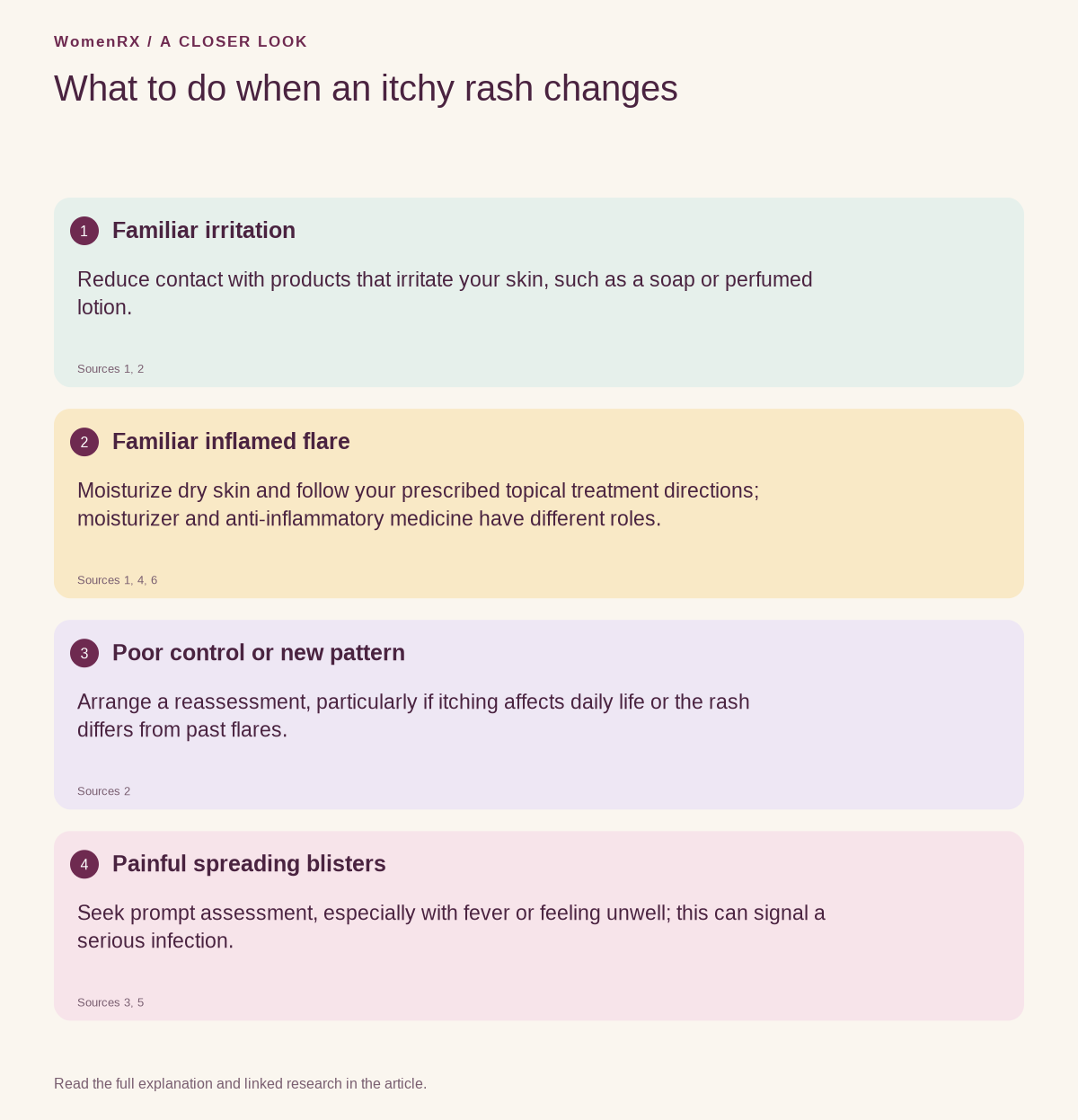
What to do when an itchy rash changes
Familiar irritation: Reduce contact with products that irritate your skin, such as a soap or perfumed lotion.12
Familiar inflamed flare: Moisturize dry skin and follow your prescribed topical treatment directions; moisturizer and anti-inflammatory medicine have different roles.146
Poor control or new pattern: Arrange a reassessment, particularly if itching affects daily life or the rash differs from past flares.2
Painful spreading blisters: Seek prompt assessment, especially with fever or feeling unwell; this can signal a serious infection.35
Read the figure as text
Match the situation to the next useful step; the branches are not a diagnostic test.- Familiar irritation: Reduce contact with products that irritate your skin, such as a soap or perfumed lotion.12
- Familiar inflamed flare: Moisturize dry skin and follow your prescribed topical treatment directions; moisturizer and anti-inflammatory medicine have different roles.146
- Poor control or new pattern: Arrange a reassessment, particularly if itching affects daily life or the rash differs from past flares.2
- Painful spreading blisters: Seek prompt assessment, especially with fever or feeling unwell; this can signal a serious infection.35
More questions, answered
Could an itchy rash be something other than eczema?
Yes. Itching can also come from conditions such as psoriasis, fungal infections or scabies. If the pattern is new or your usual treatment isn’t helping, having the rash examined is more useful than guessing from itch alone. 2
Sources you can check
- Eczema | Dermatitis | Atopic Dermatitis | MedlinePlusAccessed 2026-09-25Return to first citation
- Itchy skin - NHSAccessed 2026-09-25Return to first citation
- Clinical Insights of Kaposi's Varicelliform Eruption Associated with Underlying Primary Dermatoses- A Case Series from Hadoti Region of Rajasthan.Sharma N, Shrivastava H, Joshi S, Kushwaha RK, Jain SK. · Indian journal of dermatology · 2025Return to first citation
- Disproportionality Analysis of Nemolizumab in Patients with Atopic Dermatitis: A Real-World Pharmacovigilance Study.Chen M, Ke C, Huang Y. · Dermatitis : contact, atopic, occupational, drug · 2025Return to first citation
- Kaposi's Varicelliform Eruption: A Potentially Life-Threatening Complication of Atopic Dermatitis.Martín-Galache M, Escalona-Gil AM, Posado-Domínguez L, Jiménez-Domínguez A, Arévalo-Cenzual A, López-Ávila FJ, Consuegra-Llapur E. · European journal of case reports in internal medicine · 2024Return to first citation
- From prebiotics to engineered microbes: microbe-inspired treatments for atopic dermatitis.van Hout NE, Nevot G, Jansen PAM, Mannan AA, Zeeuwen PLJM, Hijnen DJ, Tanaka RJ, Güell M, van den Bogaard EH. · The British journal of dermatology · 2026Return to first citation
- Beclometasone skin cream: a medicine to treat itching, swollen and irritated skin - NHSAccessed 2026-09-25Return to first citation