Ceramide Moisturizers: What to Look For and Expect
A ceramide moisturizer may help dry skin feel more comfortable, but the finished formula matters more than the ingredient name alone.
Ceramides are lipids in the skin’s outer barrier, which helps limit water loss. Studies of some moisturizers have found improved hydration in people with dry or eczema-prone skin, but a ceramide label can’t predict how a particular product will work for you. Look for evidence on the finished product, check the rest of its ingredients, and choose a texture your skin tolerates. 1 2 3

Why ceramides are in skin care
Your skin’s outer layer helps hold water in. Ceramides are among the lipids in that layer, and people with atopic dermatitis can have an altered mix of ceramides alongside other changes to the skin barrier. That gives ceramides a sensible role in a moisturizer, especially if dryness is part of what’s bothering you. It doesn’t mean adding ceramides fixes every cause of dry or irritated skin. 2
Eczema is a useful example of the distinction. Dryness and barrier trouble are part of the picture, but eczema also involves inflammation. Regular moisturizing can support eczema care; a moisturizer may not be enough when a flare needs treatment. 5
What the studies tell you about a product
In a 2023 randomized split-body study, 30 adults with self-described mild-to-moderate eczema-prone skin used two different over-the-counter moisturizers for four weeks. Both increased measured skin hydration and reduced water loss through the skin. One produced a greater hydration improvement than the other, showing that even products studied for a similar purpose needn’t perform identically. 1
A 2024 study offers another helpful comparison. Forty adults with mild, dry eczema on their lower legs applied a ceramide-containing moisturizer to one leg and the moisturizing vehicle of a prescription cream to the other over 17 days. Both improved hydration. Water-loss measurements favored the ceramide moisturizer on day one, but the researchers found no difference between the products at later measured time points. 3
These studies tested finished formulations, not ceramides added to an otherwise identical cream. They support the idea that particular moisturizers can help hydration, not a claim that ceramides alone caused the improvement or that every ceramide cream beats a moisturizer without them. 1 3
A useful way to compare two jars or bottles
Start with the job you want the product to do. If your main complaint is skin that feels dry and tight, a claim about moisturizing is relevant. If the package promises to treat eczema, look for evidence of improvement in eczema symptoms or severity, not just a hydration measurement. Moisturizing and controlling inflammation aren’t the same result. 1 5
Next, check what any research actually tested. Was it this finished product, or simply another product that contains ceramides? Who used it, for how long, and what improved? For example, a short-term increase in measured water content after one application is interesting, but it can’t tell you whether a cream will control recurring eczema. A study comparing a ceramide-based cream with an aqueous moisturizer measured changes after a single application; its researchers also noted the small sample and short follow-up. 2
Then read beyond the front label. A formula can contain ingredients that serve different moisturizing roles, not just ceramides. One studied eczema moisturizer, for example, combined ceramides and other barrier lipids with ingredients such as glycerin, dimethicone, and shea butter. That example is a reason to assess the whole formula, not a shopping list of ingredients every product must contain. 4 If you already know an ingredient bothers your skin, check for it rather than assuming a ceramide product will feel gentle.
Finally, consider the experience of using it. For example, a richer cream may feel welcome on rough hands but unpleasant on your face; that’s a preference to test, not proof that one texture treats eczema better. Notice whether the moisturizer feels comfortable on the area you’re using it and whether you’d willingly keep using it. In a small study of children with atopic dermatitis, ratings of one moisturizer’s acceptability varied considerably. That doesn’t predict what you’ll like, but it does underline why the best-sounding label isn’t the whole decision. 6
If your skin repeatedly feels worse with a product, you don’t need to keep using it to prove a point. And if eczema remains itchy or disruptive despite moisturizing, the next question is what care the inflammation needs, rather than which ceramide label sounds strongest. 5
There’s no established reason from these studies to choose a different ceramide moisturizer simply because you’re a woman. The practical comparison is the same: what the product has shown it can do, what else is in it, and how your skin responds.
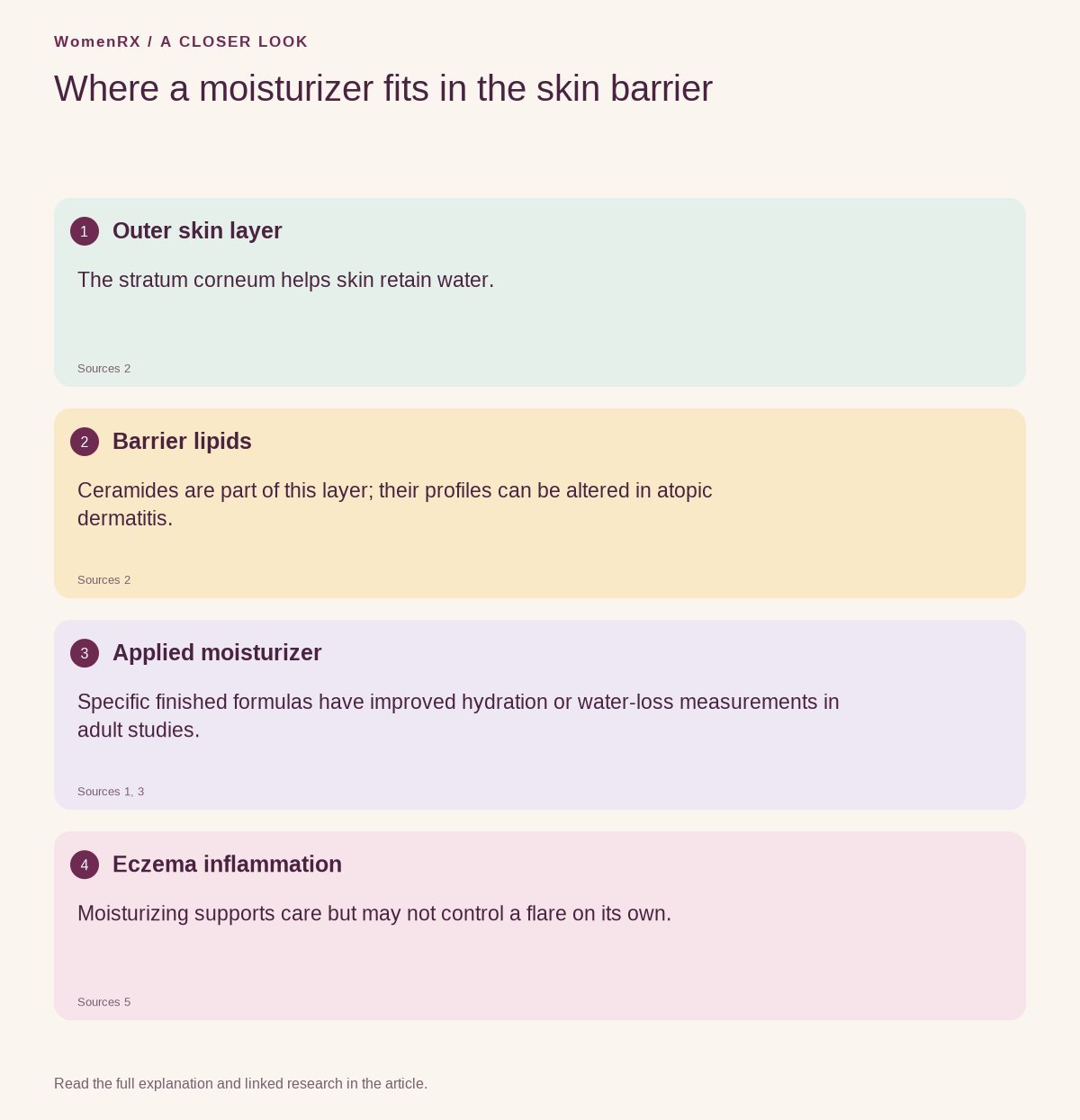
Where a moisturizer fits in the skin barrier
Outer skin layer: The stratum corneum helps skin retain water.2
Barrier lipids: Ceramides are part of this layer; their profiles can be altered in atopic dermatitis.2
Applied moisturizer: Specific finished formulas have improved hydration or water-loss measurements in adult studies.13
Eczema inflammation: Moisturizing supports care but may not control a flare on its own.5
Read the figure as text
A simple view of what ceramides do in skin and what applying a complete moisturizer may, and may not, accomplish.- Outer skin layer: The stratum corneum helps skin retain water.2
- Barrier lipids: Ceramides are part of this layer; their profiles can be altered in atopic dermatitis.2
- Applied moisturizer: Specific finished formulas have improved hydration or water-loss measurements in adult studies.13
- Eczema inflammation: Moisturizing supports care but may not control a flare on its own.5
More questions, answered
Can I use a ceramide moisturizer instead of eczema treatment?
A moisturizer can help support dry, eczema-prone skin, but improved hydration doesn’t establish that it controls eczema inflammation. When moisturizing alone doesn’t control a flare, additional treatment may be needed. 1 5
Sources you can check
- Individual Article: Over-the-Counter Moisturizers Significantly Improve Skin Hydration in Adults With Eczema/Atopy-Prone Skin.Nguyen H, Nguyen T, Mantilla A, Emesiani C, Meckfessel M. · Journal of drugs in dermatology : JDD · 2023Return to first citation
- Noninvasive assessment of skin barrier function: evaluating ceramide-based moisturizer using confocal Raman spectroscopy.Rajarahm P, Bi R, Attia AE, Zhang R, Thng STG, Ng SP, Yuan L, Olivo M. · Journal of biomedical optics · 2025Return to first citation
- Assessment of the Vehicle for Roflumilast Cream Compared to a Ceramide-Containing Moisturizing Cream in Mild Eczema.Draelos ZD, Higham RC, Osborne DW, Seal MS, Burnett P, Berk DR. · Journal of drugs in dermatology : JDD · 2024Return to first citation
- A pilot study investigating the efficacy of botanical anti-inflammatory agents in an OTC eczema therapy.Draelos ZD. · Journal of cosmetic dermatology · 2016Return to first citation
- Use of ceramides and related products for childhood-onset eczema.Hon KL, Leung AK. · Recent patents on inflammation & allergy drug discovery · 2013Return to first citation
- Acceptability and efficacy of an emollient containing ceramide-precursor lipids and moisturizing factors for atopic dermatitis in pediatric patients.Hon KL, Pong NH, Wang SS, Lee VW, Luk NM, Leung TF. · Drugs in R&D · 2013Return to first citation