Mood Changes Around Hormonal Transitions: What We Know
Mood symptoms can shift around reproductive transitions, but timing alone doesn’t show that hormones are the only cause.
Research links premenstrual symptoms with sensitivity to cyclical hormone shifts, and recognizes mood disturbance during pregnancy and postpartum and the menopause transition. But the evidence differs by stage and doesn’t make hormones a universal explanation. Individual sensitivity, stress, genetics, and mental health conditions also matter. Notice when symptoms begin and how they affect daily life, then describe that pattern when seeking care. 8 3 4 5 6
A change in mood that keeps returning at a particular point in your cycle or around pregnancy, postpartum, or perimenopause is worth describing. The timing may offer a clue, but it doesn’t prove that a hormone change caused the symptoms. Anxiety and depression can also occur independently of reproductive transitions, and their causes can involve biological, psychological, and environmental factors. 1 2
Before a period: sensitivity may matter more than hormone levels
Premenstrual symptoms are associated with sensitivity to the usual hormonal shifts of the cycle. That’s different from saying a hormone is simply too high or too low. A 2026 review describes possible links between cyclical hormone changes, neurotransmitter pathways, stress responses, and mood, while also noting that the causes of premenstrual syndrome aren’t fully clear. 8
Premenstrual dysphoric disorder, or PMDD, is a recognized condition involving significant mood symptoms. Approaches described for PMDD include psychotherapy, lifestyle measures, selective serotonin reuptake inhibitors (SSRIs), and hormonal contraceptives. Auricular acupressure, by contrast, is still being studied: a 2026 paper describes a planned pilot trial, not results showing that the treatment works. 7 This distinction matters when a treatment claim sounds more certain than the evidence behind it.
A useful observation is whether the change is repeatedly tied to a part of your cycle, rather than assuming that any anxiety or low mood is premenstrual. If symptoms also occur at other times, or interfere with work, relationships, sleep, or everyday tasks, mention that too. Anxiety disorders can involve persistent, overwhelming anxiety that disrupts daily activities; depression can affect daily functioning and may have causes unrelated to reproductive hormones. 1 2
Pregnancy and postpartum: a complex transition, not one hormone story
Pregnancy and the postpartum period bring substantial biological changes, but research has not reduced perinatal depression to a single hormonal mechanism. One systematic review examined 47 studies of cortisol, a stress-related hormone, and perinatal depression. The studies varied considerably in how they measured cortisol and depression. Some higher-quality studies found associations between cortisol patterns and mood, but those findings don’t establish that cortisol changes cause depression. 3
A separate systematic review of 39 genetic studies also described environmental stressors and the timing of symptoms as relevant to peripartum depression. Its findings support a picture with multiple influences, not a simple hormone-only explanation. 4 Feeling low or anxious during pregnancy or after birth is therefore worth taking seriously without treating it as proof of a hormone imbalance.
Perimenopause: mood symptoms are recognized, but evidence has limits
Perimenopause can involve mood disturbance, and menopause guidelines reviewed in 2024 consistently included it among symptoms associated with the transition. Those guidelines supported menopausal hormone therapy for vasomotor symptoms and menopause-associated mood disturbance. They did not recommend it as a treatment for clinical depression. The distinction is useful: a change in mood around menopause and a depressive disorder aren’t automatically the same thing. 6
Some research is exploring whether sensitivity to estradiol fluctuations helps explain why experiences differ. In a randomized trial of 66 perimenopausal women, greater anxiety sensitivity to estradiol fluctuations was associated with more reward-seeking behavior among participants assigned transdermal estradiol, especially when they reported more stressful recent life events. Most participants did not meet criteria for a depressive or anxiety disorder when they enrolled, and the outcome was a behavioral task, not proof that estradiol treats depression or anxiety generally. 5
What to make of the pattern
If symptoms seem to follow a reproductive transition, try describing the timing and the impact rather than deciding the cause in advance. For example, you might say, “This low mood seems to return before my period,” or “My anxiety changed during perimenopause, and it’s now affecting sleep and work.” Include whether symptoms persist outside the suspected window, began during pregnancy or postpartum, or feel similar to a mental health problem you’ve had before.
That context can help distinguish a recurring transition-linked pattern from symptoms that are persistent, more widespread, or occurring alongside other life or health changes. It also leaves room to discuss care for anxiety or depression itself. Psychotherapy and medication are established treatment options for anxiety disorders; depression care may also involve psychotherapy, medication, or both. 1 2 The right explanation and treatment depend on the pattern and the person, not on assuming all mood symptoms are hormonal.
Mood evidence across reproductive transitions
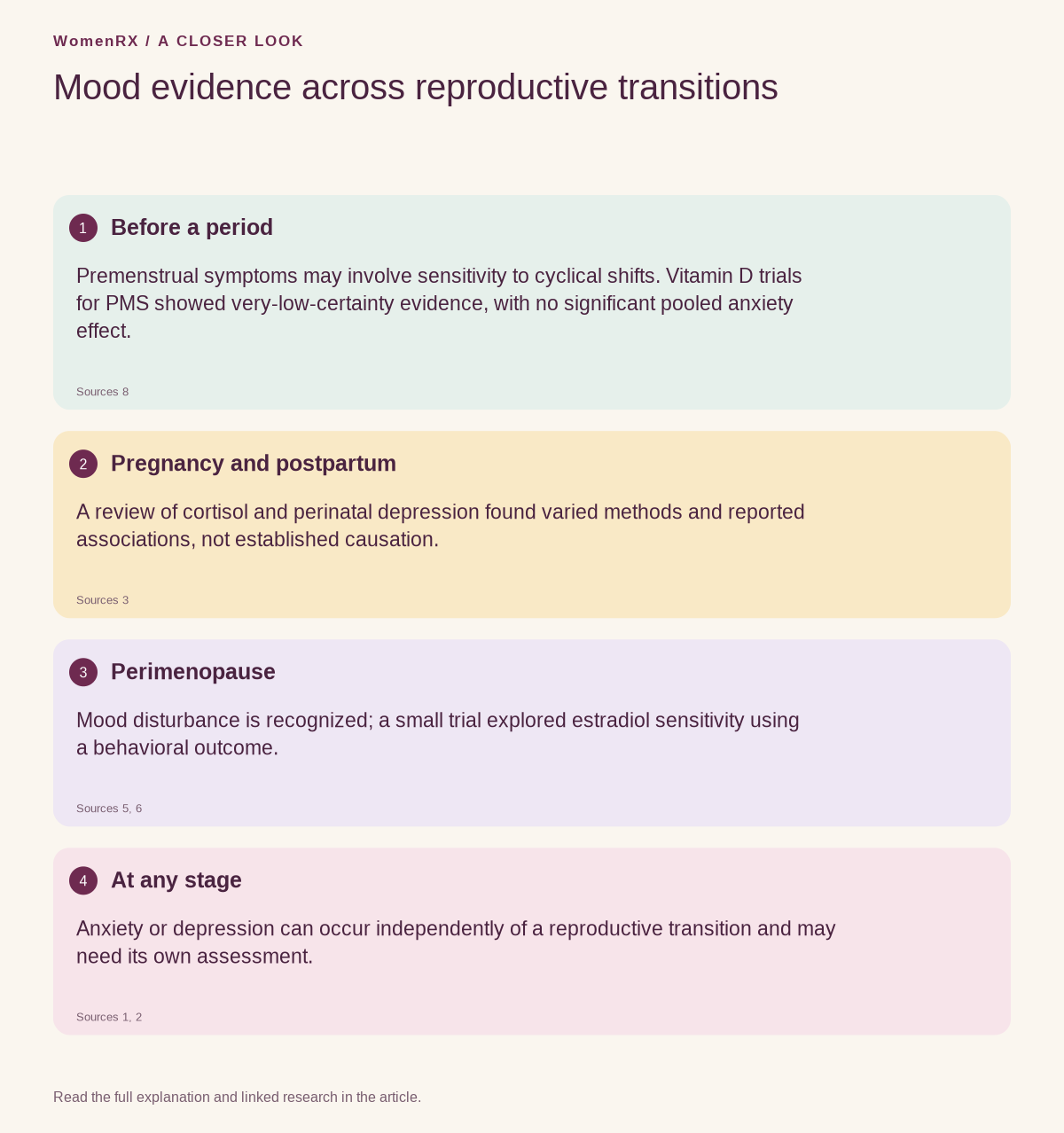
Before a period: Premenstrual symptoms may involve sensitivity to cyclical shifts. Vitamin D trials for PMS showed very-low-certainty evidence, with no significant pooled anxiety effect.8
Pregnancy and postpartum: A review of cortisol and perinatal depression found varied methods and reported associations, not established causation.3
Perimenopause: Mood disturbance is recognized; a small trial explored estradiol sensitivity using a behavioral outcome.56
At any stage: Anxiety or depression can occur independently of a reproductive transition and may need its own assessment.12
Read the figure as text
This timeline locates the transitions discussed and shows what each body of research can support. It does not diagnose a condition or imply that symptoms progress from one stage to another.- Before a period: Premenstrual symptoms may involve sensitivity to cyclical shifts. Vitamin D trials for PMS showed very-low-certainty evidence, with no significant pooled anxiety effect.8
- Pregnancy and postpartum: A review of cortisol and perinatal depression found varied methods and reported associations, not established causation.3
- Perimenopause: Mood disturbance is recognized; a small trial explored estradiol sensitivity using a behavioral outcome.56
- At any stage: Anxiety or depression can occur independently of a reproductive transition and may need its own assessment.12
More questions, answered
Does a mood change around perimenopause mean I have clinical depression?
Not necessarily. Mood disturbance can occur during the menopause transition, but it isn’t automatically the same as clinical depression. Depression is assessed by its symptoms, duration, and effect on daily life, rather than timing alone. 2 6
Can hormone treatment be assumed to treat anxiety or depression?
No. Menopause guidance supports menopausal hormone therapy for menopause-associated mood disturbance, but not as a treatment for clinical depression. A small perimenopause trial also cannot establish hormone treatment as a general treatment for anxiety or depression. 5 6
Sources you can check
- Anxiety: MedlinePlusAccessed 2026-09-25Return to first citation
- Depression: MedlinePlusAccessed 2026-09-25Return to first citation
- Perinatal maternal depression and cortisol function in pregnancy and the postpartum period: a systematic literature review.Seth S, Lewis AJ, Galbally M. · BMC pregnancy and childbirth · 2016Return to first citation
- The Influence of genetic factors on peripartum depression: A systematic review.Figueiredo FP, Parada AP, de Araujo LF, Silva WA, Del-Ben CM. · Journal of affective disorders · 2015Return to first citation
- Hormone sensitivity predicts the beneficial effects of transdermal estradiol on reward-seeking behaviors in perimenopausal women: A randomized controlled trial.Swales DA, Lozza-Fiacco S, Andersen EH, Cooper JA, Treadway MT, Xia K, Schiller CE, Girdler SS, Dichter GS. · Psychoneuroendocrinology · 2023Return to first citation
- A systematic review and critical appraisal of menopause guidelines.Hemachandra C, Taylor S, Islam RM, Fooladi E, Davis SR. · BMJ sexual & reproductive health · 2024Return to first citation
- Auricular Acupressure for Depressive and Anxiety Symptoms in Women with Premenstrual Dysphoric Disorder: Protocol for a Pilot Randomized Sham-Controlled Trial.Zeng YM, Liu SY, Qiu JH, Shi JY, Tong JT, Zhang QY, Wang JX. · Neuropsychiatric disease and treatment · 2026Return to first citation
- Efficacy of Vitamin D Supplementation to Alleviate Premenstrual Syndrome Symptoms: A Systematic Review and Meta-Analysis of Randomized Controlled Trials.Zainab A, Tageldin RS, Patel R, Hassan MA, Aburas LA, Alkahily M, Shamsan L, Al-Olaimat SS, Sayeed A, Abu-Zaid A. · Journal of clinical medicine · 2026Return to first citation