Mood Changes and Hormonal Shifts: Patterns Worth Tracking
A simple daily record can help you compare mood with cycle timing, life stage, sleep, stress, and everyday function.
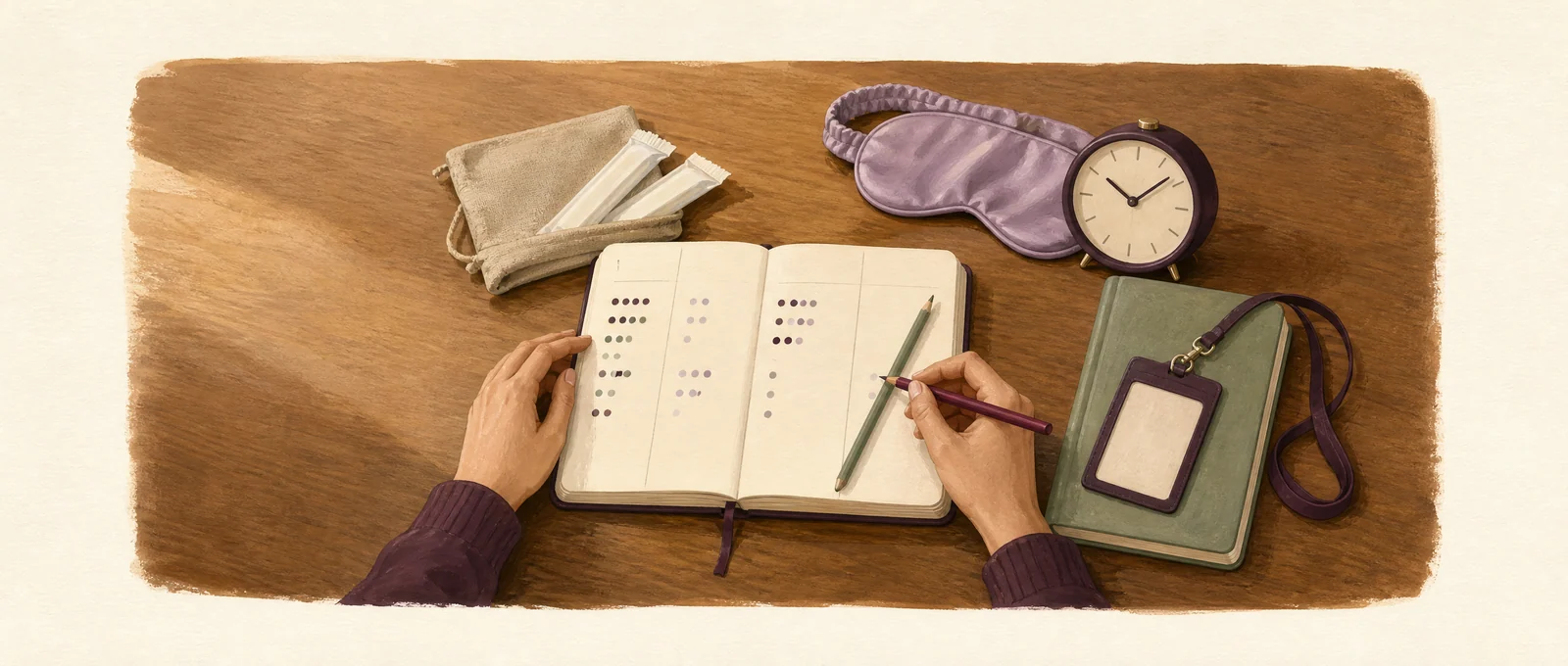
Mood changes can coincide with menstrual-cycle or menopause-related shifts, but timing alone doesn’t show that hormones caused them. Record your mood, cycle or life-stage context, sleep, notable stressors, and effects on daily life together. Look for patterns that recur, including times when symptoms ease, and use the record to describe what you’ve noticed, not to diagnose a hormone problem.
Look for a pattern, not a single explanation
A mood change that appears around the same time in more than one cycle is worth noticing, but it isn’t proof that hormones caused it. Mood can have more than one influence, and a log is most useful when it captures the surrounding context as well as the timing.
A systematic review of 20 studies found modest support for greater emotional reactivity to laboratory stress during the luteal phase, the part of the cycle after ovulation. That is a group-level finding about responses to stress tasks, not a way to identify the cause of your own mood changes. 1
Keep the daily record brief
One short entry a day can include:
- Timing: Note bleeding or cycle timing if you know it, or label a distinct life-stage context.
- Mood: Describe what you noticed, such as irritability, anxiety, low mood, or emotional sensitivity.
- Context: Add sleep, notable stressors, illness, or a change in routine that stands out.
- Function: Note whether it affected concentration, relationships, work, or usual tasks.
You don’t need a complicated rating scale. A few words can help you compare days without turning the record into a diagnosis. For example, you might note that irritability appeared before bleeding on several occasions, but also that sleep was shorter or stress was higher. That observation shows what happened together; it doesn’t determine which factor mattered most.
Some women also find it hard to separate cyclical changes from other ongoing experiences. In interviews, 14 Swedish women with ADHD described uncertainty about whether changes in mood and daily functioning related to their cycle, ADHD, or both. Their accounts offer one example of why context matters, but they don’t establish a pattern for all women. 2
Make room for different life stages
Menstrual cycles: Record mood alongside cycle timing, rather than assuming every difficult day is premenstrual. If symptoms show up at different points, or continue beyond a particular part of the cycle, include that too. The research on luteal-phase stress reactivity offers a possible group-level pattern, not a personal test. 1
Pregnancy: Label pregnancy and, if relevant, the trimester as context; menstrual-cycle comparisons won’t describe this period. A cross-sectional study assessed depressive symptoms and biological factors in 400 women in their third trimester and reported associations. Because it captured information at one point in time, it cannot show that hormone changes caused the symptoms. 4
Postpartum: Keep postpartum entries distinct from pregnancy and from ordinary cycle tracking. Note mood, sleep, stress, and effects on daily life without assuming that the experience follows a particular hormone pattern.
Menopause transition: Hormone levels vary during the transition, and hot flashes and mood disturbances may occur. If both show up, record when each happens rather than treating one as proof of the cause of the other. 3
What a useful pattern can tell you
Look at the whole record: when symptoms tend to begin, whether they ease at other times, what else was happening, and how much daily life was affected. A repeated pattern can make a conversation with a clinician more specific, but it can’t confirm a hormone imbalance or identify a treatment on its own.
If the record doesn’t show a clear cycle-related pattern, that is still useful information. You can describe what you are experiencing without forcing it into a hormonal explanation.
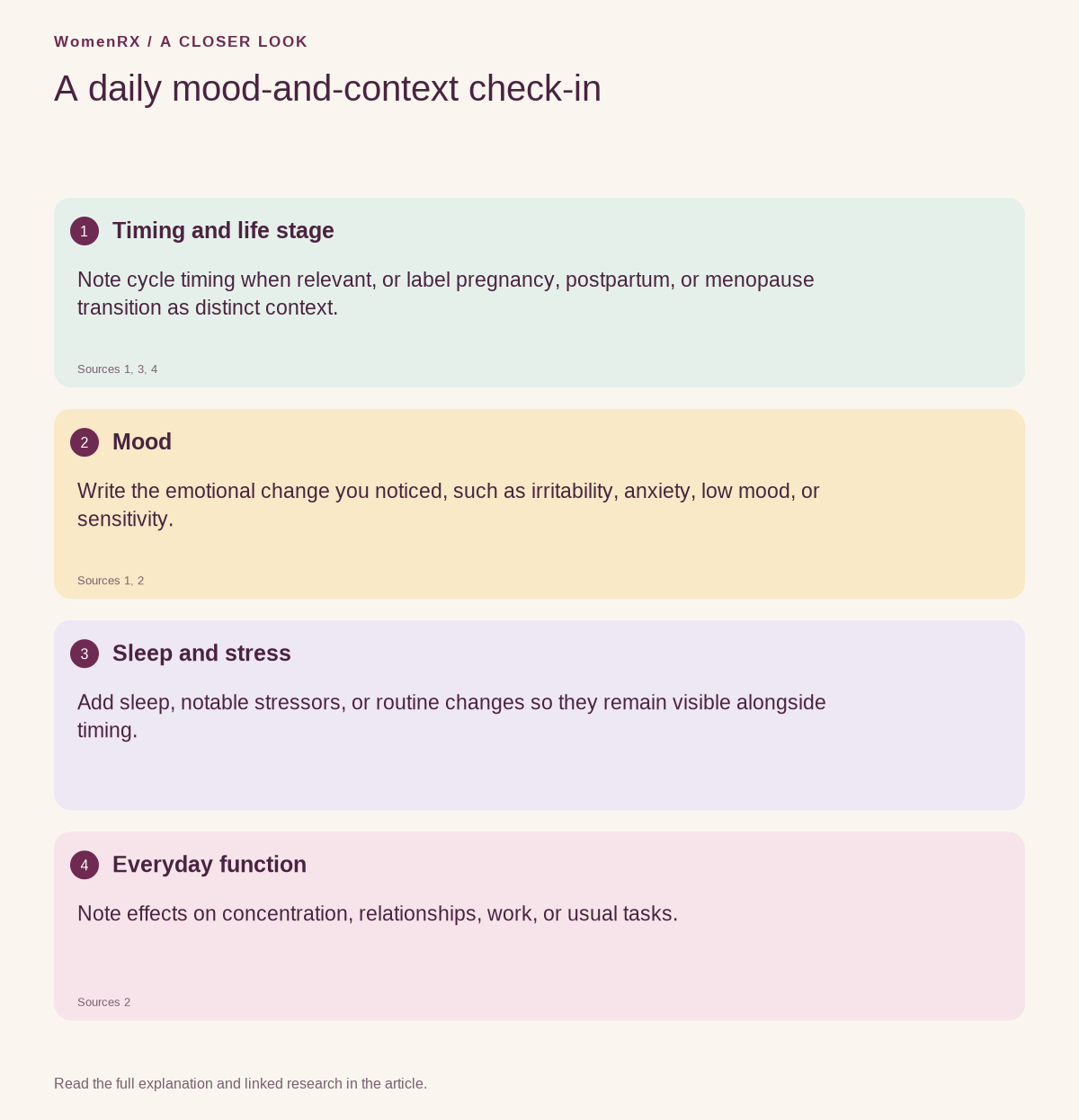
A daily mood-and-context check-in
Timing and life stage: Note cycle timing when relevant, or label pregnancy, postpartum, or menopause transition as distinct context.134
Mood: Write the emotional change you noticed, such as irritability, anxiety, low mood, or sensitivity.12
Sleep and stress: Add sleep, notable stressors, or routine changes so they remain visible alongside timing.
Everyday function: Note effects on concentration, relationships, work, or usual tasks.2
Read the figure as text
Record these details together to compare recurring timing with the rest of your day, without treating the log as a diagnosis.- Timing and life stage: Note cycle timing when relevant, or label pregnancy, postpartum, or menopause transition as distinct context.134
- Mood: Write the emotional change you noticed, such as irritability, anxiety, low mood, or sensitivity.12
- Sleep and stress: Add sleep, notable stressors, or routine changes so they remain visible alongside timing.
- Everyday function: Note effects on concentration, relationships, work, or usual tasks.2
Sources you can check
- Cardiac Autonomic and Affective Reactivity to Laboratory Stressors across the Menstrual Cycle: A Systematic Review.Delcourt ML, Copenhaver E, Cruess DG. · Behavioral medicine (Washington, D.C.) · 2025Return to first citation
- "Controlled by Female Hormones": A Qualitative Interview Study of Swedish Women's Experiences of Gender-Specific Aspects of Life With ADHD.McTaggart J, Thorell LB, Borg Skoglund C, Envall N, Kopp Kallner H. · Journal of attention disorders · 2026Return to first citation
- The Postmenopausal WomenRoeca C, Al-Safi Z, Santoro N. · 2000Return to first citation
- The see-saw effect of neuroactive steroids and endocrine disrupting compounds on maternal mental health status.Aishwarya S, Vinodhini VM, Renuka P, Anuradha M, Arul Saravanan R. · Neurotoxicology · 2025Return to first citation