When Anxiety Seems to Follow Your Hormones
A recurring pattern can be worth discussing, but timing alone can’t show what’s causing your anxiety.
Look for a pattern that repeats, not just one difficult day. Note when anxiety starts and eases, whether you feel better between episodes, and how it affects daily life. Record menstrual or reproductive-life-stage changes alongside sleep, caffeine, other substances, and medicine changes. These details can make a clinical conversation more specific, but research on cycle-related anxiety is limited and doesn’t prove a hormonal cause for you. 1 5 6
A pattern is a clue, not a diagnosis
Anxiety can be a normal response to stress. When it feels hard to control, persists, or interferes with work, relationships, or everyday activities, it’s worth discussing. A clinician will ask about your symptoms and medical history and may consider whether another health issue is contributing. Caffeine, other substances, and some medicines can also make anxiety worse. 1
Instead of asking only, “Was I anxious near my period?”, look at whether the pattern repeats, whether there are calmer stretches, and what else was changing at the time. A recurring pattern is useful information about timing. It does not, by itself, identify a cause.
Keep a brief record of what changes
For each spell, note when it began and eased, what you experienced, and whether it affected daily tasks, relationships, or activities you’ve started avoiding. If you menstruate, note cycle timing or when bleeding began. You can also record sleep, caffeine or other substance use, and changes in medicines or treatment. These details help put the timing in context; they aren’t a test for hormonal anxiety. 1
Pay attention to recurrence and symptom-free intervals. For example, if anxiety rises before a period and eases afterward more than once, that’s a pattern you can describe. It still doesn’t establish why it happens. You don’t need a perfect log, and you don’t need to wait to seek help if anxiety is interfering with your life. 1
The evidence isn’t the same at every life stage
For menstrual-cycle anxiety, human findings are limited. In a self-report survey of women with generalized social anxiety, 46% of the 140 women invited returned the survey. A subgroup of respondents reported that symptoms were worse before menstruation. This finding describes some women with a particular anxiety disorder, not how often the pattern occurs among women generally. 5
A separate community study of 63 women found an association between menstrual-cycle phase and anxiety among women who had not given birth. But the anxiety interaction with reproductive status was no longer statistically significant after the researchers accounted for age and cycle length. That result doesn’t provide a dependable rule for predicting one person’s symptoms. 6
Pregnancy and the postpartum period are distinct from an ordinary cycle. In the survey of women with generalized social anxiety, some respondents described symptoms easing during pregnancy and returning to their earlier levels postpartum. This was a retrospective report from a subgroup, not a prediction for every pregnancy or postpartum experience. 5
The postpartum period can also bring physical and emotional challenges. If you’re extremely sad or unable to care for yourself or your baby, contact a clinician promptly. 2
During menopause, describe when the anxiety began in relation to changes in your menstrual pattern or other symptoms, and whether you’ve started or changed treatment. Menopause guidance addresses treatments for symptoms such as hot flashes and genitourinary symptoms. That doesn’t establish that an individual’s anxiety is caused by hormones, so raise the anxiety itself and its effect on your life rather than assuming it will be explained by the transition. 3 4
Bring the pattern and its impact into the conversation
You might say, “I’ve noticed this tends to happen at this point in my cycle,” or, “It began around this life-stage change, and it’s affecting my sleep and work.” Then ask whether the pattern suggests anything to assess, whether caffeine, a medicine, or another health issue could be contributing, and what options fit the symptoms and their impact. Anxiety treatment can include psychotherapy, medicine, or both, depending on the person and the type of anxiety. 1
Whether you’re cycling, pregnant, recently postpartum, or in menopause, timing is one piece of the picture. The useful next step is to share what repeats, what else changed, and how much it’s affecting your day-to-day life.
A timeline for describing anxiety
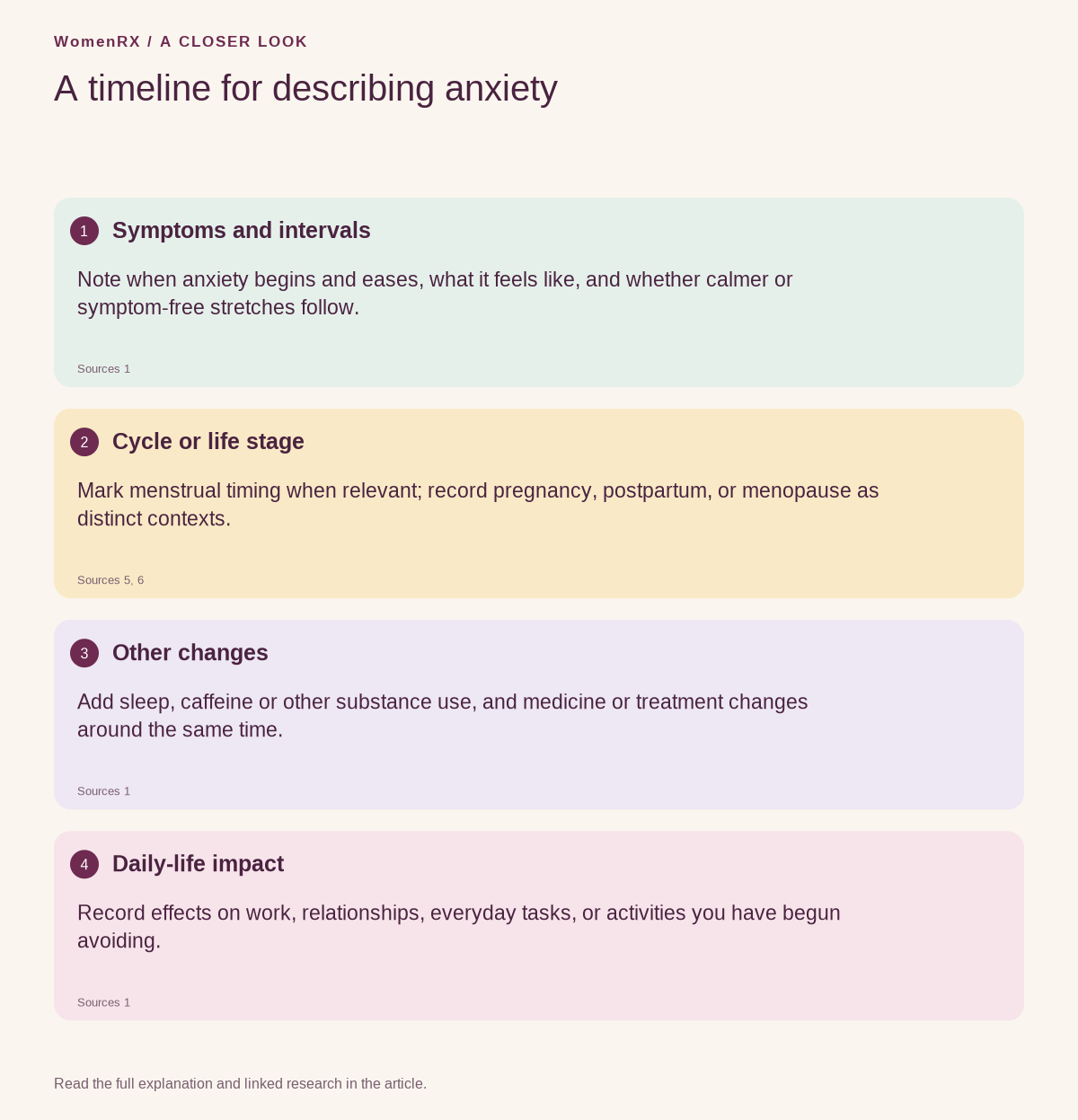
Symptoms and intervals: Note when anxiety begins and eases, what it feels like, and whether calmer or symptom-free stretches follow.1
Cycle or life stage: Mark menstrual timing when relevant; record pregnancy, postpartum, or menopause as distinct contexts.56
Other changes: Add sleep, caffeine or other substance use, and medicine or treatment changes around the same time.1
Daily-life impact: Record effects on work, relationships, everyday tasks, or activities you have begun avoiding.1
Read the figure as text
Use these prompts to connect symptom changes with cycle or life-stage context, other changes, and everyday impact. A timeline can organize a conversation, but it cannot diagnose a hormonal cause.- Symptoms and intervals: Note when anxiety begins and eases, what it feels like, and whether calmer or symptom-free stretches follow.1
- Cycle or life stage: Mark menstrual timing when relevant; record pregnancy, postpartum, or menopause as distinct contexts.56
- Other changes: Add sleep, caffeine or other substance use, and medicine or treatment changes around the same time.1
- Daily-life impact: Record effects on work, relationships, everyday tasks, or activities you have begun avoiding.1
Sources you can check
- Anxiety: MedlinePlusAccessed 2026-09-25Return to first citation
- Postpartum Care: MedlinePlusAccessed 2026-09-25Return to first citation
- The 2022 hormone therapy position statement of The North American Menopause Society.“The 2022 Hormone Therapy Position Statement of The North American Menopause Society” Advisory Panel. · Menopause (New York, N.Y.) · 2022Return to first citation
- The 2023 nonhormone therapy position statement of The North American Menopause Society.Menopause (New York, N.Y.) · 2023Return to first citation
- The effects of female reproductive hormones in generalized social anxiety disorder.van Veen JF, Jonker BW, van Vliet IM, Zitman FG. · International journal of psychiatry in medicine · 2009Return to first citation
- The impact of the ovarian cycle on anxiety, allopregnanolone, and corticotropin releasing hormone changes after motherhood in female rats and women.Pestana JE, Kershaw KA, Graham BM. · Translational psychiatry · 2023Return to first citation