How Estrogen and Progesterone Can Shape Mood
Hormones can influence mood, but how you respond to a change and when symptoms appear tell a more useful story than a single hormone level.
Estrogen and progesterone interact with brain processes involved in emotion and stress, but neither hormone has a predictable one-to-one effect on mood. Some people may be especially sensitive to hormonal changes. A recurring premenstrual pattern, worsening of an ongoing condition, and symptoms around pregnancy or menopause call for different questions, even when hormones may play a part. 2 3 4

If your mood seems to shift with your cycle or a reproductive transition, it’s reasonable to wonder about hormones. The useful distinction is between a change in hormone levels, your response to that change, and the pattern of symptoms you actually experience. Research links estrogen and progesterone to processes involved in emotion and stress response, but those processes interact with one another. They don’t produce the same mood outcome in everyone. 2
A hormone level is not a mood reading
Estrogen and progesterone change across the menstrual cycle and reproductive life stages. That tells us when a hormonal influence might be plausible, not whether a particular level explains how you feel. Research on premenstrual dysphoric disorder (PMDD), for example, explores whether some people are especially sensitive to hormonal fluctuations. Sensitivity to a change is a different question from whether a hormone is simply “too high” or “too low.” 2 3
The third piece is the pattern. Do symptoms appear during a recurring part of your cycle and ease at other times? Or are they present much of the month but worse around your period? Those descriptions can point an evaluation in different directions. Neither proves that hormones are the sole cause. 4
Before a period: two patterns worth distinguishing
Premenstrual mood symptoms may be part of a premenstrual disorder. PMDD involves severe emotional and physical symptoms that interfere with daily functioning. But depression, anxiety, or another existing psychiatric condition may also get worse before or during menstruation. A review of cycle-related psychiatric symptoms discusses both patterns and describes monitoring symptom timing as part of clinical management. 4
For example, “I’m anxious most weeks, and it intensifies before my period” conveys something different from “I have a recurring stretch of difficult symptoms before my period and feel noticeably different at other times.” The point isn’t to diagnose yourself from a calendar. It’s to bring the full pattern, including what happens between periods, into the conversation about care. 4
Pregnancy and postpartum: a transition, not an explanation by itself
Pregnancy and the period after birth involve hormonal changes and are discussed in research on mood vulnerability. Yet hormonal change alone cannot tell you why one person experiences depression or anxiety and another does not. Reviews describe interactions among hormones, brain processes, stress-response systems, and other factors rather than a single cause. 2 3
If your mood changes during pregnancy or after birth, the symptoms themselves deserve attention: when they began, whether they persist, and how they affect daily life. Assuming they’re just hormones can obscure what you’re going through.
Perimenopause: separate symptom relief from mood treatment
Research on hormone therapy and mood differs by menopausal stage. A 2026 narrative review describes possible antidepressant effects of estrogen therapy in some perimenopausal women, less clear findings for postmenopausal depression, and uncertain effects of progesterone. That is not a reliable prediction of whether hormone therapy will help an individual’s mood. 5
There’s also an important treatment distinction. Menopausal hormone therapy is established as an effective treatment for vasomotor symptoms, such as hot flashes, and for the genitourinary syndrome of menopause. The evidence that it treats a mood disorder is a separate, less settled question. Treatment decisions depend on the reason for treatment and an individual assessment of benefits and risks. 1 5
When describing a mood change, it helps to include both its timing and what happens outside that window. “I feel low throughout the month, but it’s worse before my period” and “My mood changed during perimenopause, alongside hot flashes” give more useful context than trying to assign a feeling to one hormone. Hormones may be part of the picture without being the whole answer. 2 4
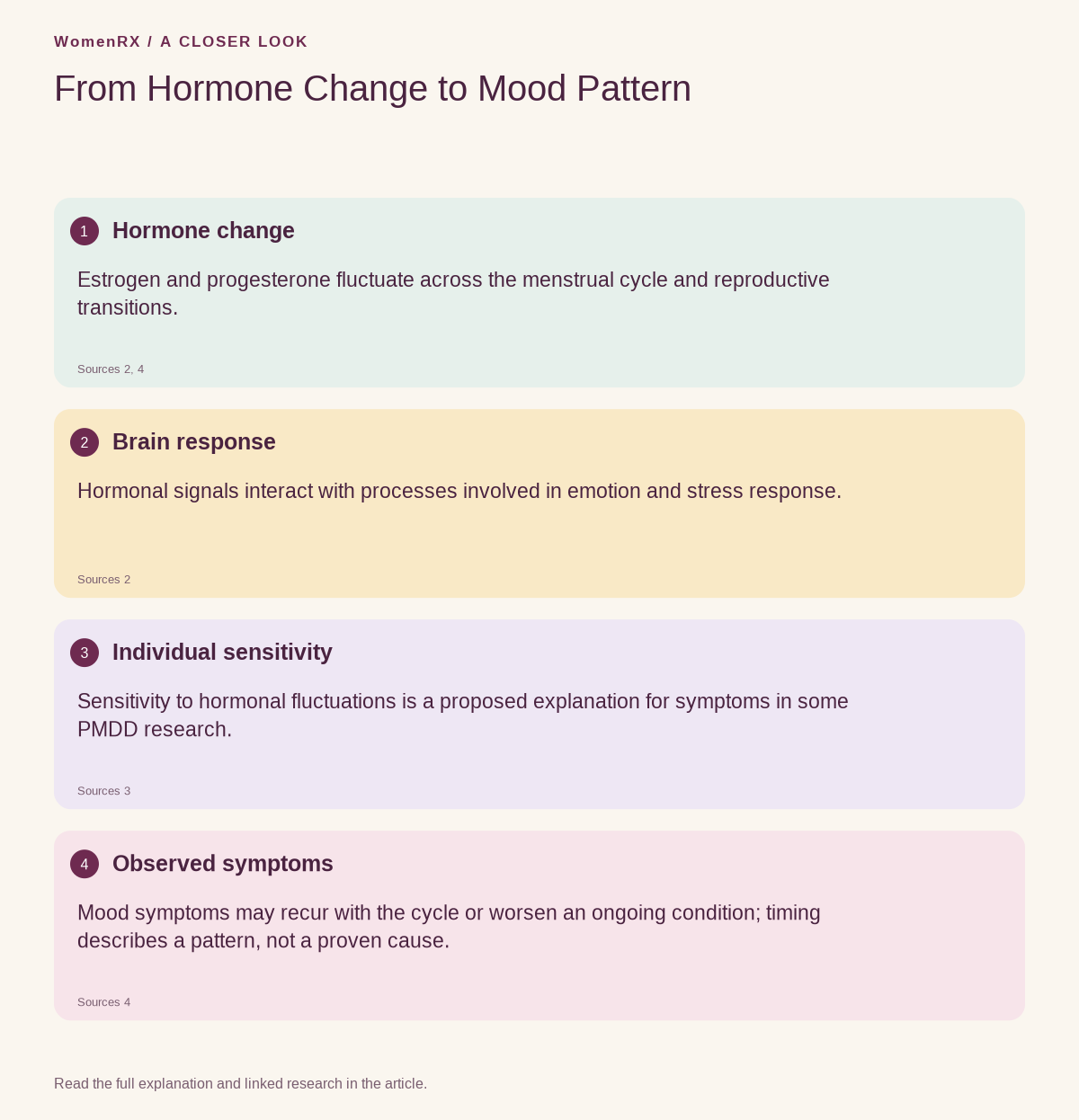
From Hormone Change to Mood Pattern
Hormone change: Estrogen and progesterone fluctuate across the menstrual cycle and reproductive transitions.24
Brain response: Hormonal signals interact with processes involved in emotion and stress response.2
Individual sensitivity: Sensitivity to hormonal fluctuations is a proposed explanation for symptoms in some PMDD research.3
Observed symptoms: Mood symptoms may recur with the cycle or worsen an ongoing condition; timing describes a pattern, not a proven cause.4
Read the figure as text
Four distinct parts of the picture help explain why a hormonal shift may matter without proving the cause of a particular mood change.- Hormone change: Estrogen and progesterone fluctuate across the menstrual cycle and reproductive transitions.24
- Brain response: Hormonal signals interact with processes involved in emotion and stress response.2
- Individual sensitivity: Sensitivity to hormonal fluctuations is a proposed explanation for symptoms in some PMDD research.3
- Observed symptoms: Mood symptoms may recur with the cycle or worsen an ongoing condition; timing describes a pattern, not a proven cause.4
More questions, answered
Does feeling low before my period mean I have PMDD?
Not by itself. An existing condition can worsen around a period, while a premenstrual disorder has its own recurring pattern. PMDD involves severe emotional and physical symptoms that interfere with daily functioning, so both the timing and the impact of symptoms matter. 4
Sources you can check
- The 2022 hormone therapy position statement of The North American Menopause Society.“The 2022 Hormone Therapy Position Statement of The North American Menopause Society” Advisory Panel. · Menopause (New York, N.Y.) · 2022Return to first citation
- Neuroinflammation and the Female Brain: Sex-Specific Mechanisms Underlying Mood Disorders and Stress Vulnerability.Marano G, d'Abate C, Traversi G, Mazza O, Gaetani E, Esposito R, Pavese F, Paris I, Mazza M. · Life (Basel, Switzerland) · 2026Return to first citation
- Using estrogen and progesterone to treat premenstrual dysphoric disorder, postnatal depression and menopausal depression.Mu E, Chiu L, Kulkarni J. · Frontiers in pharmacology · 2025Return to first citation
- Unmasking the cycle: Premenstrual and menstrual exacerbation of psychiatric disorders and impact on female mental health.Mazza M, Marano G. · World journal of psychiatry · 2025Return to first citation
- The role of hormone replacement therapy in the management of perimenopausal mental health symptoms: A narrative review.Langhe R, Kelly T, Ibrahim R, Al-Janabi R, Mohammed G, Mousa N. · International journal of gynaecology and obstetrics: the official organ of the International Federation of Gynaecology and Obstetrics · 2026Return to first citation