Gum Changes in Perimenopause: What a Dental Check Can Clarify
Bleeding, soreness, dryness, and gum changes can have different explanations, and a dental exam can help sort them out.
Bleeding, soreness, dryness, or a change in your gums isn’t proof that perimenopause has caused gum disease. A dental exam can check for gum inflammation and deeper periodontal changes, while your symptom pattern and dental history add context. Research suggests some periodontal differences after menopause, but it doesn’t establish that perimenopause causes an individual woman’s symptoms. 1 2

Start with the symptom, not the hormone explanation
If your gums bleed, feel sore, look different, or your mouth feels dry, it’s reasonable to bring that up at a dental visit, especially if it keeps happening or is changing. These symptoms don’t tell you on their own whether you have gum disease or whether hormones are involved.
Gingivitis affects the gums. Periodontitis involves damage to the tissues supporting the teeth and can include bone loss. A dental professional assesses periodontal health using an examination and, when appropriate, dental X-rays; a symptom alone can’t show how deep a problem goes. 2 4
Dryness is a separate clue, not a diagnosis of gum disease. In one cross-sectional study of 112 women who attended a university dental hospital, women in the cluster with discontinued menstrual periods reported more oral dryness. The study used self-reported symptoms and can’t show that menopause caused the dryness or that it meant periodontal disease was present. 3
What menopause research can, and can’t, tell you
Research on periodontal health across the transition is limited. A 2026 systematic review compared postmenopausal with premenopausal women across nine observational studies. It found trends toward greater attachment loss, deeper periodontal pockets, and more inflammation after menopause, but the studies varied and the authors rated the evidence as moderate to low overall. Findings on periodontitis severity conflicted and had very low certainty. 1
That review studied postmenopausal women, not perimenopause specifically. It can’t establish that hormones caused the differences, or explain what’s behind one person’s bleeding or soreness. Age, smoking, oral hygiene, dental attendance, and other health factors matter when a dentist assesses periodontal risk. Smoking and infrequent dental attendance are among the risk factors or predictors identified in a review of periodontal diagnosis and treatment. 1 2
What to tell the dentist
A short, factual account is more useful than trying to diagnose the cause yourself. Before the visit, consider noting:
- What changed: bleeding, soreness, visible gum changes, dryness, or another symptom. Describe what you notice without assuming it’s from menopause.
- When it happens: when you first noticed it, whether it comes and goes, and whether it seems to be changing.
- Your dental context: when you last had a dental exam, any past gum treatment, your usual oral-care routine, and whether you smoke. Oral hygiene and dental history help put symptoms in context. 2 3
- Your medicines: bring a current list, including recent changes. This is useful background for the dental visit; it doesn’t mean a medicine is necessarily the cause.
The dental assessment may include an interview, a periodontal examination, and radiographs when needed. Measurements such as pocket depth and attachment loss help assess periodontal changes; they aren’t things you can reliably judge by looking in the mirror. 2
When not to leave it to self-care
Arrange a dental visit for bleeding or soreness that keeps returning, persistent dryness, or gum changes you’re concerned about. These symptoms deserve assessment rather than an assumption that they’re a normal part of perimenopause. If a tooth feels loose, tell the dentist promptly; tooth mobility is associated with a poorer periodontal prognosis after treatment. 2
In the meantime, keep your usual oral-care routine and share what you’ve noticed at the visit. The goal is to find out whether the issue is gum inflammation, a deeper periodontal change, dryness, or something else, then respond to that finding rather than treating hormones as the explanation by default.
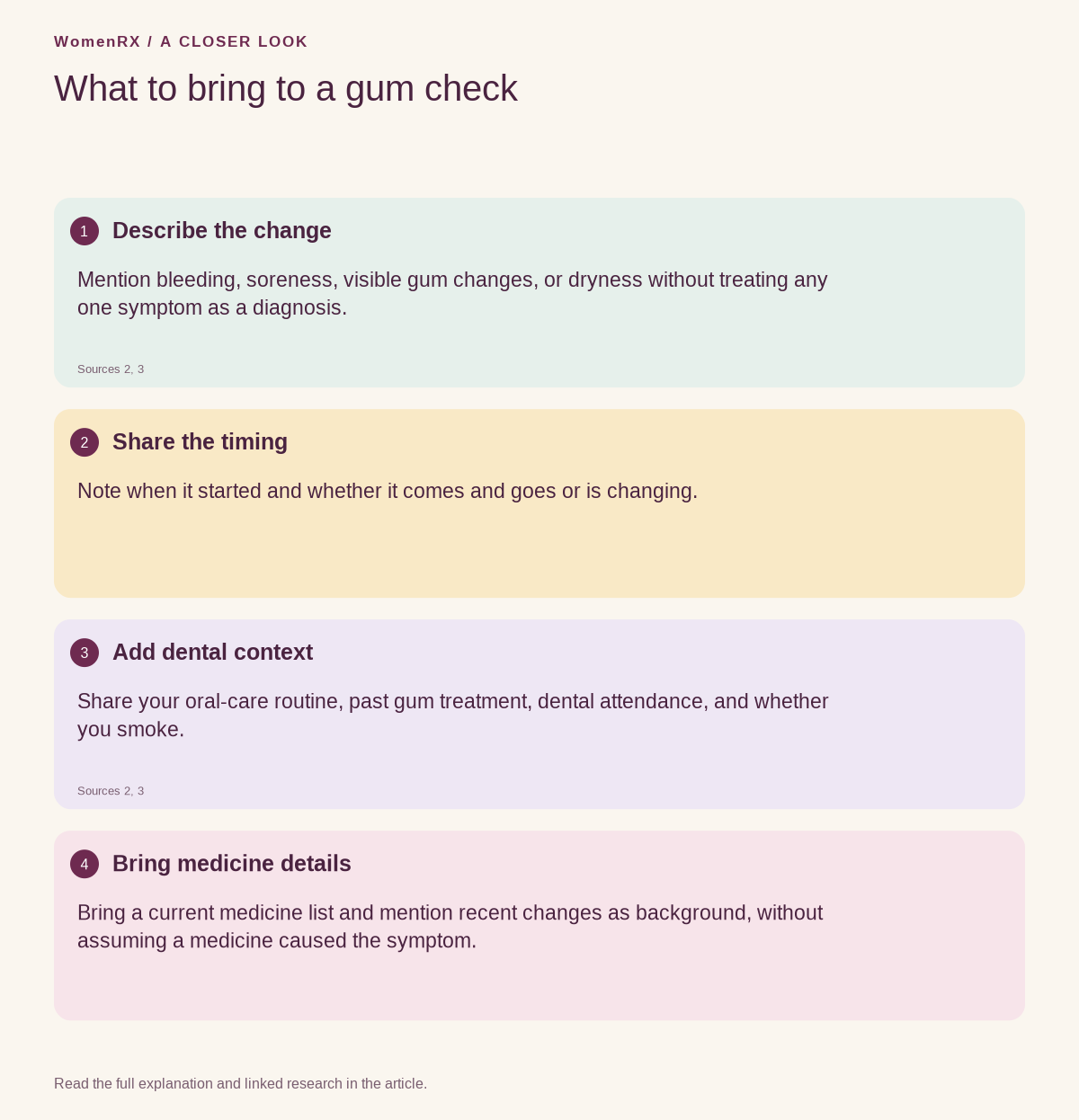
What to bring to a gum check
Describe the change: Mention bleeding, soreness, visible gum changes, or dryness without treating any one symptom as a diagnosis.23
Share the timing: Note when it started and whether it comes and goes or is changing.
Add dental context: Share your oral-care routine, past gum treatment, dental attendance, and whether you smoke.23
Bring medicine details: Bring a current medicine list and mention recent changes as background, without assuming a medicine caused the symptom.
Read the figure as text
Use these prompts to describe what you notice and give the dentist relevant context without assuming the cause.- Describe the change: Mention bleeding, soreness, visible gum changes, or dryness without treating any one symptom as a diagnosis.23
- Share the timing: Note when it started and whether it comes and goes or is changing.
- Add dental context: Share your oral-care routine, past gum treatment, dental attendance, and whether you smoke.23
- Bring medicine details: Bring a current medicine list and mention recent changes as background, without assuming a medicine caused the symptom.
More questions, answered
Does bleeding gums mean I have periodontitis?
No. Bleeding can be a sign of gum inflammation, but it doesn’t establish how deep a problem goes. A periodontal examination is needed to assess supporting-tissue changes. 2 4
Does dry mouth mean menopause is damaging my gums?
Not by itself. A small cross-sectional study found more self-reported dryness in a cluster of women with discontinued menstrual periods, but it could not establish the cause or diagnose gum disease from dryness. 3
Sources you can check
- Impact of menopause on clinical periodontal outcomes: a systematic review.Martín FC, Rus MJ, de la Cruz Gándara Alvarez A, Simon-Soro A, Cantiga-Silva C. · Clinical oral investigations · 2026Return to first citation
- Periodontal risk assessment, diagnosis and treatment planning.Pihlstrom BL. · Periodontology 2000 · 2001Return to first citation
- Clusters explaining the relation between menopause and self-reported periodontal disease: a cross-sectional study.Fadel HT, Qarah LA, Alharbi MO, Al-Sharif A, Al-Harkan DS, Kassim S, Abu-Hammad O, Dar-Odeh N. · PeerJ · 2025Return to first citation
- Exploring the age-dependent burden of periodontal disease in women across different socio-demographic levels.Wu M, Liu M, Cao Y, Ye C, Qu Q, Zheng Y, Chen S. · Tropical medicine and health · 2025Return to first citation