Histamine Intolerance in Perimenopause: What’s Actually Known
Hormones can affect allergic conditions, but a symptom flare in perimenopause doesn’t establish histamine intolerance.
Neither the evidence on hormone-related asthma patterns nor the guidance on suspected reactions to ingested histamine can tell you how long your symptoms will last in perimenopause or whether they will stop after menopause. Suspected reactions to ingested histamine have no reliable confirming laboratory test, and asthma patterns cannot establish a menopause link for food-related symptoms. If symptoms keep returning, investigate the particular symptoms and their triggers rather than assume they’ll end after menopause. 45
If flushing, itching, headaches, or stomach upset seem to arrive alongside changes in your periods, it’s reasonable to wonder whether hormones are involved. The harder question is whether histamine intolerance explains those symptoms. That’s a much bigger claim than noticing a pattern.
Why the hormone connection sounds plausible
Histamine is involved in allergic reactions, and laboratory work suggests estrogen can influence some histamine-related processes. For example, estradiol increased histamine release from mouse mast cells studied in a lab. That experiment helps explain why researchers ask about a hormone connection. It doesn’t show that estrogen changes cause reactions to histamine in food, or predict what will happen during perimenopause. 36
There is human evidence that some allergic conditions vary with reproductive stage. A review describes worsening asthma symptoms around menstruation in some women with asthma, while noting that the mechanisms behind patterns after menopause remain unclear. Asthma is not the same condition as a suspected reaction to histamine in food. A change in one cannot establish the other. 4
What about the question ‘How long will this last?’ Neither the research on asthma nor the guidance on suspected reactions to ingested histamine provides a number of months or a menopause milestone for these symptoms. Even if symptoms began during perimenopause, that timing alone can’t tell you their cause or whether they’ll stop after your final period. 45
What “histamine intolerance” does and doesn’t tell you
Histamine occurs in foods and drinks such as wine and cheese, and people can report feeling unwell after consuming them. But the diagnosis is less settled than the name suggests. An allergy-society guideline calls the evidence connecting ingested histamine to reproducible symptoms limited and contradictory. It also says a causal link between those reactions and deficient diamine oxidase, or DAO, has not been established. 15
That distinction matters if you’ve seen a DAO blood test advertised as an answer. The guideline says serum DAO results are inconclusive and that there is no reliable laboratory test to confirm or rule out adverse reactions to ingested histamine. A result shouldn’t be used on its own to explain a wide range of new symptoms. 5
Nor is an extensive low-histamine diet a dependable shortcut to an answer. The guideline found very limited evidence for its effects, largely from observational studies that cannot establish cause and effect. It warns that people can end up restricting food far more than their history calls for. General food-intolerance guidance also advises against cutting foods out without medical or dietitian advice. 51
Follow the symptom, not just the theory
The details of a reaction can point toward different questions. For example, if discomfort repeatedly follows a particular meal by a few hours and is mainly bloating or stomach pain, a food intolerance may be worth investigating. If eating is followed by itchy skin, wheezing, or swelling of the lips or face, food allergy needs consideration instead. Food allergy can be serious; throat tightness or difficulty swallowing calls for emergency help right away. 12
A useful conversation about recurring symptoms starts with what actually happens: the symptom, when it begins, whether the same food or drink is involved each time, and whether it happens without that exposure. Mention any pattern you’ve noticed around periods, too. The point isn’t to prove a hormone theory with a diary. It’s to help distinguish a repeatable food-related reaction from an allergy or another explanation, without committing to a restrictive diet first. Guidance on suspected food intolerance uses symptom history and, when appropriate, a supervised period of avoiding and reintroducing a suspected food; it cautions against relying on commercial home intolerance tests. 15
You can take the perimenopause timing seriously without letting it settle the diagnosis. The strongest next move is to investigate the reactions you’re having, especially any possible allergy symptoms, while keeping claims about estrogen and dietary histamine in their proper place: questions under study, not a way to predict when symptoms will ease. 245
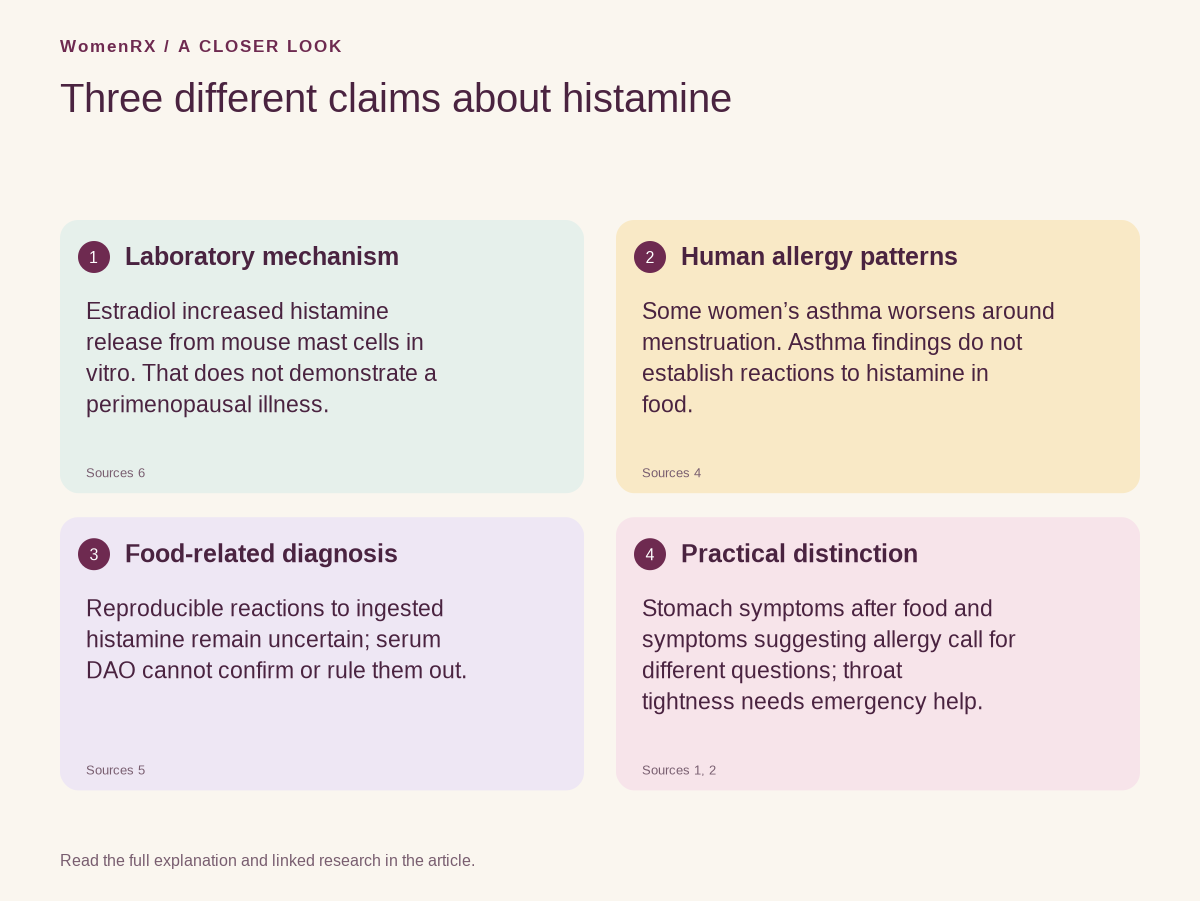
Three different claims about histamine
Laboratory mechanism: Estradiol increased histamine release from mouse mast cells in vitro. That does not demonstrate a perimenopausal illness.6
Human allergy patterns: Some women’s asthma worsens around menstruation. Asthma findings do not establish reactions to histamine in food.4
Food-related diagnosis: Reproducible reactions to ingested histamine remain uncertain; serum DAO cannot confirm or rule them out.5
Practical distinction: Stomach symptoms after food and symptoms suggesting allergy call for different questions; throat tightness needs emergency help.12
Read the figure as text
These findings answer different questions and shouldn’t be treated as interchangeable evidence.- Laboratory mechanism: Estradiol increased histamine release from mouse mast cells in vitro. That does not demonstrate a perimenopausal illness.6
- Human allergy patterns: Some women’s asthma worsens around menstruation. Asthma findings do not establish reactions to histamine in food.4
- Food-related diagnosis: Reproducible reactions to ingested histamine remain uncertain; serum DAO cannot confirm or rule them out.5
- Practical distinction: Stomach symptoms after food and symptoms suggesting allergy call for different questions; throat tightness needs emergency help.12
More questions, answered
Can a DAO blood test confirm histamine intolerance?
No. An allergy-society guideline describes serum DAO measurements as inconclusive and says there is no reliable laboratory test that confirms or rules out adverse reactions to ingested histamine. 5
Sources you can check
- Food intolerance - NHSAccessed 2026-09-25Return to first citation
- Food allergy - NHSAccessed 2026-09-25Return to first citation
- Antihistamines - NHSAccessed 2026-09-25Return to first citation
- Sex in Respiratory and Skin Allergies.Ridolo E, Incorvaia C, Martignago I, Caminati M, Canonica GW, Senna G. · Clinical reviews in allergy & immunology · 2019Return to first citation
- Guideline on management of suspected adverse reactions to ingested histamine: Guideline of the German Society for Allergology and Clinical Immunology (DGAKI), the Society for Pediatric Allergology and Environmental Medicine (GPA), the Medical Association of German Allergologists (AeDA) as well as the Swiss Society for Allergology and Immunology (SGAI) and the Austrian Society for Allergology and Immunology (ÖGAI).Reese I, Ballmer-Weber B, Beyer K, Dölle-Bierke S, Kleine-Tebbe J, Klimek L, Lämmel S, Lepp U, Saloga J, Schäfer C, Szepfalusi Z, Treudler R, Werfel T, Zuberbier T, Worm M. · Allergologie select · 2021Return to first citation
- Bisphenol A at concentrations relevant to human exposure enhances histamine and cysteinyl leukotriene release from bone marrow-derived mast cells.O'Brien E, Dolinoy DC, Mancuso P. · Journal of immunotoxicology · 2014Return to first citation