Histamine Intolerance and Perimenopause: What’s the Evidence?
Hormones may affect histamine-related processes, but allergy-like symptoms during perimenopause don’t establish histamine intolerance.
There’s a plausible hormonal connection, but research hasn’t established that perimenopause causes histamine intolerance. Symptoms attributed to the condition overlap with allergy, digestive, and skin problems, and no validated test confirms it. The most useful distinction is whether symptoms repeatedly follow a particular exposure or occur in other settings too. 2
Why the connection sounds plausible
Histamine is involved in normal immune and digestive processes. Diamine oxidase, often called DAO, helps break down histamine in the gut. The term “histamine intolerance” describes symptoms thought to arise when dietary histamine exceeds the body’s capacity to break it down. Researchers have reported changes in DAO levels across the menstrual cycle and estrogen-related effects on histamine activity. Some of the hormonal findings come from animal research. Together, they suggest a question worth studying, not proof that the hormonal changes of perimenopause cause histamine intolerance. 2
That distinction matters if itching, flushing, nasal symptoms, or digestive discomfort have appeared or changed as your periods become less predictable. The timing is worth mentioning. It can’t, by itself, tell you whether histamine, hormones, a seasonal allergy, a digestive condition, or something else is responsible. Symptoms attributed to histamine intolerance are varied and nonspecific. 2
Which pattern are you trying to explain?
Start with the symptom itself rather than the label. For example, repeated flushing and bloating soon after a particular meal raise a different question from nasal congestion that also occurs outdoors during allergy season. Neither pattern proves a diagnosis, but each points to different exposures worth considering. A clinical assessment may need to consider food allergy, gastrointestinal conditions, or skin disorders, depending on what’s happening. 2
It helps to describe a few episodes concretely: what happened, when it began, how long it lasted, and whether it followed food or drink. Note whether the same symptoms occur without that exposure. Cycle timing, seasonal allergies, exercise, and recent medical or lifestyle changes may also be relevant. You don’t need to turn this into an elaborate daily log. The aim is to bring enough detail to test a possible pattern rather than assume one. 2
There’s a second distinction if the main concern is a menopausal vasomotor symptom. The Menopause Society’s 2023 review does not recommend dietary modification as a treatment for vasomotor symptoms. That finding shouldn’t be confused with the separate, still uncertain question of whether a carefully assessed food-related pattern might explain someone’s digestive or allergy-like symptoms. 12
Why a test or food list may not settle it
There’s no clinically available, validated biomarker that confirms histamine intolerance. Serum DAO results can vary within a person and don’t consistently track symptoms. A skin-prick test can help investigate allergic reactions, but it doesn’t show how well the gut breaks down dietary histamine. Stool histamine isn’t considered a reliable test for this purpose either. 2
Broad low-histamine food lists can look more definite than the evidence allows. Histamine content varies, and researchers disagree about some proposed food exclusions. Studies of low-histamine diets also use different diagnostic criteria and approaches, making their results hard to apply to an individual. If food repeatedly seems involved, discuss whether a structured assessment with reintroduction makes sense before cutting out many foods. Improvement after avoiding foods can be useful information, but it isn’t, on its own, proof of histamine intolerance. 2
Perimenopause belongs in the story you tell about when symptoms changed. It doesn’t have to become the explanation before the pattern and other possible causes have been examined. 2
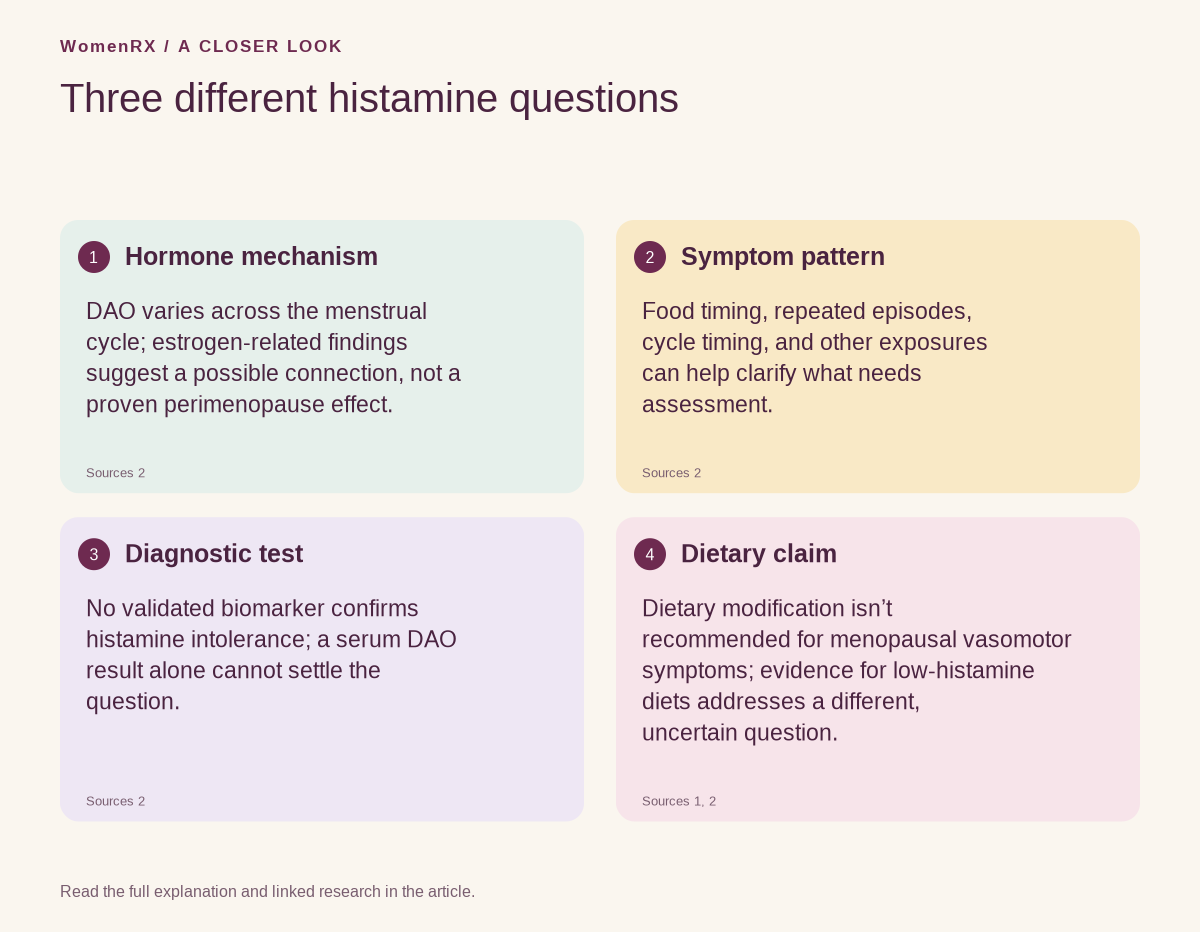
Three different histamine questions
Hormone mechanism: DAO varies across the menstrual cycle; estrogen-related findings suggest a possible connection, not a proven perimenopause effect.2
Symptom pattern: Food timing, repeated episodes, cycle timing, and other exposures can help clarify what needs assessment.2
Diagnostic test: No validated biomarker confirms histamine intolerance; a serum DAO result alone cannot settle the question.2
Dietary claim: Dietary modification isn’t recommended for menopausal vasomotor symptoms; evidence for low-histamine diets addresses a different, uncertain question.12
Read the figure as text
This evidence map separates a plausible mechanism from symptoms and treatment claims that require different kinds of evidence.- Hormone mechanism: DAO varies across the menstrual cycle; estrogen-related findings suggest a possible connection, not a proven perimenopause effect.2
- Symptom pattern: Food timing, repeated episodes, cycle timing, and other exposures can help clarify what needs assessment.2
- Diagnostic test: No validated biomarker confirms histamine intolerance; a serum DAO result alone cannot settle the question.2
- Dietary claim: Dietary modification isn’t recommended for menopausal vasomotor symptoms; evidence for low-histamine diets addresses a different, uncertain question.12
Sources you can check
- The 2023 nonhormone therapy position statement of The North American Menopause Society.Menopause (New York, N.Y.) · 2023Return to first citation
- Evidence for Dietary Management of Histamine Intolerance.Jackson K, Busse W, Gálvez-Martín P, Terradillos A, Martínez-Puig D. · International journal of molecular sciences · 2025Return to first citation