Histamine Intolerance and Menopause: What Symptoms Can Tell You
Flushing, itching, and digestive symptoms can overlap with menopause, but they don’t confirm histamine intolerance.
Histamine intolerance is a proposed explanation for varied symptoms, but there’s no validated test that confirms it, and those symptoms can have other causes. Menopause-related hot flashes are a recognized concern in their own right; having them doesn’t establish histamine intolerance. Before restricting foods or trying supplements, look for repeatable patterns and consider other explanations with a clinician. 23
Flushing, itching, headaches, or digestive discomfort can make a food-related explanation seem likely, especially when symptoms happen after eating. But these symptoms overlap with several conditions. A pattern is worth investigating; it isn’t, by itself, a diagnosis of histamine intolerance. 3
What “histamine intolerance” can and can’t tell you
Histamine intolerance is commonly described as symptoms arising when the body doesn’t break down histamine from food effectively. Diamine oxidase, or DAO, is one enzyme involved in that process. There’s no clinically validated biomarker that confirms histamine intolerance, and researchers and clinicians don’t agree on a standardized diagnostic approach. A blood DAO result alone cannot settle the question. 3
Symptoms attributed to histamine intolerance can include bloating, abdominal pain, diarrhea, headache, dizziness, nasal symptoms, itching, and flushing. Because each can occur for other reasons, a symptom list or a reaction after one meal can’t establish the cause. 3
Keep menopause and food reactions as separate questions
Menopause-related hot flashes are a recognized clinical concern. The North American Menopause Society identifies hormone therapy as the most effective treatment for bothersome vasomotor symptoms, while noting that its benefits and risks vary with individual circumstances. A hot flash deserves consideration as a menopause symptom in its own right, not as evidence of histamine intolerance. 2
Claims about changing hormones and histamine need a separate look. One small observational study followed 30 women already diagnosed with histamine intolerance through pregnancy and afterward. Twenty-seven reported symptom improvement during pregnancy, alongside increased measured DAO activity. Pregnancy is not perimenopause or postmenopause, and this study doesn’t show that estrogen changes cause histamine symptoms during menopause. 4
If flushing is your main concern, notice whether it also happens without an apparent food trigger. If itching, digestive symptoms, or nasal symptoms occur too, they may warrant separate consideration. More than one explanation can be relevant at once.
Other causes can look similar
The symptoms determine which alternatives are worth assessing. Allergy or mast-cell disease may be relevant for some allergy-like reactions. Irritable bowel syndrome, inflammatory bowel disease, or dyspepsia may be considered for digestive symptoms; hives, swelling, or other skin conditions may matter when itching or a rash is prominent. These are possibilities to assess, not diagnoses to make from a list. 3
Food intolerance and food allergy aren’t the same. A food allergy can involve wheezing or swelling of the lips, face, or eyes. If breathing problems or swelling occur after eating, seek urgent medical help rather than treating the episode as a routine intolerance or testing a diet at home. 1
Look for a pattern without cutting out whole food groups
Write down what you ate and drank, when symptoms began, what they felt like, and whether the same pattern repeats. Include context that could change the interpretation: exercise, stress, seasonal allergies, menstrual-cycle changes if you still have periods, and recent medication or lifestyle changes. For example, flushing that also occurs when you haven’t recently eaten tells a different story from a reaction that repeatedly follows the same food. A record helps frame the question; it cannot confirm a diagnosis. 3
Resist removing many foods based on an online list or a home test. Some purchasable food-intolerance tests aren’t recommended because evidence for their accuracy is limited, and their results may encourage unnecessary restriction. If a food connection seems consistent, a clinician or dietitian can help assess it without overlooking other causes or needlessly narrowing your diet. 13
DAO supplements aren’t a settled answer either. A review describes limited clinical evidence: the DAO formulations studied were derived from porcine kidneys, although some included additional ingredients such as vitamin C or catalase. It reports no clinical data for DAO derived from plants or microorganisms. That evidence can’t tell you whether a supplement will help your particular symptoms. 3
The useful distinction is between two questions: do the episodes fit a recognized menopause concern, and is there a repeatable relationship with food? You can investigate both without committing to a histamine-intolerance label first.
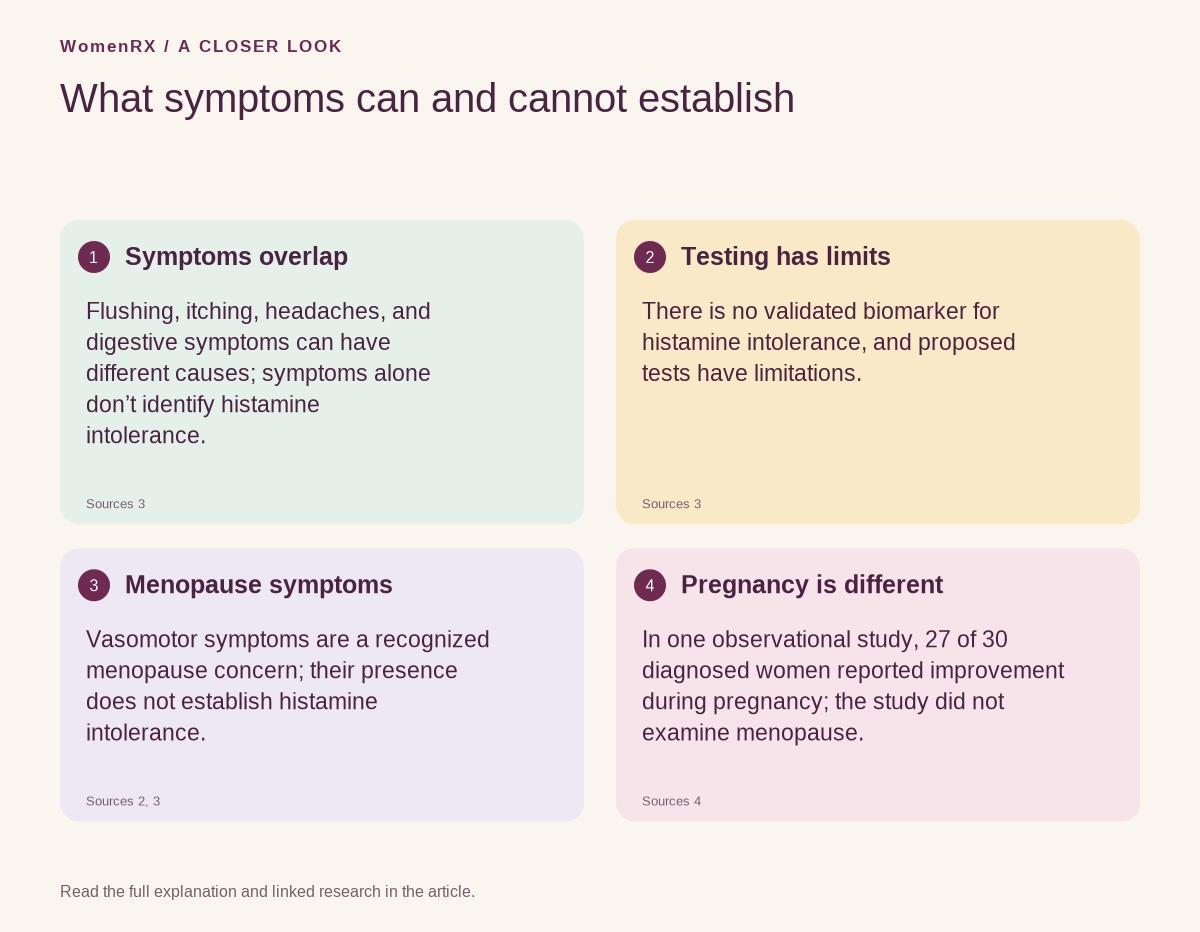
What symptoms can and cannot establish
Symptoms overlap: Flushing, itching, headaches, and digestive symptoms can have different causes; symptoms alone don’t identify histamine intolerance.3
Testing has limits: There is no validated biomarker for histamine intolerance, and proposed tests have limitations.3
Menopause symptoms: Vasomotor symptoms are a recognized menopause concern; their presence does not establish histamine intolerance.23
Pregnancy is different: In one observational study, 27 of 30 diagnosed women reported improvement during pregnancy; the study did not examine menopause.4
Read the figure as text
This evidence map separates symptom overlap, testing limits, and findings from different life stages.- Symptoms overlap: Flushing, itching, headaches, and digestive symptoms can have different causes; symptoms alone don’t identify histamine intolerance.3
- Testing has limits: There is no validated biomarker for histamine intolerance, and proposed tests have limitations.3
- Menopause symptoms: Vasomotor symptoms are a recognized menopause concern; their presence does not establish histamine intolerance.23
- Pregnancy is different: In one observational study, 27 of 30 diagnosed women reported improvement during pregnancy; the study did not examine menopause.4
More questions, answered
Does feeling better on a low-histamine diet confirm histamine intolerance?
No. Response to dietary changes and reintroduction can be part of a clinical assessment, but the symptoms are nonspecific and there’s no validated confirming biomarker. Feeling better doesn’t, on its own, identify why. 3
Sources you can check
- Food intolerance - NHSAccessed 2026-09-25Return to first citation
- The 2022 hormone therapy position statement of The North American Menopause Society.“The 2022 Hormone Therapy Position Statement of The North American Menopause Society” Advisory Panel. · Menopause (New York, N.Y.) · 2022Return to first citation
- Evidence for Dietary Management of Histamine Intolerance.Jackson K, Busse W, Gálvez-Martín P, Terradillos A, Martínez-Puig D. · International journal of molecular sciences · 2025Return to first citation
- Improvement of Histamine Intolerance Symptoms in Pregnant Women with Diamine Oxidase Deficiency: An Exploratory Study.Duelo A, Sánchez-Pérez S, Pellicer-Roca S, Sánchez-Buxens S, Comas-Basté O, Latorre-Moratalla ML, Vidal-Carou MC. · Journal of clinical medicine · 2025Return to first citation