Histamine Intolerance and Menopause: What a Food Pattern Means
Recurring symptoms after meals deserve attention, but a food pattern alone can’t confirm histamine intolerance or link it to menopause.
If symptoms keep returning after particular foods, make a record and arrange a medical assessment rather than assuming histamine is the cause. Histamine intolerance has no validated diagnostic biomarker, and its symptoms can resemble allergy or other food intolerances. Hot flashes can complicate the picture around menopause, but a flush near mealtime doesn’t establish an estrogen-histamine link. 1 2 5 6
Start with the pattern, not the label
Perhaps you’ve noticed a headache and stomach upset after wine, or symptoms that seem to follow cheese. The timing matters, especially if it happens more than once. But symptoms attributed to histamine intolerance are varied and nonspecific. A repeated reaction is a reason to look more closely, not enough to identify histamine as the cause. 1 4 6
If food-related symptoms keep coming back, arrange an assessment. A food-and-symptom record can help you explain what’s happening without having to settle on a diagnosis first. 1
What menopause adds to the question
Hot flashes can bring sudden warmth and sweating as estrogen levels fall around menopause. If one happens near a meal, it may be hard to tell whether eating was relevant or simply happened at the same time. The overlap does not show that changing estrogen levels caused histamine intolerance. 2
That distinction is useful in perimenopause, when you may be trying to make sense of new symptoms alongside changes in your periods. Notice whether an episode feels like sudden heat and sweating, digestive discomfort, an itchy skin reaction, or a combination. Those details give a clinician more to work with than either “menopause” or “histamine intolerance” as a starting label. Histamine-intolerance symptoms can affect more than the digestive system, but they do not form a pattern that, by itself, confirms the diagnosis. 4 6
Why diet changes and tests can mislead
Researchers have proposed that difficulty breaking down dietary histamine contributes to symptoms, with attention often focused on diamine oxidase, or DAO, an enzyme involved in histamine breakdown. But there is no validated biomarker for diagnosing histamine intolerance, and the diagnostic value of proposed DAO tests remains uncertain. 5 6
One small study shows why even a convincing reaction needs careful interpretation. Researchers gave placebo-controlled histamine challenges to 59 people who already suspected histamine intolerance. Thirty-seven reported symptoms after placebo, and the researchers excluded histamine intolerance in 50. Four had objective symptoms after histamine but not placebo; the researchers called these cases plausible, not certain, because chance reactions could not be ruled out. Most participants were middle-aged women, but the study did not establish a menopause-related cause. Its results cannot tell you what is behind your own symptoms. 3
Feeling better after changing your diet is worth noting, but it isn’t proof either. In that challenge study, many participants reported improvement while eating a low-histamine diet even though histamine intolerance was later excluded for most of the group. Home tests marketed for food intolerance also aren’t recommended: evidence for their accuracy is limited, and their results may encourage unnecessary food exclusions. If you’re considering cutting out foods, discuss how to investigate and reintroduce them with a clinician or dietitian rather than building an increasingly restrictive diet on your own. 1 3
Similar symptoms, different next steps
Food allergy deserves particular attention because it differs from food intolerance. Allergy can involve itchy skin, wheezing, or swelling of the lips, face, or eyes. If you think you’re having a serious allergic reaction, seek emergency help immediately rather than waiting for a routine appointment. Recurring symptoms after food still merit assessment. 1
Other intolerances can also cause symptoms after eating. Lactose intolerance, for example, is a common food intolerance, while reviews of histamine intolerance describe symptoms that can resemble allergies and other conditions. The question isn’t just “Was there histamine in the food?” It’s “What else fits the symptoms and timing, and what needs to be checked first?” 1 6
Bring a record that helps answer that question
For each episode, jot down what you ate and drank, when symptoms began, what they felt like, and how long they lasted. Note whether the same thing happened on another occasion. If relevant, include whether you noticed sudden heat or sweating that felt like a hot flash. For example, “warmth and sweating before dinner” tells a different story from “stomach upset that repeatedly starts after the same meal.”
A diary can reveal a possible trigger; it cannot diagnose histamine intolerance. Bring it to an assessment and ask which other explanations fit your pattern before removing more foods. Clinically guided avoidance and reintroduction may be used to investigate a suspected food intolerance, while unnecessary exclusions can leave gaps in your diet. 1
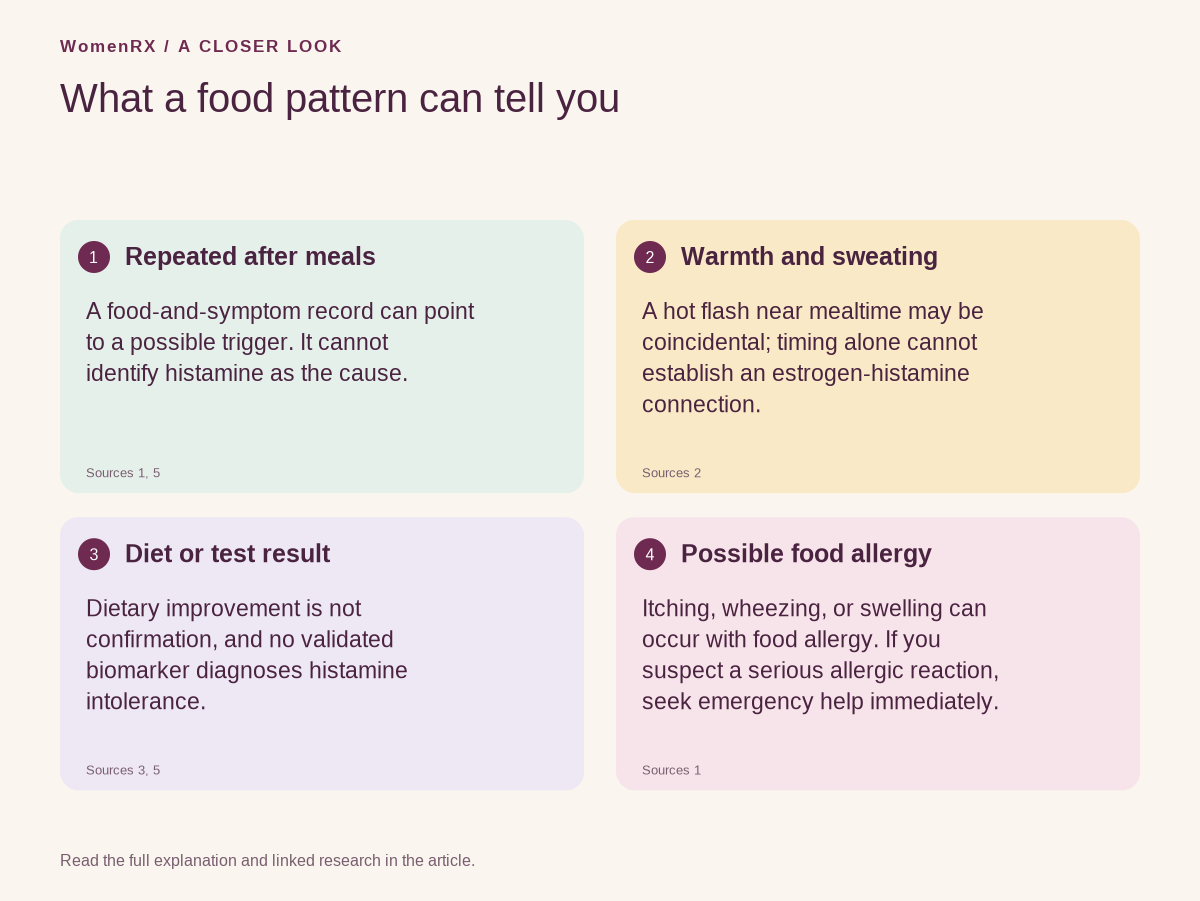
What a food pattern can tell you
Repeated after meals: A food-and-symptom record can point to a possible trigger. It cannot identify histamine as the cause.15
Warmth and sweating: A hot flash near mealtime may be coincidental; timing alone cannot establish an estrogen-histamine connection.2
Diet or test result: Dietary improvement is not confirmation, and no validated biomarker diagnoses histamine intolerance.35
Possible food allergy: Itching, wheezing, or swelling can occur with food allergy. If you suspect a serious allergic reaction, seek emergency help immediately.1
Read the figure as text
A recurring symptom is useful information, but different observations answer different questions.- Repeated after meals: A food-and-symptom record can point to a possible trigger. It cannot identify histamine as the cause.15
- Warmth and sweating: A hot flash near mealtime may be coincidental; timing alone cannot establish an estrogen-histamine connection.2
- Diet or test result: Dietary improvement is not confirmation, and no validated biomarker diagnoses histamine intolerance.35
- Possible food allergy: Itching, wheezing, or swelling can occur with food allergy. If you suspect a serious allergic reaction, seek emergency help immediately.1
Sources you can check
- Food intolerance - NHSAccessed 2026-09-25Return to first citation
- CLIMARA PRO (ESTRADIOL AND LEVONORGESTREL) PATCH [BAYER HEALTHCARE PHARMACEUTICALS INC.] | US prescribing information and patient instructionsAccessed 2026-09-25Return to first citation
- Placebo-Controlled Histamine Challenge Disproves Suspicion of Histamine Intolerance.Bent RK, Kugler C, Faihs V, Darsow U, Biedermann T, Brockow K. · The journal of allergy and clinical immunology. In practice · 2023Return to first citation
- Histamine Intolerance: Symptoms, Diagnosis, and Beyond.Jochum C. · Nutrients · 2024Return to first citation
- Evidence for Dietary Management of Histamine Intolerance.Jackson K, Busse W, Gálvez-Martín P, Terradillos A, Martínez-Puig D. · International journal of molecular sciences · 2025Return to first citation
- Histamine intolerance.Hakl R, Litzman J. · Vnitrni lekarstvi · 2023Return to first citation