Histamine Intolerance, Menopause, and the Supplement Question
DAO has a plausible role in breaking down food histamine, but the small human study can’t show whether it helps during menopause.
Histamine intolerance is a possible explanation for recurring food-related symptoms, not a diagnosis you can make from flushing alone. Diamine oxidase (DAO) helps break down histamine in the gut, but a small, uncontrolled supplement study can’t establish that DAO works or whether its effects differ during menopause. Start by distinguishing food-linked reactions from hot flashes before buying supplements or cutting out foods. 1 5 6
First, separate a food reaction from a hot flash
If you flush after dinner, it’s reasonable to wonder whether the meal played a part. But timing alone won’t identify the cause. Food-intolerance symptoms can appear hours after eating, and histamine is one of several food components that may be involved. The same guidance also lists lactose, caffeine, and other ingredients as possible causes of intolerance symptoms. Meanwhile, hot flashes can occur as part of menopause without a food reaction. 1 3
That distinction changes what to do next. For example, flushing that repeatedly follows the same food raises a different question from heat and sweating that also happen when you haven’t recently eaten. You could note the food, when you ate it, when symptoms began, and whether the pattern repeats. Those notes describe what happened; they do not diagnose histamine intolerance.
Don’t dismiss signs of an allergic reaction as an intolerance. Wheezing and swelling of the lips or face can be allergy symptoms. If your throat feels tight or you’re struggling to swallow, seek emergency care. 1
What “histamine intolerance” means, and what remains uncertain
Histamine can be present in foods and drinks, including wine and cheese. DAO is an enzyme involved in breaking down histamine in the gut. The proposed idea behind histamine intolerance is that histamine from food causes symptoms when it isn’t broken down sufficiently. That mechanism is plausible, but it doesn’t mean every digestive symptom, headache, or episode of flushing is caused by histamine. Diagnostic methods are not standardized, and identifying the condition remains difficult. 1 5 6
A low DAO blood result isn’t a stand-alone answer. In one DAO supplement study, researchers selected people using low serum DAO values alongside recurring symptoms and a history of improvement on a histamine-reduced diet. That describes how participants were chosen, not a validated test that can settle the question for anyone with symptoms. 5 6
DAO supplements: an interesting result, not a clear recommendation
In an open-label pilot study, 28 people who had been identified as having histamine intolerance took DAO capsules for four weeks, then stopped for four weeks. Their reported symptom scores fell while they took DAO and rose again afterward. Participants knew when they were taking the supplement, there was no placebo group, and they continued a histamine-reduced diet throughout the study. Those limits make it hard to tell how much of the change was due to DAO. 6
The group included 21 women and 7 men, ages 19 to 72. These findings cannot establish whether DAO works differently during perimenopause or postmenopause, or whether changing estrogen levels affect food-related histamine symptoms. A later review discusses DAO trials but also identifies unresolved problems with diagnosis and supplement efficacy. 5 6
There’s a separate question between whether DAO could help and whether a particular capsule has useful activity. In a laboratory experiment, one commercial product made with pig kidney extract showed no measurable DAO activity under the study’s test conditions. That finding does not describe every product or prove what happens after someone takes one. It does show why a promising enzyme mechanism is not the same thing as evidence for any bottle on a shelf. 7
What about vitamin C or quercetin?
Vitamin C has established roles in the body, including immune function. That fact does not tell us whether taking it reduces food-linked flushing or digestive symptoms. The small human study described above tested DAO, not vitamin C or quercetin, so its results cannot answer whether either of those supplements helps. 2 6
If the symptom you want to treat is a menopause hot flash, there’s more directly relevant guidance. The North American Menopause Society’s 2023 review does not recommend supplements or herbal remedies for menopause-related hot flashes and night sweats. It identifies other evidence-supported nonhormonal options, including cognitive behavioral therapy, clinical hypnosis, and certain prescription medicines. Hormone therapy remains the most effective treatment for vasomotor symptoms, with its suitability depending on individual circumstances. This hot-flash guidance does not resolve whether a particular meal causes a food reaction. 3 4
Make food changes narrow and reversible
A long list of prohibited foods can feel decisive, but it may leave you with fewer foods without making the cause any clearer. For a suspected food intolerance, one assessment approach is to avoid a specific suspected food for a limited period and then reintroduce it to see whether symptoms return. Get guidance from a clinician or dietitian before cutting foods out, especially if several foods seem to be involved; unnecessary restrictions can be harmful. Home intolerance tests are not recommended because their accuracy is uncertain and they may prompt broad food avoidance. 1
The useful question is not simply, “Which histamine supplement should I take?” It’s whether your symptoms consistently follow food, occur independently as hot flashes, or include signs that need a different kind of assessment. That answer gives you a better basis for deciding what, if anything, to change.
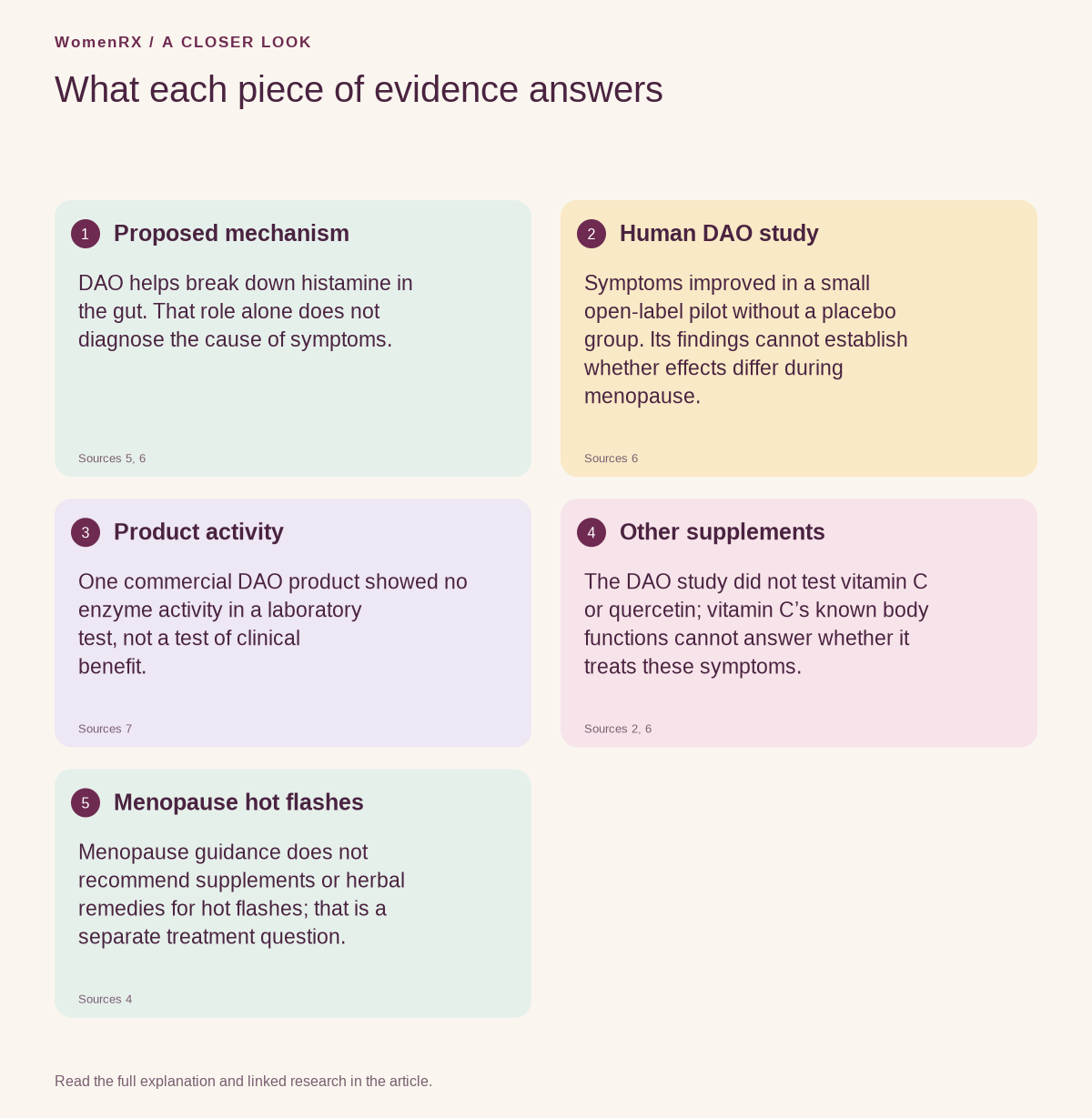
What each piece of evidence answers
Proposed mechanism: DAO helps break down histamine in the gut. That role alone does not diagnose the cause of symptoms.56
Human DAO study: Symptoms improved in a small open-label pilot without a placebo group. Its findings cannot establish whether effects differ during menopause.6
Product activity: One commercial DAO product showed no enzyme activity in a laboratory test, not a test of clinical benefit.7
Other supplements: The DAO study did not test vitamin C or quercetin; vitamin C’s known body functions cannot answer whether it treats these symptoms.26
Menopause hot flashes: Menopause guidance does not recommend supplements or herbal remedies for hot flashes; that is a separate treatment question.4
Read the figure as text
The proposed mechanism, a symptom study, and a product test address different questions.- Proposed mechanism: DAO helps break down histamine in the gut. That role alone does not diagnose the cause of symptoms.56
- Human DAO study: Symptoms improved in a small open-label pilot without a placebo group. Its findings cannot establish whether effects differ during menopause.6
- Product activity: One commercial DAO product showed no enzyme activity in a laboratory test, not a test of clinical benefit.7
- Other supplements: The DAO study did not test vitamin C or quercetin; vitamin C’s known body functions cannot answer whether it treats these symptoms.26
- Menopause hot flashes: Menopause guidance does not recommend supplements or herbal remedies for hot flashes; that is a separate treatment question.4
More questions, answered
Does a low DAO blood test confirm histamine intolerance?
No single DAO result settles the question. Diagnostic methods are not standardized, and the study that used low serum DAO values also selected participants using their symptoms and response to a histamine-reduced diet. 5 6
Sources you can check
- Food intolerance - NHSAccessed 2026-09-25Return to first citation
- Vitamin C - Health Professional Fact SheetAccessed 2026-09-25Return to first citation
- The 2022 hormone therapy position statement of The North American Menopause Society.“The 2022 Hormone Therapy Position Statement of The North American Menopause Society” Advisory Panel. · Menopause (New York, N.Y.) · 2022Return to first citation
- The 2023 nonhormone therapy position statement of The North American Menopause Society.Menopause (New York, N.Y.) · 2023Return to first citation
- Diamine oxidase deficiency implications for health, current management, and future directions in the treatment of histamine intolerance: A review.Alemany-Fornés M, Bori J, Muguerza B, Suárez M. · International journal of biological macromolecules · 2025Return to first citation
- Diamine oxidase supplementation improves symptoms in patients with histamine intolerance.Schnedl WJ, Schenk M, Lackner S, Enko D, Mangge H, Forster F. · Food science and biotechnology · 2019Return to first citation
- Evaluation of porcine diamine oxidase for the conversion of histamine in food-relevant amounts.Kettner L, Seitl I, Fischer L. · Journal of food science · 2020Return to first citation