Histamine Intolerance and Perimenopause: Sorting Out the Symptoms
Flushing, itching, and stomach symptoms can overlap, but their timing and accompanying signs matter more than the label “histamine intolerance.”
Perimenopausal flushing, food reactions, and allergy can feel similar. Menopause guidance addresses vasomotor symptoms but doesn’t establish histamine intolerance as their cause. Hormone-related findings from mouse-derived cells don’t show that hormone changes cause histamine intolerance in perimenopausal women. If symptoms repeatedly follow a food, note the timing before changing your diet. Hives, swelling, or wheezing deserve assessment as possible allergy signs; breathing or throat symptoms need emergency care. 1 3 5 6 7
A flush after dinner can raise two questions at once: Was it the meal, or is it perimenopause? If you also itch or feel sick to your stomach, “histamine intolerance” may seem to tie everything together. It’s a possibility to assess, not a diagnosis you can make from a symptom list.
Start with what happens alongside the flush
Menopause guidance addresses vasomotor symptoms, but it does not establish histamine intolerance as their cause. If flushing happens at different times, including when you haven’t eaten, that’s useful context. 6 7
A reaction that repeatedly follows a particular food raises a different question. Histamine is present in foods and drinks such as cheese and wine, and it is listed among possible food-intolerance triggers. Food-intolerance symptoms usually occur a few hours after eating, according to NHS guidance. Timing is a clue, though, not proof that histamine was responsible: foods and drinks contain more than one ingredient, and symptoms can have other causes. 1
Allergy deserves separate attention. It can involve itchy skin, wheezing, or swelling of the lips, face, or eyes. Don’t assume those signs are a harmless intolerance or a hot flash, even if they happen during perimenopause. If you develop trouble breathing, throat tightness, difficulty swallowing, or sudden severe dizziness or confusion, seek emergency care immediately. 1 3
Where the hormone theory stands
There is a reason researchers ask whether hormones might affect histamine-related reactions. In a laboratory study, estradiol increased histamine release from mast cells derived from female mice. That finding does not show that hormone fluctuations cause food-related symptoms in perimenopausal women. A laboratory mechanism cannot tell you whether your own flushing is a hot flash, an allergy, or a food reaction. 5
That distinction can spare you an unnecessarily restrictive diet while leaving room to investigate symptoms that genuinely recur.
Make the pattern useful without cutting out foods
For a few episodes, jot down what happened in ordinary terms: what you ate or drank, when symptoms started, whether you had flushing alone or also hives, swelling, wheezing, or digestive symptoms, and whether a similar episode happened without that food. If periods are changing, noting where you are in your cycle may add context. For example, a flush that occurs after many different meals and at other times points to a different question than itching that repeatedly follows the same food. Neither pattern diagnoses its cause.
If reactions keep coming back, bring that record to a clinician rather than removing whole groups of foods on your own. A supervised elimination followed by reintroduction is one possible way to assess a suspected food intolerance. Some home intolerance tests have limited evidence of accuracy and may lead people to avoid multiple foods unnecessarily. 1
If flushing is the main problem and food or allergy signs don’t fit, it’s worth discussing it as a possible vasomotor symptom. Evidence-based options exist for bothersome vasomotor symptoms, including hormone therapy and several nonhormone treatments. That is a more direct discussion than treating every flush as a reason to avoid histamine-containing foods. 6 7
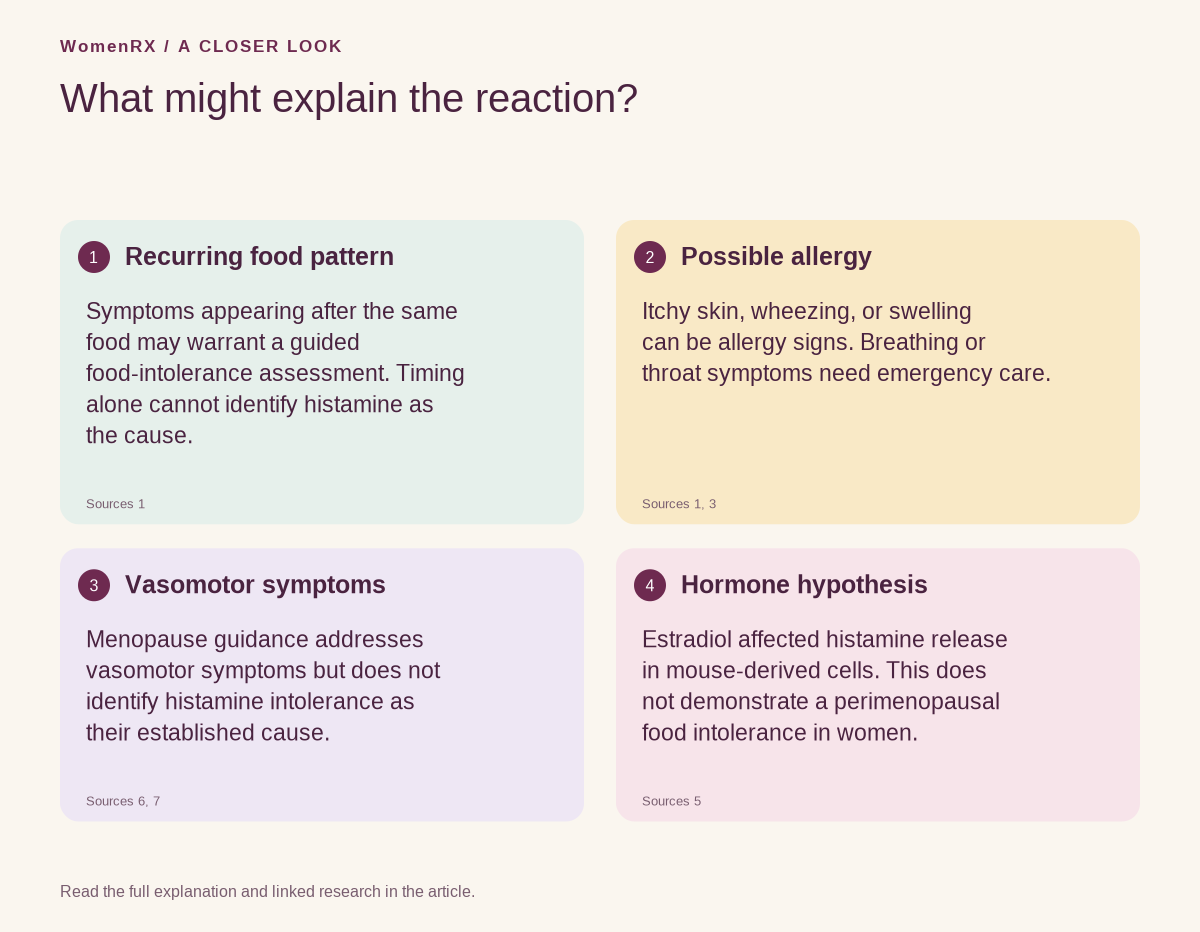
What might explain the reaction?
Recurring food pattern: Symptoms appearing after the same food may warrant a guided food-intolerance assessment. Timing alone cannot identify histamine as the cause.1
Possible allergy: Itchy skin, wheezing, or swelling can be allergy signs. Breathing or throat symptoms need emergency care.13
Vasomotor symptoms: Menopause guidance addresses vasomotor symptoms but does not identify histamine intolerance as their established cause.67
Hormone hypothesis: Estradiol affected histamine release in mouse-derived cells. This does not demonstrate a perimenopausal food intolerance in women.5
Read the figure as text
These distinctions can help you decide what to describe when seeking assessment. They do not diagnose the cause.- Recurring food pattern: Symptoms appearing after the same food may warrant a guided food-intolerance assessment. Timing alone cannot identify histamine as the cause.1
- Possible allergy: Itchy skin, wheezing, or swelling can be allergy signs. Breathing or throat symptoms need emergency care.13
- Vasomotor symptoms: Menopause guidance addresses vasomotor symptoms but does not identify histamine intolerance as their established cause.67
- Hormone hypothesis: Estradiol affected histamine release in mouse-derived cells. This does not demonstrate a perimenopausal food intolerance in women.5
More questions, answered
If an antihistamine helps, does that confirm histamine intolerance?
No. Cetirizine blocks histamine’s effects and can relieve allergy symptoms, but feeling better after taking it doesn’t identify a particular food or establish a food intolerance. Cetirizine can also cause sleepiness, despite being described as a non-drowsy antihistamine. 2 3 4
Sources you can check
- Food intolerance - NHSAccessed 2026-09-25Return to first citation
- About cetirizine - NHSAccessed 2026-09-25Return to first citation
- Side effects of cetirizine - NHSAccessed 2026-09-25Return to first citation
- Common questions about cetirizine - NHSAccessed 2026-09-25Return to first citation
- Bisphenol A at concentrations relevant to human exposure enhances histamine and cysteinyl leukotriene release from bone marrow-derived mast cells.O'Brien E, Dolinoy DC, Mancuso P. · Journal of immunotoxicology · 2014Return to first citation
- The 2022 hormone therapy position statement of The North American Menopause Society.“The 2022 Hormone Therapy Position Statement of The North American Menopause Society” Advisory Panel. · Menopause (New York, N.Y.) · 2022Return to first citation
- The 2023 nonhormone therapy position statement of The North American Menopause Society.Menopause (New York, N.Y.) · 2023Return to first citation