Histamine Intolerance and Perimenopause: What Does the Evidence Show?
Hormonal changes and histamine have been studied in a few different ways, but that doesn’t establish perimenopause as a cause of food-related histamine intolerance.
If you’re noticing symptoms during perimenopause, that timing alone can’t show that hormones caused them or confirm histamine intolerance. A human airway-cell experiment found that estradiol changed cells’ response to histamine, but it didn’t study perimenopause, food reactions, or histamine breakdown. Histamine intolerance also lacks standardized diagnostic methods, and its symptoms overlap with other conditions. 124
What the hormone finding does, and doesn’t, tell us
One human laboratory study examined airway smooth-muscle tissue and cells. Acute exposure to estradiol changed the cells’ calcium response to histamine. That finding concerns how airway cells respond to histamine; it didn’t examine people with perimenopause, food-related symptoms, or the enzymes that break down histamine. It can’t establish that hormonal fluctuations cause a person to react to histamine in foods. 4
If symptoms begin or change around perimenopause, the timing is worth describing, but it doesn’t identify the cause. The more useful question is what pattern the symptoms follow and whether another explanation fits better.
The label is less settled than it sounds
“Histamine intolerance” is used for a range of symptoms attributed to difficulty breaking down histamine, often involving the enzyme diamine oxidase (DAO). Reviews describe a lack of standardized diagnostic methods. One also notes limitations in serum DAO measurement, and evaluation of suspected cases needs to consider other conditions that can cause similar symptoms. 12
Symptoms often attributed to histamine intolerance, including digestive complaints, itching, and headaches, aren’t specific to it. They can overlap with allergic conditions and functional gastrointestinal disorders. A recurring symptom after a particular food may be useful information, but a broad collection of symptoms or a single test result doesn’t settle the diagnosis. 2
There’s also a question of reproducibility. A 2025 clinical review reports that double-blind, placebo-controlled oral histamine challenges haven’t confirmed consistent, repeatable reactions; symptoms have also occurred after placebo. That makes it harder to tell whether histamine itself explains a person’s symptoms. It doesn’t mean the symptoms aren’t real. It means the label shouldn’t be assumed from symptoms alone. 3
How to approach food without shrinking your diet unnecessarily
It can be tempting to cut out a long list of foods when symptoms are uncomfortable. But severe restriction can affect food choice, quality of life, and social life. A review on suspected histamine intolerance recommends focusing on easing symptoms and expanding food choices, with support from a dietitian or nutritionist experienced in allergy-related concerns. 3
If food seems to be involved, start with a specific question: do the same symptoms reliably follow the same food or type of food, or is the connection less consistent? Histamine levels in food can vary with processing and storage, and individual tolerance can vary too. That makes a simple online avoid-list a poor substitute for careful assessment. 2
You could ask whether a limited, planned dietary trial makes sense for your situation, what change would count as meaningful, and how you’ll avoid unnecessary long-term exclusions. Improvement during a diet change may be useful to discuss, but it doesn’t by itself prove a particular mechanism, especially when symptoms vary and challenge tests can produce symptoms after placebo. 23
Questions that focus the conversation
You might ask:
- What conditions besides histamine intolerance could explain these symptoms, including allergy-related or digestive causes?
- Do my symptoms repeatedly follow particular foods, or could the timing be coincidental?
- How should a DAO result be interpreted, given the limitations of available testing?
- If we change my diet, how will we decide whether it helped and when to broaden my food choices again?
A 2024 paper describes a planned controlled trial of a low-histamine diet and DAO supplements, but it’s a study protocol, not a report of results. It therefore can’t establish whether either approach works. 5
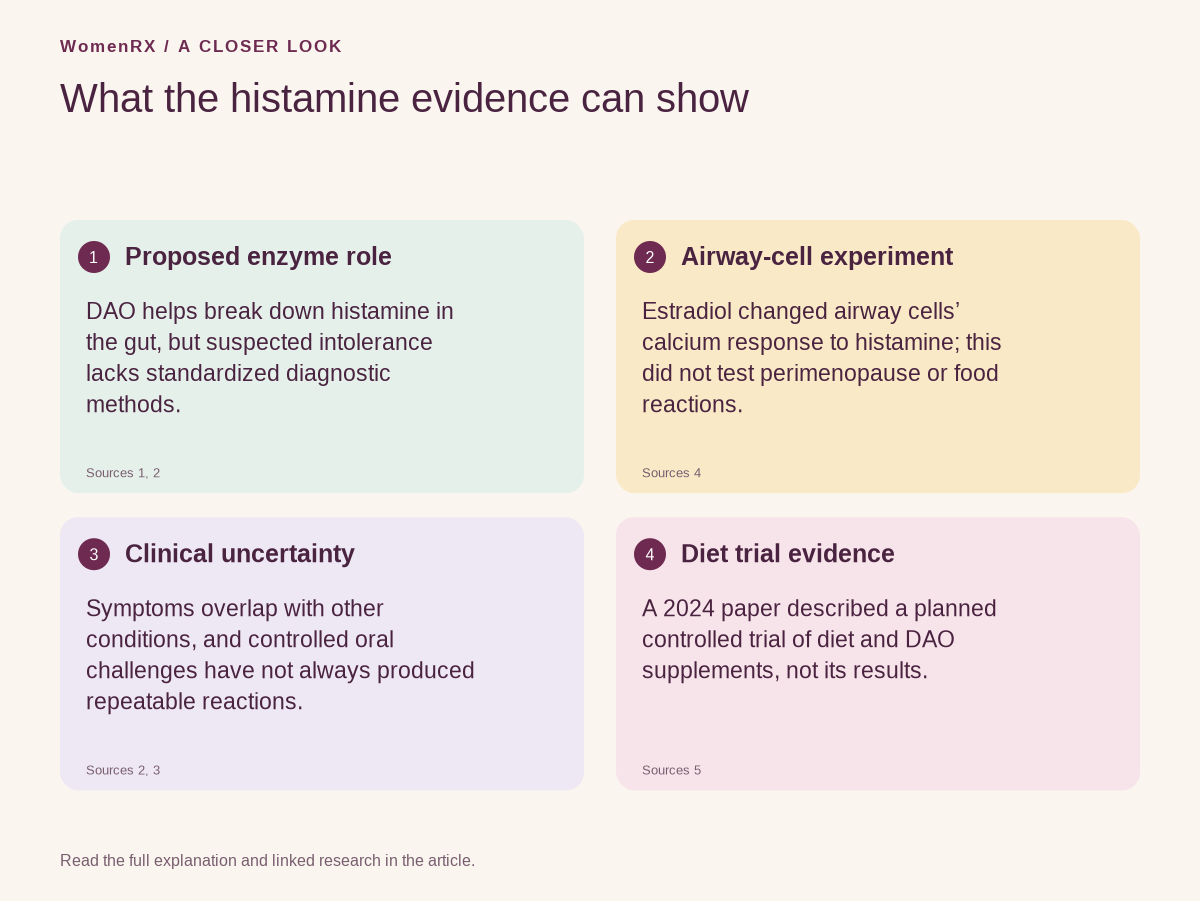
What the histamine evidence can show
Proposed enzyme role: DAO helps break down histamine in the gut, but suspected intolerance lacks standardized diagnostic methods.12
Airway-cell experiment: Estradiol changed airway cells’ calcium response to histamine; this did not test perimenopause or food reactions.4
Clinical uncertainty: Symptoms overlap with other conditions, and controlled oral challenges have not always produced repeatable reactions.23
Diet trial evidence: A 2024 paper described a planned controlled trial of diet and DAO supplements, not its results.5
Read the figure as text
Separate a proposed mechanism from clinical proof, diagnostic uncertainty, and the limits of diet evidence.- Proposed enzyme role: DAO helps break down histamine in the gut, but suspected intolerance lacks standardized diagnostic methods.12
- Airway-cell experiment: Estradiol changed airway cells’ calcium response to histamine; this did not test perimenopause or food reactions.4
- Clinical uncertainty: Symptoms overlap with other conditions, and controlled oral challenges have not always produced repeatable reactions.23
- Diet trial evidence: A 2024 paper described a planned controlled trial of diet and DAO supplements, not its results.5
More questions, answered
Can a DAO blood test confirm histamine intolerance?
Not on its own. Reviews describe limitations in serum DAO measurement and a lack of standardized diagnostic methods, so a result needs to be interpreted alongside symptoms and possible alternative explanations. 12
Does feeling better on a low-histamine diet prove the diagnosis?
Not necessarily. Symptoms attributed to histamine are nonspecific, and controlled oral challenges haven’t always produced repeatable reactions. A dietary change may be worth discussing, but improvement alone doesn’t establish why symptoms changed. 23
Sources you can check
- Diamine oxidase deficiency implications for health, current management, and future directions in the treatment of histamine intolerance: A review.Alemany-Fornés M, Bori J, Muguerza B, Suárez M. · International journal of biological macromolecules · 2025Return to first citation
- Diamine Oxidase and Gastrointestinal Diseases.Żybul P, Przybyłkowski A, Wojas O, Samoliński B. · Biomolecules · 2026Return to first citation
- [Suspected histamine intolerance-how to proceed?]Reese I. · Dermatologie (Heidelberg, Germany) · 2025Return to first citation
- Rapid effects of estrogen on intracellular Ca2+ regulation in human airway smooth muscle.Townsend EA, Thompson MA, Pabelick CM, Prakash YS. · American journal of physiology. Lung cellular and molecular physiology · 2010Return to first citation
- Study Protocol for a Prospective, Unicentric, Double-Blind, Randomized, and Placebo-Controlled Trial on the Efficacy of a Low-Histamine Diet and DAO Enzyme Supplementation in Patients with Histamine Intolerance.Duelo A, Sánchez-Pérez S, Ruiz-Leon AM, Casanovas-Garriga F, Pellicer-Roca S, Iduriaga-Platero I, Costa-Catala J, Veciana-Nogués MT, Fernández-Solà J, Muñoz-Cano RM, Bartra J, Comb... · Nutrients · 2024Return to first citation