Histamine-Like Symptoms in Your 40s: What Hormones Can Explain
Hot flashes, hives, and digestive symptoms can overlap, but being in your 40s doesn’t show that histamine or perimenopause is the cause.
Perimenopause can cause hot flashes, often felt as sudden warmth and sweating, but that doesn’t diagnose histamine intolerance. Hives and digestive symptoms are different patterns with several possible explanations. Estrogen may affect processes related to histamine, but that research hasn’t shown that perimenopause causes histamine intolerance or that hormone treatment treats it. Separating the symptoms and their timing is a more useful first step. 1 3 6
First, separate the symptoms
A wave of warmth and sweating can fit a menopausal hot flash. Menopause guidance recognizes hot flashes as a vasomotor symptom, but flushing alone doesn’t point specifically to histamine intolerance. Menstrual changes may make perimenopause relevant to the bigger picture; they don’t explain every new symptom by themselves. 1 3
Hives are a visible, itchy rash with raised bumps or patches. Histamine can be involved in hives, but the rash alone doesn’t identify its trigger or show that food is the cause. 2
Bloating, abdominal pain, fullness, diarrhea, and constipation are among the digestive symptoms reported in suspected histamine intolerance. They’re nonspecific, too. Depending on the symptoms, other possibilities can include food allergy, a skin condition, irritable bowel syndrome, or dyspepsia. The useful first question is not “Could histamine be involved?” but “What exactly is happening, and what else could explain this pattern?” 6
What the estrogen connection actually shows
There is a possible biological connection, but it’s easy to overread it. A review describes research on estrogen and mast-cell reactivity, as well as estrogen-related changes in histamine-dependent skin-prick reactions. It also reports that serum diamine oxidase (DAO) levels, an enzyme measure related to histamine breakdown, have been found to vary across the menstrual cycle, with higher levels in the luteal phase than the follicular phase. That is a finding about DAO levels, not proof that histamine levels or symptoms change in the same way. 6
These findings make hormone-related effects worth studying. They do not establish that estrogen changes cause histamine intolerance, that a symptom cluster in your 40s is hormonal, or that changing hormones will treat suspected histamine intolerance. Menopause guidance supports hormone and nonhormone treatments for menopausal symptoms such as hot flashes; it does not present them as treatments for histamine intolerance. 3 4 6
Why a food pattern or test may not settle it
Symptoms after eating can be a clue to discuss, but they don’t confirm histamine intolerance on their own. In a single-blind, placebo-controlled challenge study of 59 people with suspected histamine intolerance, 37 reported symptoms after placebo. The researchers excluded histamine intolerance in 50 of the 59. Four people had objective symptoms after histamine but not placebo, which the authors called “plausible” rather than definitive cases. This small study doesn’t prove the condition never occurs; it shows why placebo responses complicate assessment. 5
A DAO blood result doesn’t settle the question either. In that study, DAO levels varied among people without the diagnosis, limiting the test’s usefulness. A review likewise reports that there isn’t a clinically validated biomarker for histamine sensitivity and describes limitations in serum DAO testing. Treat a test result as one piece of information, not a stand-alone explanation for symptoms. 5 6
Make the pattern more useful
For a short record, separate episodes by what you notice: sudden heat and sweating, a visible raised itchy rash, or digestive symptoms. Note when symptoms begin, how long they last, what you ate and when, any medication or lifestyle changes, and menstrual timing. The point isn’t to prove a diagnosis at home. It’s to avoid combining several different experiences into one label and to make the pattern clearer for an evaluation. 6
The next evaluation can follow the symptom that is most persistent or disruptive. Recurrent hives or itching may call for assessment focused on skin or allergy causes; ongoing digestive symptoms may need a gastrointestinal evaluation. If hot flashes are the main concern, ask about menopause-specific options separately. Those are distinct questions, even when they occur at the same time. 3 4 6
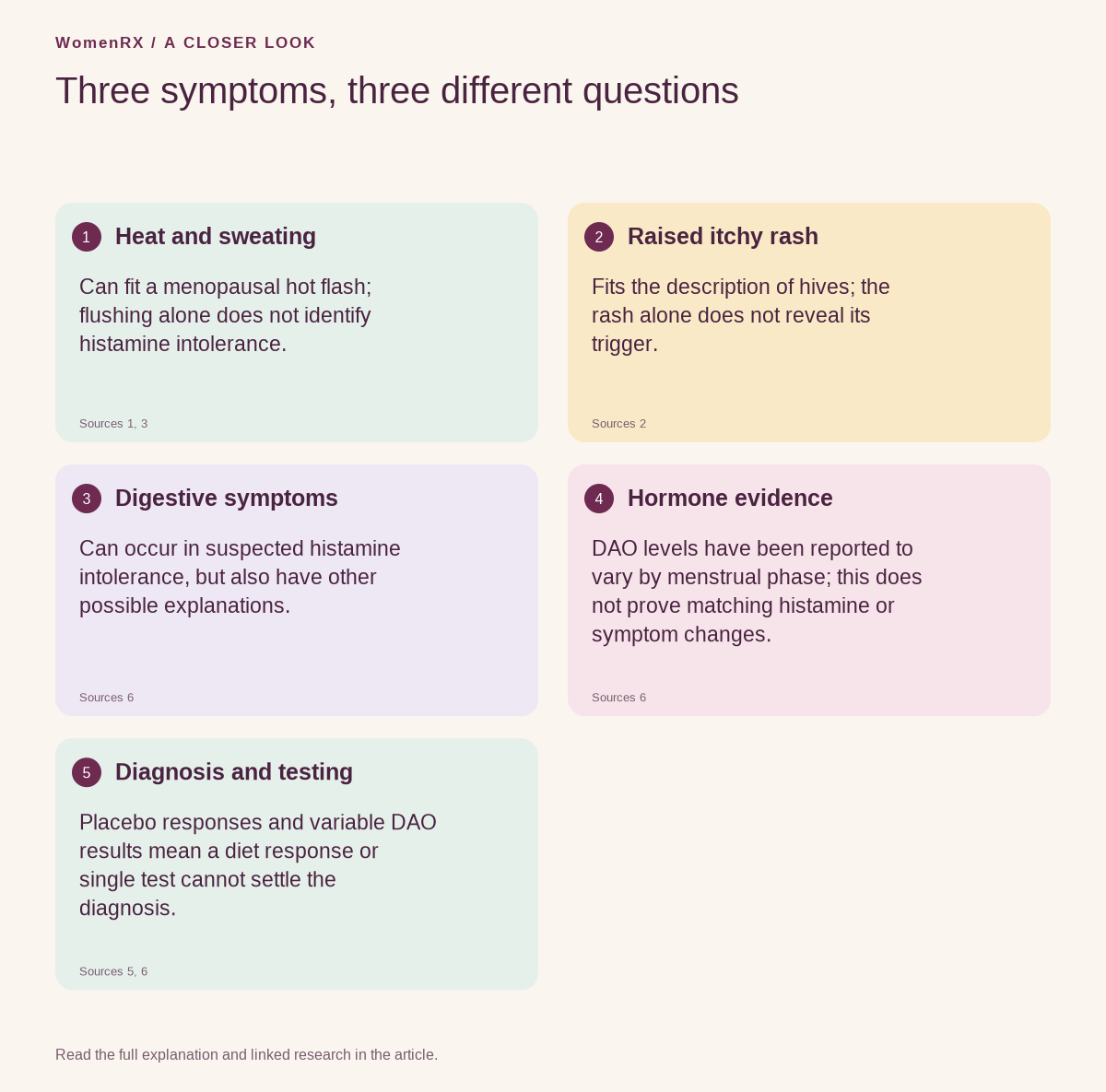
Three symptoms, three different questions
Heat and sweating: Can fit a menopausal hot flash; flushing alone does not identify histamine intolerance.13
Raised itchy rash: Fits the description of hives; the rash alone does not reveal its trigger.2
Digestive symptoms: Can occur in suspected histamine intolerance, but also have other possible explanations.6
Hormone evidence: DAO levels have been reported to vary by menstrual phase; this does not prove matching histamine or symptom changes.6
Diagnosis and testing: Placebo responses and variable DAO results mean a diet response or single test cannot settle the diagnosis.56
Read the figure as text
Compare each symptom pattern with what it can suggest and what it cannot establish.- Heat and sweating: Can fit a menopausal hot flash; flushing alone does not identify histamine intolerance.13
- Raised itchy rash: Fits the description of hives; the rash alone does not reveal its trigger.2
- Digestive symptoms: Can occur in suspected histamine intolerance, but also have other possible explanations.6
- Hormone evidence: DAO levels have been reported to vary by menstrual phase; this does not prove matching histamine or symptom changes.6
- Diagnosis and testing: Placebo responses and variable DAO results mean a diet response or single test cannot settle the diagnosis.56
More questions, answered
Does feeling better on a low-histamine diet prove histamine intolerance?
No. In a placebo-controlled study of people with suspected histamine intolerance, diet response did not reliably distinguish those with and without the diagnosis. A food pattern can be useful to describe, but improvement on a diet isn’t confirmation by itself. 5
Does DAO change during the menstrual cycle?
A review reports that serum DAO levels have been found to be higher in the luteal phase than in the follicular phase. That is a finding about DAO, not direct evidence that histamine levels or symptoms follow the same pattern, or that cycle changes diagnose histamine intolerance. 6
Sources you can check
- CLIMARA PRO (ESTRADIOL AND LEVONORGESTREL) PATCH [BAYER HEALTHCARE PHARMACEUTICALS INC.] | US prescribing information and patient instructionsAccessed 2026-09-25Return to first citation
- Hives - NHSAccessed 2026-09-25Return to first citation
- The 2022 hormone therapy position statement of The North American Menopause Society.“The 2022 Hormone Therapy Position Statement of The North American Menopause Society” Advisory Panel. · Menopause (New York, N.Y.) · 2022Return to first citation
- The 2023 nonhormone therapy position statement of The North American Menopause Society.Menopause (New York, N.Y.) · 2023Return to first citation
- Placebo-Controlled Histamine Challenge Disproves Suspicion of Histamine Intolerance.Bent RK, Kugler C, Faihs V, Darsow U, Biedermann T, Brockow K. · The journal of allergy and clinical immunology. In practice · 2023Return to first citation
- Evidence for Dietary Management of Histamine Intolerance.Jackson K, Busse W, Gálvez-Martín P, Terradillos A, Martínez-Puig D. · International journal of molecular sciences · 2025Return to first citation