Flushing, Itching, or Digestive Symptoms: Is It Histamine?
A hot flash, an itchy rash, and stomach trouble may happen around the same time without having the same cause.
Histamine intolerance is one possible explanation for flushing, itching, and digestive symptoms, but those symptoms can also occur with menopause or other conditions. Menopause doesn’t establish a histamine cause, and neither a low-histamine diet response nor a DAO test can confirm the diagnosis on its own. The useful next step is to describe which symptoms occur together and whether suspected food reactions repeat. 1 3 5
Separate the symptoms before giving them one name
If you’re getting hot flashes and stomach trouble, it’s understandable to look for one explanation. But symptoms that arrive during the same stage of life don’t necessarily share a cause.
Hot flashes are a recognized menopause-related vasomotor symptom. Itching, a visible rash or swelling, and digestive symptoms deserve their own consideration. They’re among symptoms described by people who suspect histamine intolerance, but they can also overlap with food allergy, other food intolerances, irritable bowel symptoms, and skin conditions. None of these symptoms identifies histamine intolerance by itself. 1 3
That distinction helps you ask a better question. For example, is the flushing a sudden heat episode that also happens away from meals? Does the itching come with a visible rash? Do abdominal symptoms repeatedly follow a particular food, or do they occur across many different meals? These details can help sort through possibilities without assuming every symptom has one cause. A change around menstrual cycles or menopause is worth mentioning, but timing alone can’t show that hormonal changes caused a reaction to histamine.
Why a food pattern is a clue, not a verdict
A repeatable connection with meals is more informative than a reaction you remember from one dinner. Even a convincing pattern needs careful interpretation, though: the food, the rest of the meal, and other possible conditions may matter. A review of suspected histamine intolerance describes substantial symptom overlap with food allergy, other intolerances, and digestive conditions. 1
In a single-blind, placebo-controlled study of 59 people assessed for suspected histamine intolerance, 37 reported symptoms after placebo. The researchers excluded histamine intolerance in 50 participants. Four had objective symptoms after histamine but not placebo and were classified as having plausible histamine intolerance, with chance reactions still possible. Most participants were middle-aged women, but the study didn’t establish a menopause-specific cause or diagnostic approach. 5
This doesn’t mean your symptoms aren’t real. It means that feeling better after avoiding certain foods, or feeling worse after one suspected trigger, doesn’t by itself tell you why.
Be cautious with tests and broad food restrictions
Diamine oxidase, or DAO, is an enzyme involved in breaking down dietary histamine. A DAO blood result may sound like a straightforward answer, but DAO activity varied widely among people in the challenge study who did not have histamine intolerance. The researchers concluded that DAO levels and digestive symptoms after food weren’t specific enough to make the diagnosis. 1 5
Cutting out a long list of foods can make eating and social life harder without settling the question. A clinical review of suspected histamine intolerance cautions that extensive self-imposed restriction can affect quality of life and emphasizes improving symptoms while preserving food choice. If you’ve already excluded many foods, that’s useful to bring up alongside what changed, what didn’t, and which foods you miss. 2
Match the next conversation to your main symptom
If sudden heat episodes are what bother you most, ask whether menopause-related hot flashes fit the pattern. There are evidence-based treatment options for bothersome vasomotor symptoms, including hormone therapy and several nonhormone approaches; the right choice depends on your circumstances and preferences. 3 4
If itching, rash, swelling, or meal-related digestive symptoms are more prominent, describe those specifically rather than leading with a self-diagnosis. Ask what other explanations fit, and what a proposed test could actually clarify. You don’t have to dismiss a possible food connection. You can investigate it without treating a symptom list, a diet response, or one lab result as proof of histamine intolerance. 1 2 5
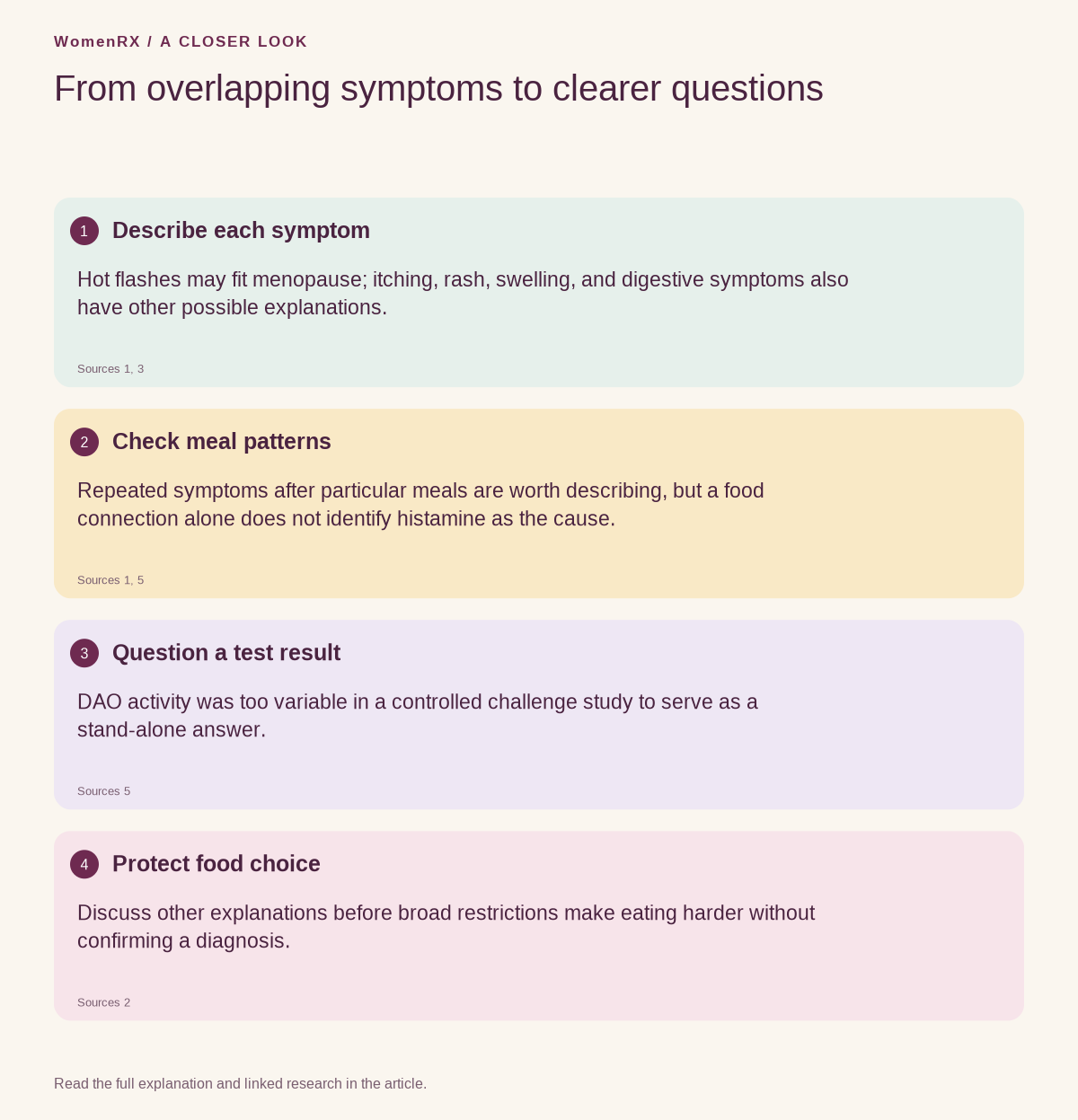
From overlapping symptoms to clearer questions
Describe each symptom: Hot flashes may fit menopause; itching, rash, swelling, and digestive symptoms also have other possible explanations.13
Check meal patterns: Repeated symptoms after particular meals are worth describing, but a food connection alone does not identify histamine as the cause.15
Question a test result: DAO activity was too variable in a controlled challenge study to serve as a stand-alone answer.5
Protect food choice: Discuss other explanations before broad restrictions make eating harder without confirming a diagnosis.2
Read the figure as text
This flow separates useful clues from conclusions that symptoms or tests cannot establish alone.- Describe each symptom: Hot flashes may fit menopause; itching, rash, swelling, and digestive symptoms also have other possible explanations.13
- Check meal patterns: Repeated symptoms after particular meals are worth describing, but a food connection alone does not identify histamine as the cause.15
- Question a test result: DAO activity was too variable in a controlled challenge study to serve as a stand-alone answer.5
- Protect food choice: Discuss other explanations before broad restrictions make eating harder without confirming a diagnosis.2
More questions, answered
Does feeling better on a low-histamine diet confirm histamine intolerance?
No. In a controlled challenge study, many participants reported some improvement on a histamine-low diet, yet histamine intolerance was excluded in most of them. Improvement is worth discussing, but it doesn’t establish the cause. 5
Can a DAO blood test settle the question?
Not on its own. DAO activity varied among people without histamine intolerance in a controlled challenge study, limiting its value as a stand-alone diagnostic test. 5
Sources you can check
- Histamine Intolerance-A Kind of Pseudoallergic Reaction.Zhao Y, Zhang X, Jin H, Chen L, Ji J, Zhang Z. · Biomolecules · 2022Return to first citation
- [Suspected histamine intolerance-how to proceed?]Reese I. · Dermatologie (Heidelberg, Germany) · 2025Return to first citation
- The 2022 hormone therapy position statement of The North American Menopause Society.“The 2022 Hormone Therapy Position Statement of The North American Menopause Society” Advisory Panel. · Menopause (New York, N.Y.) · 2022Return to first citation
- The 2023 nonhormone therapy position statement of The North American Menopause Society.Menopause (New York, N.Y.) · 2023Return to first citation
- Placebo-Controlled Histamine Challenge Disproves Suspicion of Histamine Intolerance.Bent RK, Kugler C, Faihs V, Darsow U, Biedermann T, Brockow K. · The journal of allergy and clinical immunology. In practice · 2023Return to first citation