Histamine Intolerance and Hormones: What the Evidence Shows
Hormones may influence histamine-related biology, but that doesn’t prove hormonal changes cause histamine intolerance symptoms.
There’s a plausible biological link between hormones and histamine, but the clinical evidence doesn’t establish that menstrual-cycle changes or menopause cause histamine intolerance. Symptoms such as flushing, itching, and digestive upset have many possible explanations. Histamine intolerance itself also lacks a validated diagnostic test, and a placebo-controlled study ruled it out for most people referred with suspected intolerance. 1 2
A plausible mechanism isn’t the same as a proven cause
Histamine is involved in several body processes, including allergic reactions. Diamine oxidase (DAO) helps break down histamine in the gut. Researchers have proposed that changes in DAO activity or histamine release could contribute to symptoms after eating certain foods. 2
Hormones might affect parts of this system. A review of histamine intolerance research reports that DAO levels have been observed to vary across the menstrual cycle, and that estrogen-related effects on DAO and mast-cell activity have been described. Some of those findings come from animal models or biological measures, such as skin-prick responses, rather than studies showing that women reliably develop histamine-related symptoms at particular points in their cycle. 2
That distinction matters. A mechanism can make a connection worth studying, but it doesn’t show that hormone changes cause flushing, itching, or digestive symptoms in everyday life. The clinical evidence described in these studies does not establish a hormone-driven form of histamine intolerance, or show how often symptoms change during menstrual stages, perimenopause, or menopause. 2
The diagnosis is still difficult to pin down
“Histamine intolerance” is used to describe a possible problem handling histamine from food. But its symptoms are broad and can include digestive discomfort, flushing, itching, headache, or nasal symptoms. Those symptoms can also occur for other reasons, so noticing a pattern after meals doesn’t by itself confirm the diagnosis. 2 4
A 2023 placebo-controlled challenge study tested 59 people referred for suspected histamine intolerance; 84.7% were women. Symptoms occurred after placebo in 37 participants. The researchers excluded histamine intolerance in 50 people (84.7%). Only four had objective symptoms after histamine but not placebo, and the researchers called those cases “plausible,” since chance reactions could not be ruled out. The study was small, but it shows why symptom reports and food responses need careful interpretation. 1
DAO blood tests don’t settle the question either. In a population-based study of 1,051 adults, DAO levels below a suggested cutoff were common, but levels weren’t associated with reported symptoms after histamine-rich foods. The researchers concluded that the cutoffs they examined may not be useful for diagnosing intolerance. 5
Similar symptoms can point to different conditions
A suspected food reaction is not automatically histamine intolerance. Allergy, gastrointestinal conditions, and skin conditions can have overlapping symptoms, and mast-cell disorders are a separate diagnostic consideration. A review recommends assessing possible alternatives according to the symptoms involved, including allergy or immune assessment, gastrointestinal evaluation, or dermatologic assessment when appropriate. 2
This doesn’t mean every episode needs an extensive workup. It means that a wide-ranging symptom list shouldn’t be treated as proof of one broad food intolerance, especially when the diagnosis has no validated biomarker. 1 2
A useful way to check whether there’s a pattern
If symptoms seem to follow your cycle or changes associated with menopause, look for a repeatable pattern rather than assuming hormones are the cause. For example, you might note whether symptoms happen after a particular food, whether they recur at a similar point in the cycle, and whether they also happen when that food is absent. This kind of observation can help clarify what to discuss, but it cannot diagnose histamine intolerance on its own. Symptoms, food timing, menstrual timing, and other possible triggers are among the details a clinical review may consider. 2
Be cautious about starting a long list of food restrictions based only on an online symptom checklist or an unvalidated test. A review of dietary management describes diagnosis as difficult and the clinical evidence for dietary approaches as limited. If you try a change in eating, getting individualized guidance can help avoid turning an uncertain theory into an unnecessarily restrictive diet. 2
The fairest summary is that hormones could influence histamine-related processes, but a hormone-linked histamine intolerance diagnosis isn’t established by the clinical evidence described here. A recurring timing pattern may be worth noticing; it is not, by itself, an explanation for the symptoms.
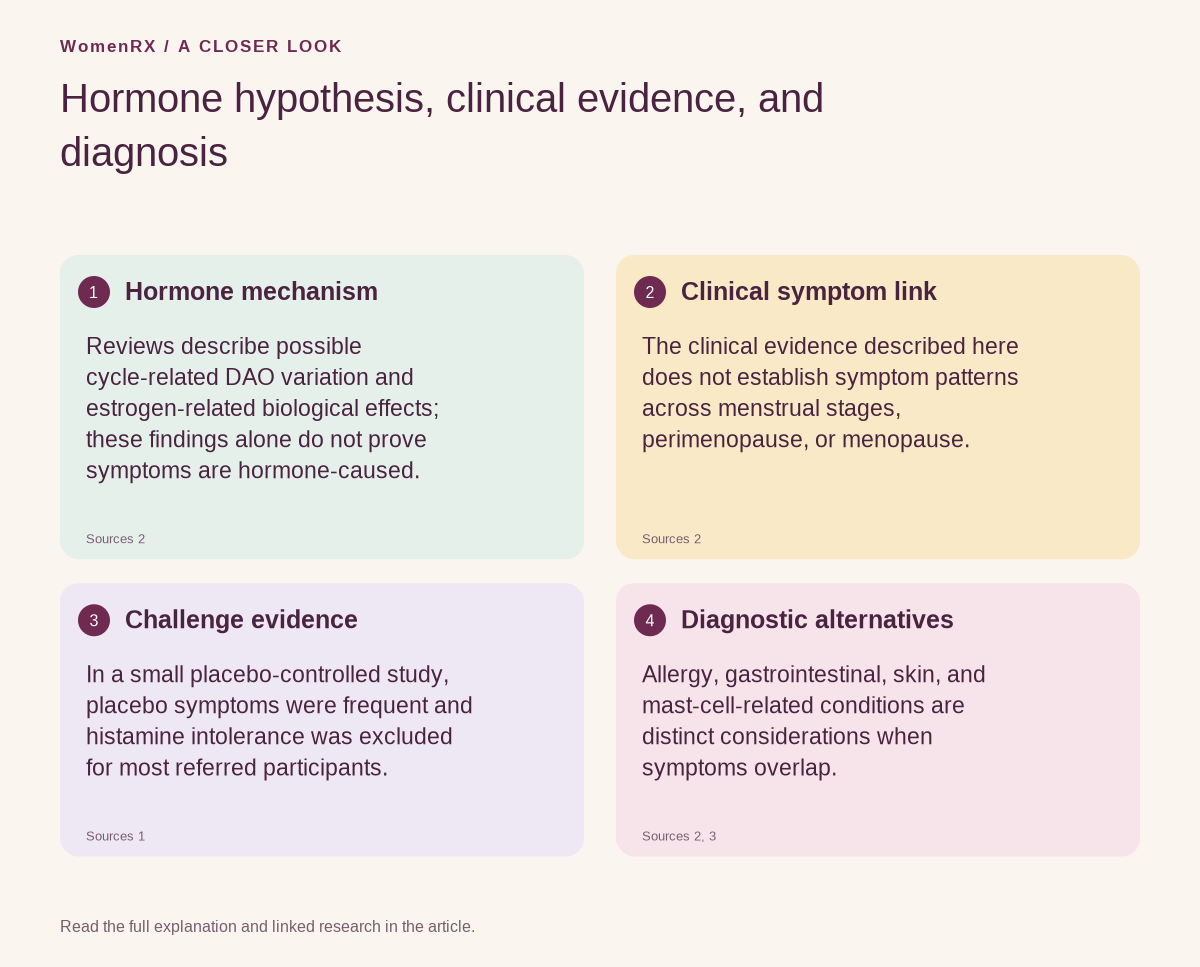
Hormone hypothesis, clinical evidence, and diagnosis
Hormone mechanism: Reviews describe possible cycle-related DAO variation and estrogen-related biological effects; these findings alone do not prove symptoms are hormone-caused.2
Clinical symptom link: The clinical evidence described here does not establish symptom patterns across menstrual stages, perimenopause, or menopause.2
Challenge evidence: In a small placebo-controlled study, placebo symptoms were frequent and histamine intolerance was excluded for most referred participants.1
Diagnostic alternatives: Allergy, gastrointestinal, skin, and mast-cell-related conditions are distinct considerations when symptoms overlap.23
Read the figure as text
These three questions help separate a biologically plausible connection from evidence that establishes a diagnosis.- Hormone mechanism: Reviews describe possible cycle-related DAO variation and estrogen-related biological effects; these findings alone do not prove symptoms are hormone-caused.2
- Clinical symptom link: The clinical evidence described here does not establish symptom patterns across menstrual stages, perimenopause, or menopause.2
- Challenge evidence: In a small placebo-controlled study, placebo symptoms were frequent and histamine intolerance was excluded for most referred participants.1
- Diagnostic alternatives: Allergy, gastrointestinal, skin, and mast-cell-related conditions are distinct considerations when symptoms overlap.23
More questions, answered
Does a low DAO result confirm histamine intolerance?
No. DAO results vary, and a population study found no association between DAO levels and reported reactions to histamine-rich foods. A low result alone doesn’t establish the diagnosis. 5
Can histamine intolerance symptoms be confused with allergies?
Yes. Symptoms can overlap, and histamine-intolerance symptoms are nonspecific. Allergy and other conditions may need separate assessment rather than being assumed to be the same diagnosis. 2 4
Sources you can check
- Placebo-Controlled Histamine Challenge Disproves Suspicion of Histamine Intolerance.Bent RK, Kugler C, Faihs V, Darsow U, Biedermann T, Brockow K. · The journal of allergy and clinical immunology. In practice · 2023Return to first citation
- Evidence for Dietary Management of Histamine Intolerance.Jackson K, Busse W, Gálvez-Martín P, Terradillos A, Martínez-Puig D. · International journal of molecular sciences · 2025Return to first citation
- Spectrum, Time Course, Stages, and a Proposal for the Diagnosis of Histamine Intolerance in General Practice: A Nonrandomized, Quasi-Experimental Study.Tamasi J, Kalabay L. · Journal of clinical medicine · 2025Return to first citation
- Histamine Intolerance: Symptoms, Diagnosis, and Beyond.Jochum C. · Nutrients · 2024Return to first citation
- The Use of DAO as a Marker for Histamine Intolerance: Measurements and Determinants in a Large Random Population-Based Survey.van Odijk J, Weisheit A, Arvidsson M, Miron N, Nwaru B, Ekerljung L. · Nutrients · 2023Return to first citation