Hot Flashes in Perimenopause: What They Feel Like and What Helps
A sudden wave of warmth and sweating can fit a hot flash, but the pattern and any other symptoms help put it in context.
A hot flash may feel like sudden warmth or intense heat, often across the face, neck, or chest, sometimes with sweating, chills, or anxiety. It can happen during the menopausal transition, by day or at night. Other causes can also lead to sweating or flushing, so note the pattern and seek care for regularly soaking night sweats or other concerning symptoms. If episodes disrupt your life, hormonal and nonhormonal treatments are worth discussing.
What a hot flash can feel like
A hot flash, also called a vasomotor symptom, can be a brief wave of warmth or a sudden, intense feeling of heat and sweating. It may be most noticeable in your face, neck, or chest. Some people also experience flushing, anxiety, or chills. A review describes episodes lasting from about one to five minutes, though an individual experience may not follow a precise clock. Hot flashes can happen during the day or wake you at night as night sweats. 2 3 4
There isn’t one exact sensation everyone has to match. A sudden, recurring heat episode while your periods are changing can make a hot flash plausible, but heat or sweating alone doesn’t establish the cause. The menopausal transition can include disruptive daytime hot flashes and night sweats. 3
When sweating may have another explanation
A warm bedroom or heavy bedding can make you sweat at night. Other possible explanations for night sweating include anxiety, alcohol or drug use, and hyperhidrosis, a condition that causes excessive sweating. Medicines can also be worth considering as a possible contributor. These possibilities don’t rule out menopause, but they’re a reason not to assume every episode is a hot flash. 1
Pay attention to the pattern: Does it arrive suddenly? Does it involve a wave of heat, flushing, or sweating? Does it happen in a cool room, or only when you’re bundled up? Does it wake you, and are your periods changing? Jotting down the episode, setting, and any other symptoms can make it easier to describe what’s happening without treating a log as a diagnosis.
Regular night sweats that soak your clothes or bedding, especially in a cool room, should be checked. Make time to seek care if night sweats regularly wake you or worry you, or occur with a very high temperature, cough, diarrhea, or unexplained weight loss. 1
What can help when symptoms are bothersome
If hot flashes are affecting sleep or daily life, you have options to discuss. Menopausal hormone therapy is described in a 2026 review of guideline recommendations as the most effective treatment for troublesome vasomotor symptoms in appropriately selected women. Whether it suits you depends on your health and personal risk factors, so the discussion is individual rather than a simple yes-or-no rule. A 2026 review focused on hormone therapy’s effects on long-term health outcomes did not establish those preventive benefits; that is a different question from using therapy to treat hot flashes. 6 5
Nonhormonal prescription approaches are another route. A 2019 review discusses options including certain SSRIs or SNRIs and gabapentin. A US prescribing label also identifies fezolinetant as a nonhormonal prescription medicine for moderate-to-severe vasomotor symptoms due to menopause. These medicines aren’t interchangeable, and their suitability depends on your circumstances and other medications. Fezolinetant’s label calls for liver blood tests before treatment and during follow-up. 4 2
Cognitive behavioral therapy may be useful for the distress and sleep problems that hot flashes bring, even though its effect on the flashes themselves is uncertain in the review. That distinction matters: an option may help you cope with symptoms without necessarily stopping the heat episodes. 4
Make the conversation specific
You don’t need to arrive with a perfect description. A useful starting point is what the episode feels like, when it happens, whether it disrupts sleep, and whether anything else is going on. If you’re considering treatment, say what matters most to you: fewer episodes, better sleep, avoiding a particular type of medication, or understanding possible risks. If you take medicines or supplements, include them in the discussion, especially when considering a prescription option. 2 6
The aim isn’t to label every flush as menopause. It’s to see whether the pattern fits, notice clues that point elsewhere, and weigh treatment options against what you want help with.
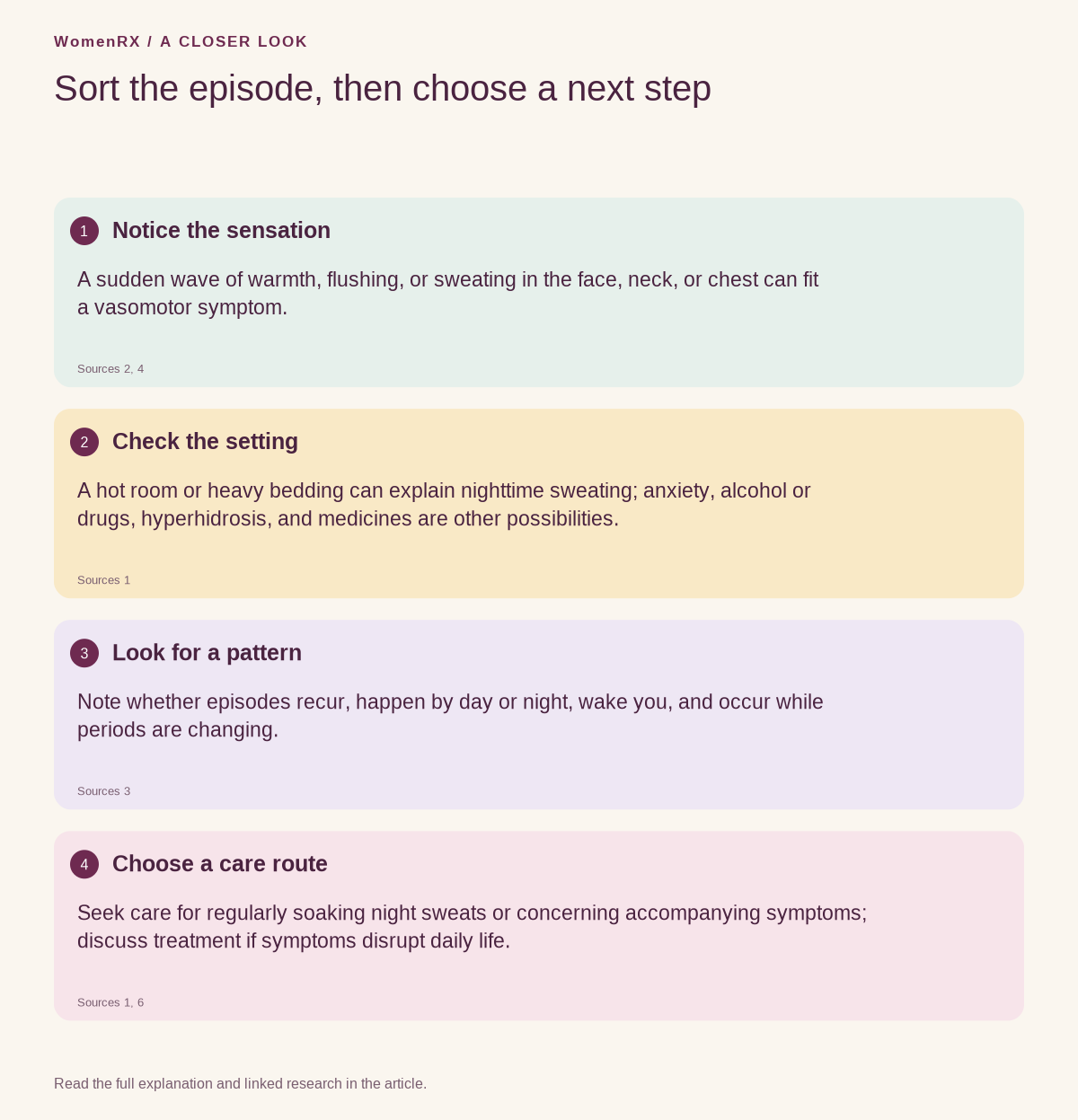
Sort the episode, then choose a next step
Notice the sensation: A sudden wave of warmth, flushing, or sweating in the face, neck, or chest can fit a vasomotor symptom.24
Check the setting: A hot room or heavy bedding can explain nighttime sweating; anxiety, alcohol or drugs, hyperhidrosis, and medicines are other possibilities.1
Look for a pattern: Note whether episodes recur, happen by day or night, wake you, and occur while periods are changing.3
Choose a care route: Seek care for regularly soaking night sweats or concerning accompanying symptoms; discuss treatment if symptoms disrupt daily life.16
Read the figure as text
A simple path from noticing a heat or sweating episode to deciding what kind of follow-up makes sense.- Notice the sensation: A sudden wave of warmth, flushing, or sweating in the face, neck, or chest can fit a vasomotor symptom.24
- Check the setting: A hot room or heavy bedding can explain nighttime sweating; anxiety, alcohol or drugs, hyperhidrosis, and medicines are other possibilities.1
- Look for a pattern: Note whether episodes recur, happen by day or night, wake you, and occur while periods are changing.3
- Choose a care route: Seek care for regularly soaking night sweats or concerning accompanying symptoms; discuss treatment if symptoms disrupt daily life.16
More questions, answered
Can hot flashes happen at night?
Yes. Hot flashes can happen during the day or night; episodes that wake you with sweating are often called night sweats. Regular soaking night sweats, especially with other concerning symptoms, deserve attention rather than an automatic menopause explanation. 1 3
Does every hot flash need treatment?
No. The treatment discussion is most relevant when symptoms are bothersome or disrupt sleep and daily life. Options include hormonal and nonhormonal approaches, and the right tradeoff depends on your health, preferences, and the symptom you most want to address. 2 6
Sources you can check
- Night sweats - NHSAccessed 2026-09-25Return to first citation
- VEOZAH (FEZOLINETANT) TABLET, FILM COATED [ASTELLAS PHARMA US, INC.] | US prescribing information and patient instructionsAccessed 2026-09-25Return to first citation
- Elinzanetant for the Treatment of Menopausal Hot Flashes: A Plain Language Review of the OASIS-1-4 Clinical Trial Results.Pinkerton JV, Nappi RE, Soares CN, Maki PM, Cardoso F, Donders G, Brennan D, Caetano C, Seitz C, Haseli-Mashhadi N, Haberland C, Brown G, Simon JA. · Women's health (London, England) · 2026Return to first citation
- Menopausal Hot Flashes: A Concise Review.Bansal R, Aggarwal N. · Journal of mid-life health · 2019Return to first citation
- The effects of menopausal hormone therapy on cardiovascular disease, cancer, cognition and depression in younger women: A systematic review.Bencivenga PA, Fort N, Fugh-Berman A, Scialli AR. · JRSM open · 2026Return to first citation
- Menopausal Hormone Therapy in Clinically Vulnerable Women: A Narrative Review of Guidelines and Real-World Evidence.Yanachkova V, Lebanova H, Stoev S. · Medicina (Kaunas, Lithuania) · 2026Return to first citation