How Many Years Can Hot Flashes Continue?
Symptoms often continue beyond the final menstrual period, and study averages describe groups, not your personal timeline.
A meta-analysis estimated a median of about four years of vasomotor symptoms among women who experienced them. That’s a group estimate, not a personal countdown: population symptom prevalence peaked about a year after the final menstrual period, and some women reported symptoms many years later. If hot flashes are bothering you now, you can discuss relief without waiting for them to stop. 3
Hot flashes can occur before periods stop and continue afterward. Research gives a broad sense of their course, but it measures two different things: how long symptoms lasted among women who had them, and how common symptoms were at different points around the final menstrual period. Neither measure predicts exactly when yours will end.
What the four-year estimate means
A meta-analysis of 10 population-based studies, with 35,445 participants, estimated a median vasomotor-symptom duration of about four years among women who experienced symptoms. Median means the midpoint of the durations in that group. It doesn’t mean every woman has symptoms for four years, or that symptoms start at the final period and end four years later. 3
The estimate also has limits: eight studies were cross-sectional snapshots, while only two followed women over time. The result is useful for setting broad expectations, but it is less precise as a forecast for one person. 3
A different measure: symptoms by time since the final period
In that same analysis, the proportion of women reporting vasomotor symptoms rose sharply in the two years before the final menstrual period and peaked about a year afterward. It did not return to premenopausal levels until around eight years after the final period. Nearly half of women reported symptoms four years after that period, and about 10% reported them as far out as 12 years afterward. 3
Those figures describe the share of women reporting symptoms at each point in time. They don’t mean an individual woman’s symptoms lasted continuously from before menopause to that later point. And a decline in the proportion of women with symptoms over time doesn’t tell us that each woman’s hot flashes gradually become less frequent. 3
Symptom definitions matter, too. When the meta-analysis separated bothersome symptoms from symptoms of any severity, bothersome symptoms peaked about a year earlier and declined faster. So a study counting any hot flash may show a different course from one focused on symptoms that cause more distress. 3
Why one woman’s timeline may differ
A prospective cohort study of 187 women in an urban Chinese community reported a median hot-flash duration of 4.5 years. That result is another group estimate, from a specific community and a relatively small cohort; it shouldn’t be treated as a universal figure or directly compared with the meta-analysis as if the study populations and methods were identical. 4
The practical takeaway is that symptoms can last beyond the final menstrual period, sometimes for years. The group averages can help set expectations, but they can’t tell you how long your symptoms will continue.
You can discuss relief before symptoms have lasted years
There’s no need to wait for a particular duration before talking about treatment. If hot flashes or night sweats are bothering you, affecting your sleep, or making everyday life harder, that burden is worth bringing up.
Menopausal hormone therapy is the most effective treatment for vasomotor symptoms, but its risks and benefits depend on factors such as the type of therapy, timing, and whether a progestogen is used. The North American Menopause Society recommends individualizing treatment and periodically reassessing whether its benefits continue to outweigh its risks. 1
If hormone therapy isn’t right for you or isn’t your preference, evidence-supported nonhormone options include cognitive behavioral therapy, clinical hypnosis, and certain prescription therapies. A discussion can focus on what’s bothering you and which options fit your circumstances, rather than on how many years you’ve already waited. 2
Symptoms around the final menstrual period
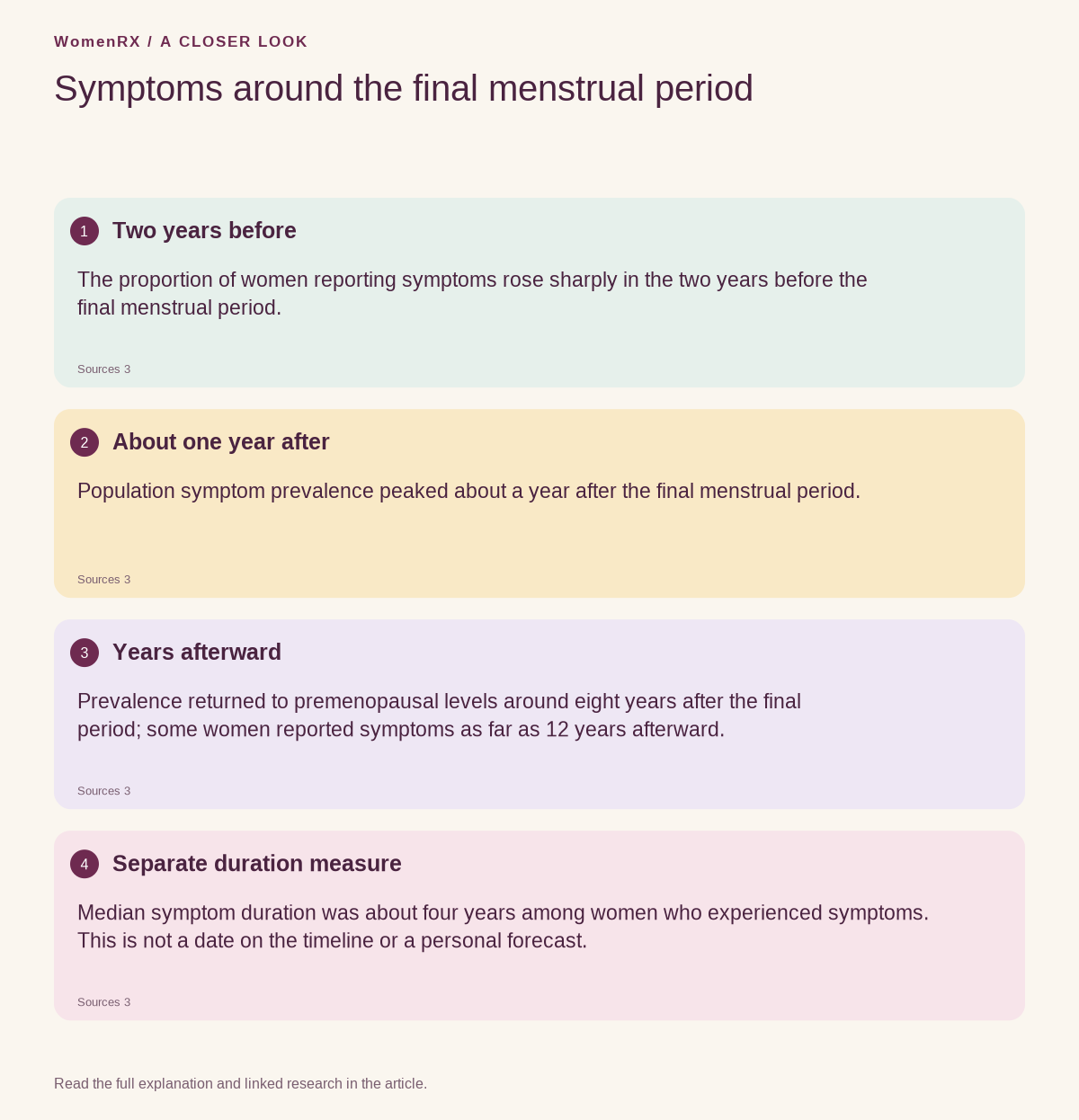
Two years before: The proportion of women reporting symptoms rose sharply in the two years before the final menstrual period.3
About one year after: Population symptom prevalence peaked about a year after the final menstrual period.3
Years afterward: Prevalence returned to premenopausal levels around eight years after the final period; some women reported symptoms as far as 12 years afterward.3
Separate duration measure: Median symptom duration was about four years among women who experienced symptoms. This is not a date on the timeline or a personal forecast.3
Read the figure as text
The timeline shows population symptom prevalence by time from the final menstrual period. The median-duration figure is a separate group measure, not a point on that timeline.- Two years before: The proportion of women reporting symptoms rose sharply in the two years before the final menstrual period.3
- About one year after: Population symptom prevalence peaked about a year after the final menstrual period.3
- Years afterward: Prevalence returned to premenopausal levels around eight years after the final period; some women reported symptoms as far as 12 years afterward.3
- Separate duration measure: Median symptom duration was about four years among women who experienced symptoms. This is not a date on the timeline or a personal forecast.3
Sources you can check
- The 2022 hormone therapy position statement of The North American Menopause Society.“The 2022 Hormone Therapy Position Statement of The North American Menopause Society” Advisory Panel. · Menopause (New York, N.Y.) · 2022Return to first citation
- The 2023 nonhormone therapy position statement of The North American Menopause Society.Menopause (New York, N.Y.) · 2023Return to first citation
- Revisiting the duration of vasomotor symptoms of menopause: a meta-analysis.Politi MC, Schleinitz MD, Col NF. · Journal of general internal medicine · 2008Return to first citation
- Vasomotor symptoms in aging Chinese women: findings from a prospective cohort study.Li J, Luo M, Tang R, Sun X, Wang Y, Liu B, Cui J, Liu G, Lin S, Chen R. · Climacteric : the journal of the International Menopause Society · 2020Return to first citation