How to Choose Greek Yogurt When Managing Weight
Compare serving sizes, labels, and toppings to build a yogurt snack or breakfast that fits the rest of your meal.
Compare plain and flavored Greek yogurt by the same serving size, checking calories, added sugars, protein, and fat rather than assuming one style is always better. Then count toppings as part of the snack or meal. Short-term appetite studies don’t show that a particular yogurt choice leads to lasting weight loss. 1 2 3
Greek yogurt can fit into a snack or breakfast when you’re managing your weight. The useful question isn’t whether Greek yogurt is a weight-loss food. It’s whether the yogurt and what you add make a satisfying choice that fits the rest of your meal.
In a study of 32 healthy women, a higher-protein Greek-style yogurt snack did not improve hunger or fullness ratings, delay dinner, or reduce dinner intake compared with an equal-calorie regular yogurt snack. 1
Compare labels using the same amount
Start with the serving size on the package. Then compare the Nutrition Facts for that amount, not just the numbers shown for different-sized containers. Look at calories, added sugars, protein, and fat. A flavored yogurt may suit you; a plain one may suit you better. The label tells you how the products actually compare, without relying on the word “Greek” or a flavor name to make the choice.
These short-term experiments didn’t compare plain with flavored Greek yogurt or test whether different fat levels lead to long-term weight loss. If you’re comparing fat levels, use the same label-reading approach rather than assuming that less fat automatically makes the better snack. What matters for the choice is the whole serving and how it works for you.
Treat toppings as part of the meal
Granola, fruit, nuts, honey, and other toppings change what’s in the bowl. If you add them, compare the finished bowl with the snack or breakfast you intended to have, instead of thinking of toppings as separate from the yogurt. For a quick comparison, check the yogurt serving first, then consider how your chosen additions change the whole meal.
Meal context matters, too. A yogurt that works as an afternoon snack may be only one part of breakfast. In a small study of 24 healthy young women, Greek yogurt with granola and a cultured nondairy product with granola both reduced appetite over two hours compared with water; the study did not find differences in food intake between the two caloric breakfasts. That short experiment doesn’t identify a best breakfast for weight loss, but it’s a reminder that protein alone doesn’t tell the whole story. 3
What fullness studies can and can’t tell you
Some short-term studies found that dairy, including Greek yogurt, reduced appetite compared with water. One randomized study of 58 young and older adults tested several dairy foods, including a 350-gram serving of Greek yogurt, and reported differences in appetite and later food intake compared with water. 2
The study of healthy women comparing higher- and lower-protein yogurt shows why “more protein means more fullness” isn’t a guarantee for every snack or person. 1
The women-specific evidence described here is limited to short-term outcomes. The yogurt snack study included healthy women, while the mixed-age dairy study included men and women and reported that appetite responses differed by sex. Neither tested a women-specific weight-loss effect. 1 2
A practical way to choose
If two yogurts appeal to you, compare them by the same serving size and choose based on their label and the meal you’re building. If you add toppings, include them in that comparison. You don’t need to find a perfect product or treat a higher protein number as a weight-loss promise.
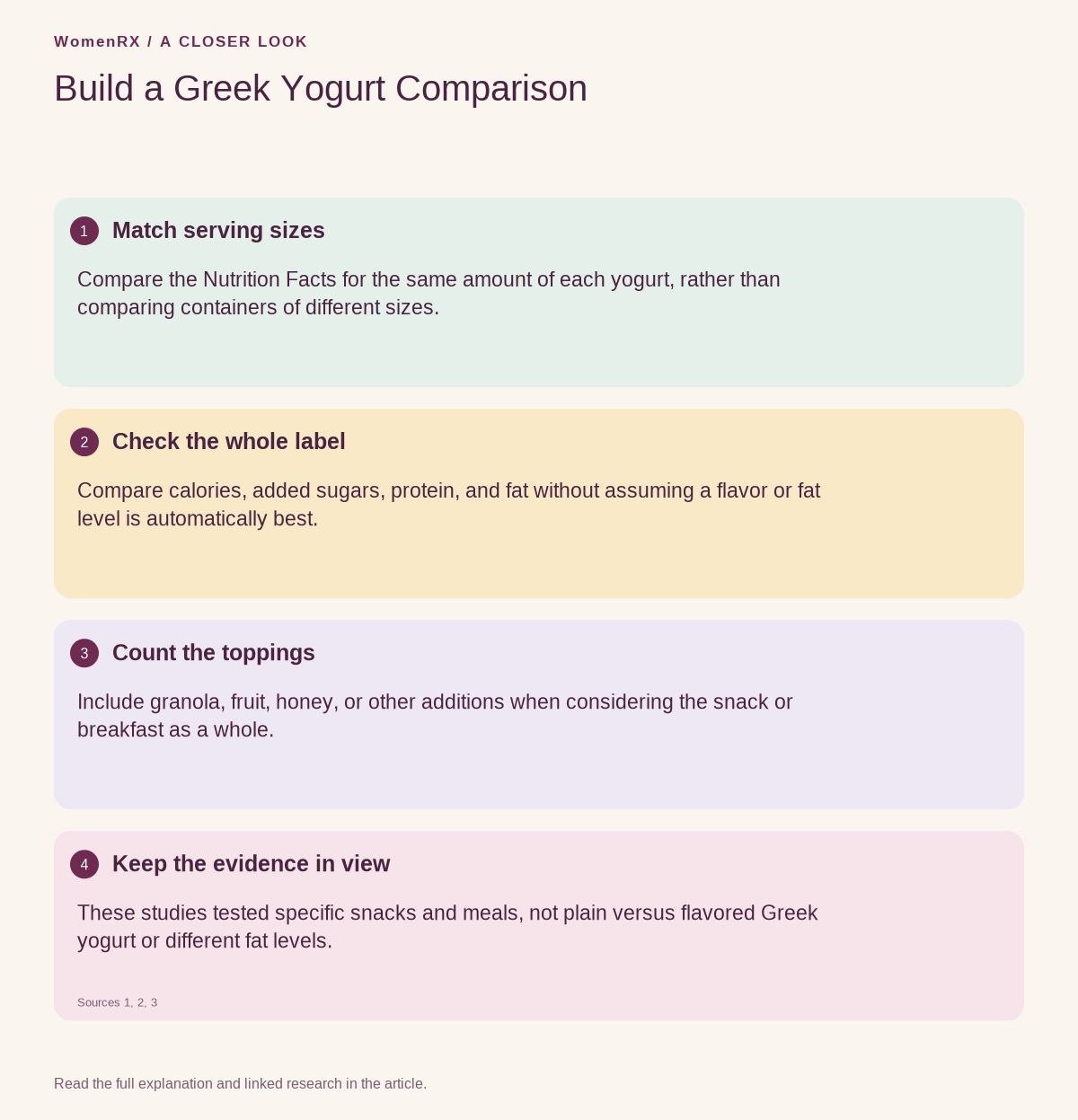
Build a Greek Yogurt Comparison
Match serving sizes: Compare the Nutrition Facts for the same amount of each yogurt, rather than comparing containers of different sizes.
Check the whole label: Compare calories, added sugars, protein, and fat without assuming a flavor or fat level is automatically best.
Count the toppings: Include granola, fruit, honey, or other additions when considering the snack or breakfast as a whole.
Keep the evidence in view: These studies tested specific snacks and meals, not plain versus flavored Greek yogurt or different fat levels.123
Read the figure as text
Use the same serving size for each yogurt, then account for toppings and the meal you’re building. This is a comparison aid, not a weight-loss score.- Match serving sizes: Compare the Nutrition Facts for the same amount of each yogurt, rather than comparing containers of different sizes.
- Check the whole label: Compare calories, added sugars, protein, and fat without assuming a flavor or fat level is automatically best.
- Count the toppings: Include granola, fruit, honey, or other additions when considering the snack or breakfast as a whole.
- Keep the evidence in view: These studies tested specific snacks and meals, not plain versus flavored Greek yogurt or different fat levels.123
More questions, answered
Does Greek yogurt have to be plain to fit a weight-management plan?
These experiments didn’t compare plain with flavored Greek yogurt. Compare the Nutrition Facts for the same serving size, including added sugars and calories, and choose the one that fits your snack or meal. 1 2 3
Does higher-protein Greek yogurt keep you full longer?
Not necessarily. In a small randomized study of healthy women, a Greek-style yogurt with 14 grams of protein did not improve hunger or fullness ratings or delay the next meal compared with a regular yogurt with 5 grams of protein. 1
Sources you can check
- The effects of increased dietary protein yogurt snack in the afternoon on appetite control and eating initiation in healthy women.Ortinau LC, Culp JM, Hoertel HA, Douglas SM, Leidy HJ. · Nutrition journal · 2013Return to first citation
- Age and Sex Interact to Determine the Effects of Commonly Consumed Dairy Products on Postmeal Glycemia, Satiety, and Later Meal Food Intake in Adults.Vien S, Fard S, El Khoury D, Luhovyy B, Fabek H, Anderson GH. · The Journal of nutrition · 2021Return to first citation
- Effects of cultured dairy and nondairy products added to breakfast cereals on blood glucose control, satiation, satiety, and short-term food intake in young women.Mather K, Boachie R, Anini Y, Panahi S, Anderson GH, Luhovyy BL. · Applied physiology, nutrition, and metabolism = Physiologie appliquee, nutrition et metabolisme · 2020Return to first citation