How to Compare Greek Yogurt Labels
The best choice for you depends on the serving you’ll eat, not the promises on the front of the container.
Start with serving size, then compare grams of protein, added sugar, calcium, and fat on the Nutrition Facts label. Those numbers let you compare a plain cup with a flavored one without assuming either has a particular nutrient profile. If lactose bothers you, your tolerance matters too: some people tolerate yogurt, while others need a lactose-free option. 13
Compare the amount you’ll actually eat
A large tub and a single-serve cup can look surprisingly similar at a glance. Check the serving size and servings per container first: the nutrients on the Nutrition Facts label are usually listed per serving, not necessarily for everything in the package. If you eat two listed servings, you’re getting twice the listed protein, sugar, calcium, and fat. 1
For a fair comparison, put two yogurts on the same footing. If one label describes a smaller serving, its lower sugar number may reflect the portion rather than a less-sweet recipe. You can compare equal amounts, or simply compare the portions you’d realistically eat. The second approach is often more useful when deciding what to buy.
Read protein and calcium as separate numbers
Greek yogurt can be a convenient protein-containing food, but the name alone won’t tell you how much is in your cup. As a reference point, a USDA food-composition entry for a 170-gram container of plain, nonfat Greek yogurt lists 17.3 grams of protein. That’s an estimate for a reference food, not a promise about every current brand, flavor, or container size. Read the protein grams on the product you’re holding. 51
A comparison at equal weight shows why it’s worth checking calcium separately. Per 100 grams, the USDA’s plain nonfat Greek yogurt reference lists 10.2 grams of protein and 110 milligrams of calcium. Its plain low-fat yogurt reference lists 5.25 grams of protein and 183 milligrams of calcium. These are two different reference foods, not a controlled test of what straining alone changes or a prediction for every product. 6
In an eight-week pilot study of older adult exercisers, the Greek yogurt used in the study supplied 225 milligrams of calcium and 17 grams of protein per 175-gram serving. Those figures describe that study’s yogurt, not Greek yogurt as a category. They’re another illustration of why protein and calcium deserve their own checks rather than one standing in for the other. 4
Calcium helps build and maintain bones, and your daily target changes with age: the recommended amount is 1,000 milligrams for women ages 19 through 50, including during pregnancy and lactation, and 1,200 milligrams from age 51 onward. Yogurt can contribute, but it isn’t required. Calcium also comes from foods such as canned fish with bones, some vegetables, and calcium-fortified foods. The label’s calcium percentage Daily Value helps compare products, while the milligrams tell you what that serving contributes to your day. 21
Plain versus flavored: check added sugar
If you like a sweet yogurt, compare the Added Sugars line, not just Total Sugars. Total sugar and added sugar are separate entries on the Nutrition Facts label. Yogurt can contain lactose, so a sugar number by itself doesn’t tell you how much sweetness was added. A flavored cup may suit you perfectly; its label lets you decide how its added sugar fits your preference. 13
For example, if you’re choosing between plain yogurt with fruit you’ll add yourself and a ready-to-eat flavored cup, compare their listed serving sizes, protein, and added sugar first. Then check calcium and fat rather than assuming the plain cup wins on every measure. Fruit or other additions you put into a plain cup also become part of what you eat.
Let fat level and your stomach have a say
The fat line is another reason to check the actual product. The USDA’s plain, nonfat Greek yogurt reference lists 0.7 grams of fat in a 170-gram container; that figure shouldn’t be carried over to a yogurt with a different fat level. Compare fat alongside protein, sugar, and calcium instead of treating one number as the whole decision. 51
If dairy sometimes causes bloating, gas, or other digestive discomfort, Greek yogurt isn’t automatically off-limits or automatically comfortable. Lactose-intolerance symptoms vary with factors including the amount of lactose eaten, and some people tolerate yogurt better than milk. A lactose-free dairy product is another option; if you choose a nondairy yogurt instead, check its protein and calcium labels rather than assuming it matches dairy yogurt. 32
If you’re pregnant, make one additional label check: choose dairy yogurt made with pasteurized milk. Unpasteurized dairy can carry germs that are particularly harmful during pregnancy. 78
The practical choice is the serving you enjoy and tolerate with a nutrient profile that fits what you’re looking for. A few lines on the back of the cup will tell you more than “Greek,” “plain,” or “high protein” on the front. 1
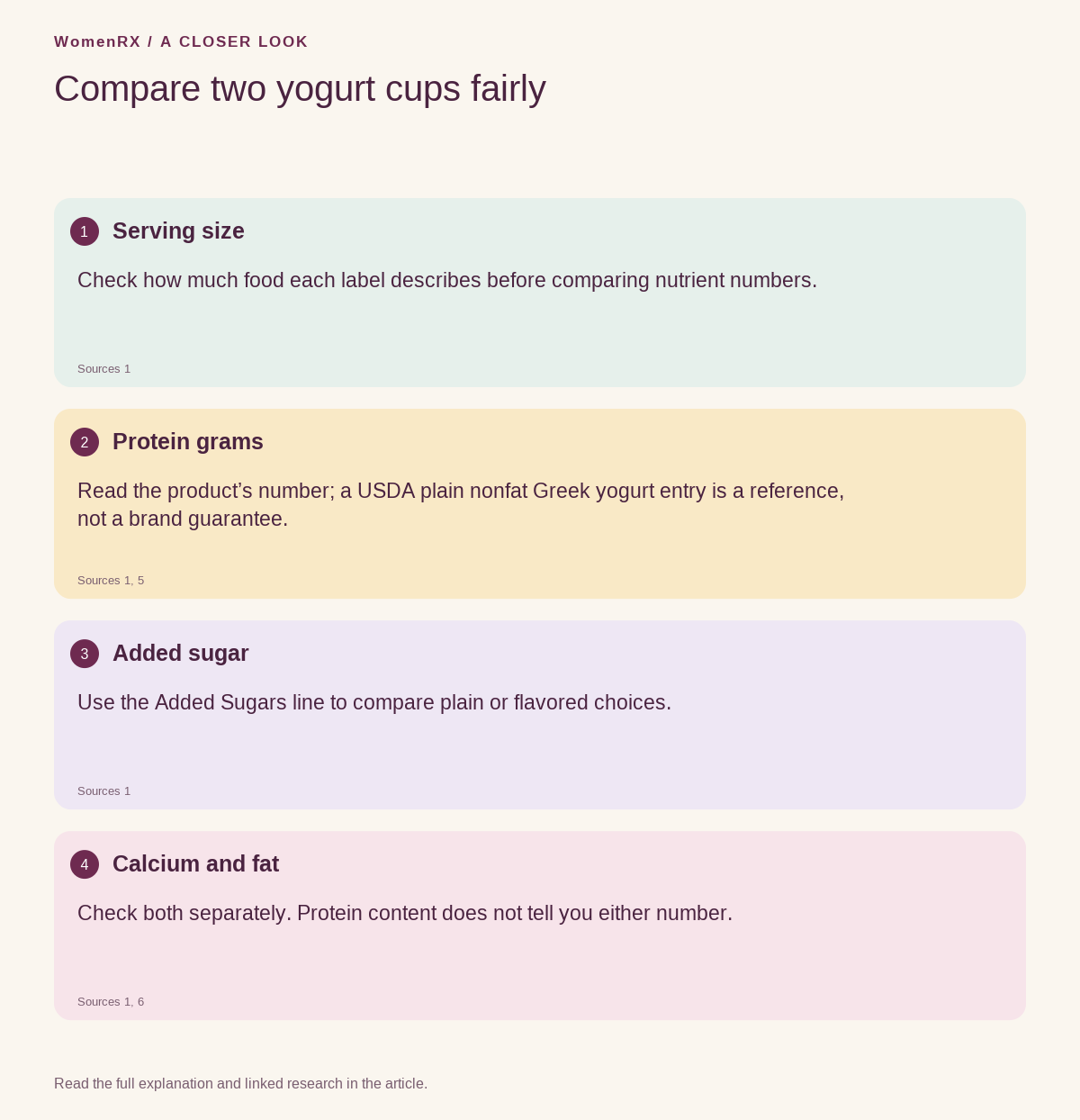
Compare two yogurt cups fairly
Serving size: Check how much food each label describes before comparing nutrient numbers.1
Protein grams: Read the product’s number; a USDA plain nonfat Greek yogurt entry is a reference, not a brand guarantee.15
Added sugar: Use the Added Sugars line to compare plain or flavored choices.1
Calcium and fat: Check both separately. Protein content does not tell you either number.16
Read the figure as text
Use the same label checks for plain and flavored cups, paying attention to the portion behind each number.- Serving size: Check how much food each label describes before comparing nutrient numbers.1
- Protein grams: Read the product’s number; a USDA plain nonfat Greek yogurt entry is a reference, not a brand guarantee.15
- Added sugar: Use the Added Sugars line to compare plain or flavored choices.1
- Calcium and fat: Check both separately. Protein content does not tell you either number.16
Sources you can check
- Food Labeling: MedlinePlusAccessed 2026-09-25Return to first citation
- Calcium - Health Professional Fact SheetAccessed 2026-09-25Return to first citation
- Effects of Prebiotic and Probiotic Supplementation on Lactase Deficiency and Lactose Intolerance: A Systematic Review of Controlled Trials.Leis R, de Castro MJ, de Lamas C, Picáns R, Couce ML. · Nutrients · 2020Return to first citation
- Effects of Greek Yogurt Supplementation and Exercise on Markers of Bone Turnover and Inflammation in Older Adult Exercisers: An 8-Week Pilot Intervention Trial.Bell M, Narciso PH, Baker E, Falk B, Roy BD, Josse AR, Klentrou P. · Nutrients · 2025Return to first citation
- USDA SR Legacy: Yogurt, Greek, plain, nonfat (Includes foods for USDA's Food Distribution Program) (FDC 170894)Accessed 2026-09-25Return to first citation
- USDA SR Legacy: greek-yogurt reference food comparisonAccessed 2026-09-25Return to first citation
- Dairy and Eggs (Food Safety for Moms-to-Be) | FDAAccessed 2026-09-25Return to first citation
- Safer Food Choices for Pregnant Women | Food Safety | CDCAccessed 2026-09-25Return to first citation