How to Compare Nutrition Labels for Your Goal
Start with the serving size, then compare the nutrient that matters for the choice you’re making.
When comparing two packaged foods, first check the serving size and servings per container, then compare the same nutrient for the same amount of each food. Use % Daily Value as a quick guide: 5% or less is low and 20% or more is high. 1 Check ingredients for details tied to your goal, and treat front-of-package claims as a starting point, not a full nutrition comparison.
A quick sequence that keeps comparisons fair
A nutrition label is most useful when you decide what you want to compare before you start reading. Are you looking for less sodium, more fiber, or a food that fits a particular ingredient-related need? That choice determines which details deserve your attention.
First, check serving size. The listed calories and nutrient amounts describe one serving, not necessarily the amount you’ll eat. Also check how many servings are in the package. If you eat or drink more than one serving, the amounts you get increase accordingly. 1
Next, compare the same amount. If two products list different serving sizes, their numbers aren’t a like-for-like comparison. Use the listed serving information to work out what each would provide for an amount you’d actually use. Some packages show both per-serving and whole-package information, but many don’t. 1
Then go straight to your priority. For a lower-sodium choice, compare sodium. For a higher-fiber choice, compare dietary fiber. The % Daily Value can help you quickly see whether a nutrient amount is relatively low or high: 5% or less is low, while 20% or more is high. It’s a comparison guide, not a personalized target for every person or every meal. 1
Finally, check ingredients and claims. The ingredient list can help with questions about what a product contains; look for the ingredients relevant to your particular reason for choosing it. Front-of-package phrases may be useful clues, but they don’t replace checking the serving size and the nutrient you care about. A claim about one feature doesn’t tell you everything about the food.
Match the comparison to the decision
If you’re reducing sodium: Compare the sodium amount for the same serving size, then consider whether that serving matches how you’ll eat the food. Don’t decide based only on a “light” or other front-label phrase; check the number that answers your question.
If you want more fiber: Compare dietary fiber on the Nutrition Facts panel, again using equivalent amounts. A larger serving can make a product appear to provide more, so keep serving size in view.
If you have an ingredient preference: Read the ingredient list as well as the nutrient panel, rather than relying only on a front-of-package nutrition claim.
A pregnancy example, without one rule for everyone
A person who is pregnant or may become pregnant might be comparing packaged grain foods with folic acid in mind. MedlinePlus identifies enriched breads, cereals, and other grain products as food sources of folic acid, which is important before and during pregnancy. 2 Applying that information to a choice between products, the useful question may be whether either is an enriched grain food, alongside whatever other comparison matters to that person.
That doesn’t make the same choice right for every woman, or mean a single label comparison covers every pregnancy-related nutrition need. The comparison should reflect the specific goal; pregnancy is one example of a life stage that can make a particular nutrient more relevant. 2
A two-package walkthrough
Imagine two cereal boxes you’re considering. Box A lists nutrients for a full-cup serving; Box B lists them for a half-cup serving. You plan to pour a cup. To compare fiber, read Box A’s fiber amount as printed, but double Box B’s: you’d eat two of its listed servings. Now compare those two amounts. If Box B’s doubled fiber amount is higher, it provides more fiber for your planned bowl, even if its per-serving number looked lower. Use the same calculation for sodium, choosing the lower amount if that’s your goal. 1
Then make the checks the numbers can’t answer. If you’re looking for an enriched grain food because folic acid matters to your choice, check what each package says about its ingredients rather than assuming the cereal with more fiber is enriched. Enriched cereals are among the foods MedlinePlus identifies as folic-acid sources. 2 A front claim about fiber or another single feature shouldn’t settle the separate question you brought to the shelf.
The most useful label isn’t necessarily the one with the most favorable number in isolation. It’s the one that helps you make the specific tradeoff you intended, using a realistic serving and the information relevant to your goal.
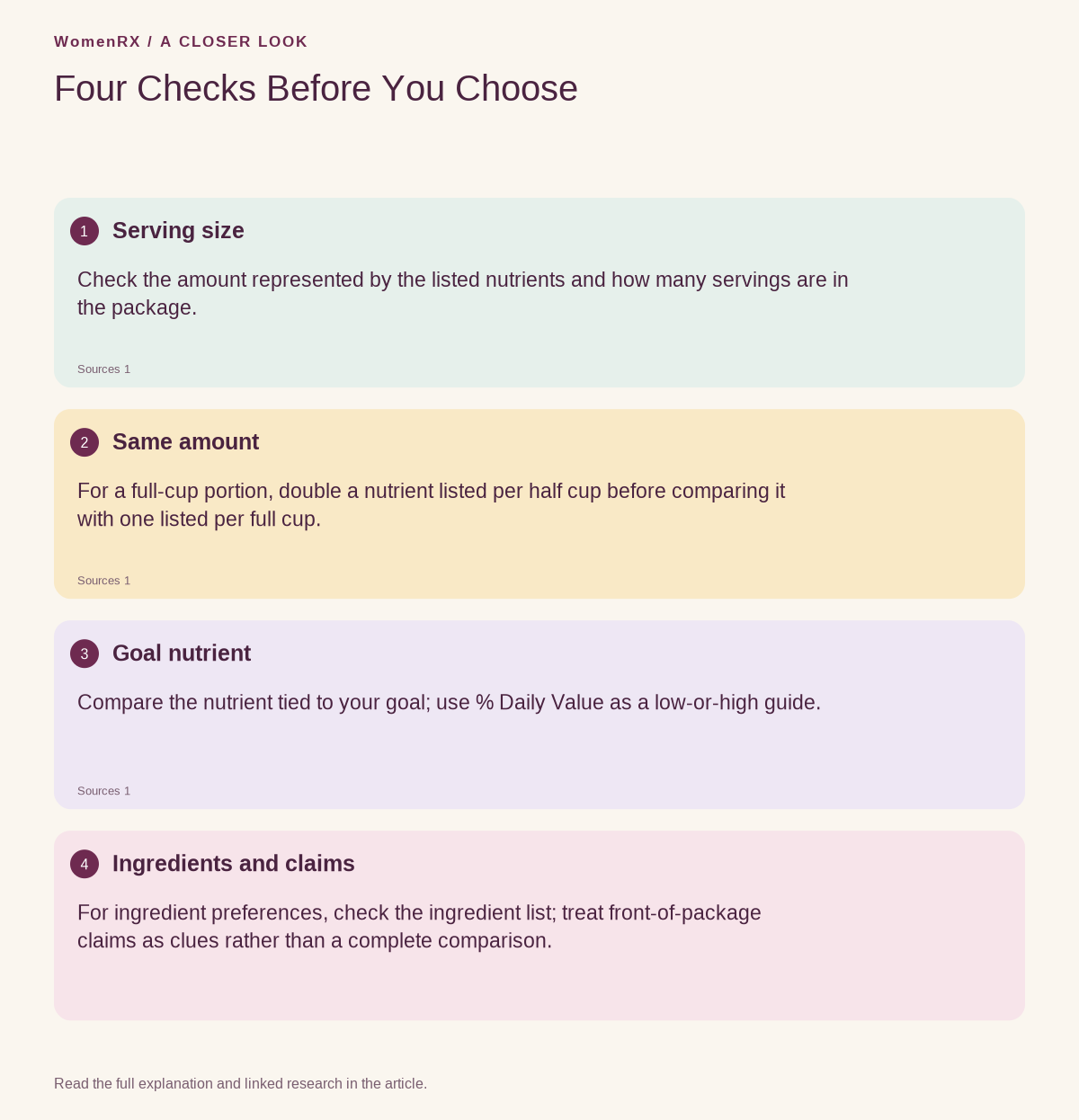
Four Checks Before You Choose
Serving size: Check the amount represented by the listed nutrients and how many servings are in the package.1
Same amount: For a full-cup portion, double a nutrient listed per half cup before comparing it with one listed per full cup.1
Goal nutrient: Compare the nutrient tied to your goal; use % Daily Value as a low-or-high guide.1
Ingredients and claims: For ingredient preferences, check the ingredient list; treat front-of-package claims as clues rather than a complete comparison.
Read the figure as text
Use the same order for both packages so serving-size differences and marketing language don’t distract from the goal you chose.- Serving size: Check the amount represented by the listed nutrients and how many servings are in the package.1
- Same amount: For a full-cup portion, double a nutrient listed per half cup before comparing it with one listed per full cup.1
- Goal nutrient: Compare the nutrient tied to your goal; use % Daily Value as a low-or-high guide.1
- Ingredients and claims: For ingredient preferences, check the ingredient list; treat front-of-package claims as clues rather than a complete comparison.
More questions, answered
What does % Daily Value tell me?
It shows what percentage of the daily recommendation for a nutrient is in one serving. As a quick guide, 5% or less is low and 20% or more is high. Check serving size before using the percentage to compare foods. 1
Should I compare foods by the whole package or by one serving?
Start with the serving size and how much you expect to eat. If you’ll have more than one serving, the amount you get will be higher than the per-serving listing. Some labels also give whole-package values, but many do not. 1
Sources you can check
- Food Labeling: MedlinePlusAccessed 2026-09-25Return to first citation
- Folic Acid: MedlinePlusAccessed 2026-09-25Return to first citation