How to Compare Glucomannan Labels and Claims
Start with the amount of glucomannan and the directions, then check whether the promised result is stronger than the evidence.
Compare the amount of glucomannan per serving, the form, and the full directions, including any fluid or swallowing warning. Be cautious with weight-loss promises: evidence is mixed, and a randomized trial in 53 adults found no meaningful weight-loss advantage over placebo after eight weeks. A label or quality seal can’t establish that a product will produce a specific health outcome. 1 2 4
A quick glucomannan label check
Before comparing prices or promotional claims, find the product’s Supplement Facts panel and directions. Use this worksheet:
- How much glucomannan is in a serving? Look for a specific amount, not just a blend name. If the amount is hidden among several fibers or ingredients, you can’t tell how much glucomannan the product provides or compare it cleanly with a single-ingredient product. Supplement amounts and formulations vary, which makes study results harder to apply to a finished product. 1
- What form is it? Note whether the product is a tablet, capsule, powder, or another form. NIH’s Office of Dietary Supplements reports significant safety concerns for tablet forms because they may cause esophageal obstruction. It reports fewer safety concerns for other forms in the data it summarizes, but that does not establish that every non-tablet product is safe for every person. 1
- What exactly do the directions say? Read the whole serving instruction, including the fluid amount or other warnings, rather than relying on the front label. A clinical trial used capsules with 8 ounces of water before meals, but that was the trial’s protocol, not a universal instruction for products with different forms or directions. Follow the product’s own label; don’t borrow a schedule from a study or another brand. 4
- Does it say when to take it around medicines? Check whether the product’s directions address medicine timing. If they don’t give a clear answer, ask a pharmacist about that specific product and your medication rather than guessing at a timing rule.
- What outcome does the claim promise? Separate a modest fullness or fiber-related explanation from a promise of substantial weight loss, lower cholesterol, or blood-sugar control. Each is a distinct outcome, and a claim about one does not prove the others. 1 4
What weight-loss claims can reasonably say
Glucomannan is a soluble fiber that can absorb water and may increase fullness. That mechanism is a reason it has been studied, not proof that a particular product causes weight loss. 1 4
The human findings are not consistent enough to treat a strong weight-loss promise as settled. In one randomized trial, 53 adults with overweight or moderate obesity took glucomannan or placebo for eight weeks. The groups did not differ significantly in weight loss or the other measured outcomes. 4
A 2021 meta-analysis of randomized, placebo-controlled trials found a statistically significant average weight difference for glucomannan compared with placebo: 1.27 kg, with a 95% confidence interval from 0.09 to 2.45 kg. The authors’ threshold for clinical significance was 2.5 kg, which this result did not reach; they concluded there was insufficient evidence to recommend the supplements reviewed for weight loss. 5
These findings help explain why a label should not promise a particular amount of weight loss. A separate randomized trial reported weight loss with a combination of glucomannan, inulin, and psyllium in a selected group of adults with obesity and specified genetic variants. Because it tested a blend in that selected population, it cannot show that glucomannan alone, or a product with a different formula, will have the same effect. 3
The eight-week trial enrolled adults, and it cannot establish a women-specific effect or answer whether glucomannan is appropriate during pregnancy. Don’t interpret general adult findings as proof of a women-specific benefit or as evidence about pregnancy. 4
Quality signals are not outcome guarantees
A clear label makes it easier to know what a product claims to contain, but it does not prove that the product works. In a laboratory analysis of 30 selected supplements marketed for immune health, only 13 had labels that accurately matched detected ingredients. That study was not about glucomannan, so it cannot tell you how accurate any particular glucomannan product is. It does illustrate why a label alone is not independent verification. 2
Third-party verification may help check that a product’s contents match its label. It does not demonstrate that the product causes weight loss or is safe for your specific situation. Treat a seal as a quality signal, not evidence for a marketing claim. 2
Put the claim beside the evidence
Use this final comparison before deciding whether the label is persuasive:
- “Promotes fullness”: This is consistent with a proposed fiber mechanism, but it does not guarantee that you will feel fuller or lose weight. 1
- “Supports weight loss”: Ask whether the claim is modest and specific. Human trial and review findings include no significant benefit in one trial and a small average difference below the meta-analysis authors’ clinical-significance threshold. 4 5
- “Clinically proven”: Check whether the study tested glucomannan alone or a multi-ingredient product, and whether its population and directions resemble the product being sold. A result from a blend or selected group is not automatically transferable. 3
- “Safe for everyone”: This is not supported. Tablet forms carry a reported obstruction concern, and the available safety summary does not establish safety for every form or individual. 1
If the label hides the glucomannan amount, leaves fluid or swallowing directions unclear, or promises a specific result that the studies don’t establish, you don’t have enough information to make a meaningful comparison.
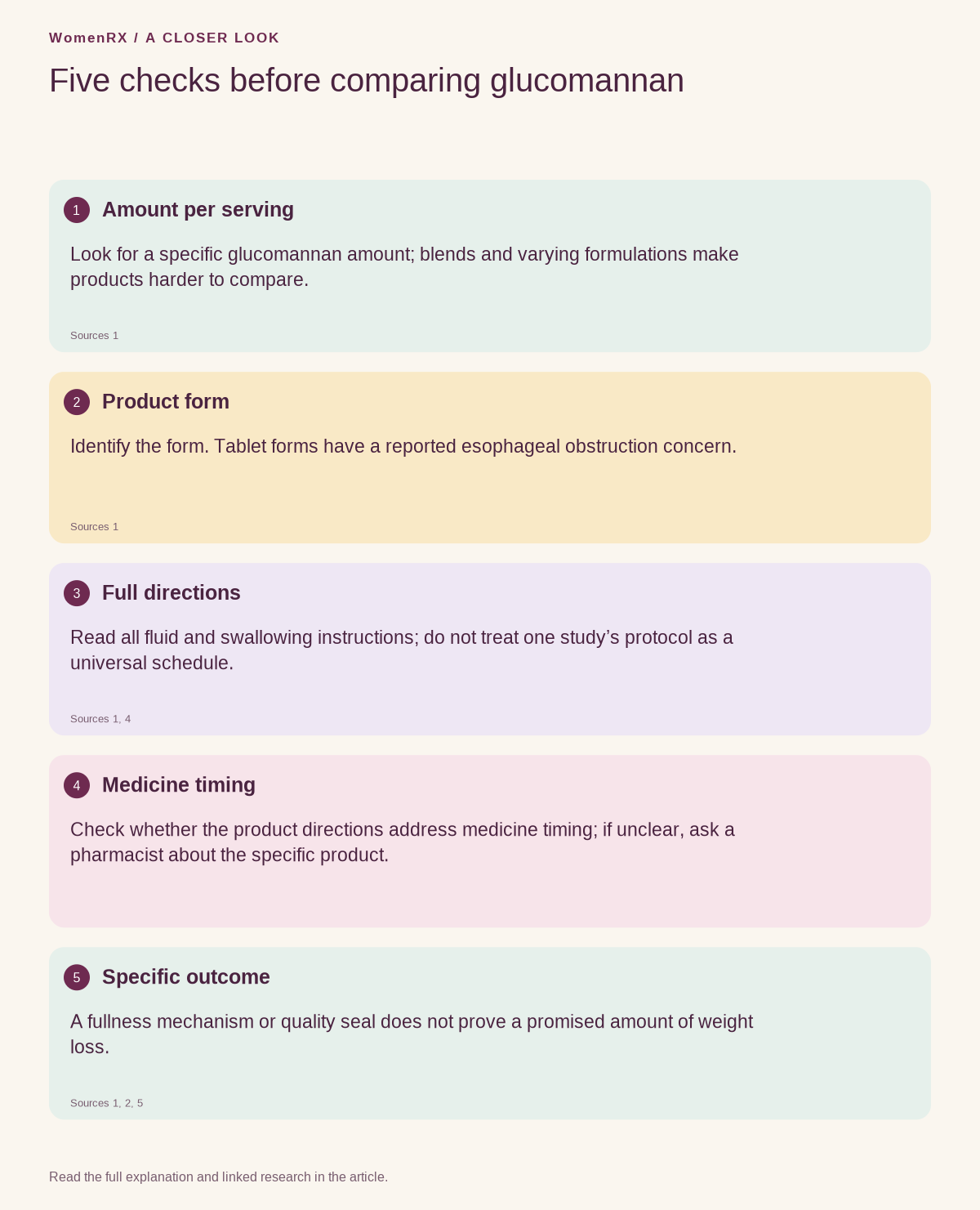
Five checks before comparing glucomannan
Amount per serving: Look for a specific glucomannan amount; blends and varying formulations make products harder to compare.1
Product form: Identify the form. Tablet forms have a reported esophageal obstruction concern.1
Full directions: Read all fluid and swallowing instructions; do not treat one study’s protocol as a universal schedule.14
Medicine timing: Check whether the product directions address medicine timing; if unclear, ask a pharmacist about the specific product.
Specific outcome: A fullness mechanism or quality seal does not prove a promised amount of weight loss.125
Read the figure as text
Use these checks to separate what a label tells you from what the clinical evidence can support.- Amount per serving: Look for a specific glucomannan amount; blends and varying formulations make products harder to compare.1
- Product form: Identify the form. Tablet forms have a reported esophageal obstruction concern.1
- Full directions: Read all fluid and swallowing instructions; do not treat one study’s protocol as a universal schedule.14
- Medicine timing: Check whether the product directions address medicine timing; if unclear, ask a pharmacist about the specific product.
- Specific outcome: A fullness mechanism or quality seal does not prove a promised amount of weight loss.125
More questions, answered
Does a third-party quality seal prove glucomannan will help with weight loss?
No. Third-party verification can help check whether a product’s contents match its label, but it does not establish effectiveness or personal safety. 2
Can I use another product’s water directions?
Don’t assume the directions transfer between products or forms. One trial’s use of capsules with water describes that study’s protocol, not a universal instruction; follow the specific product label. 4
Sources you can check
- Dietary Supplements for Weight Loss - Health Professional Fact SheetAccessed 2026-09-25Return to first citation
- Analysis of Select Dietary Supplement Products Marketed to Support or Boost the Immune System.Crawford C, Avula B, Lindsey AT, Walter A, Katragunta K, Khan IA, Deuster PA. · JAMA network open · 2022Return to first citation
- The Impact of Glucomannan, Inulin, and Psyllium Supplementation (SolowaysTM) on Weight Loss in Adults with FTO, LEP, LEPR, and MC4R Polymorphisms: A Randomized, Double-Blind, Placebo-Controlled Trial.Pokushalov E, Ponomarenko A, Garcia C, Pak I, Shrainer E, Seryakova M, Johnson M, Miller R. · Nutrients · 2024Return to first citation
- Safety and efficacy of glucomannan for weight loss in overweight and moderately obese adults.Keithley JK, Swanson B, Mikolaitis SL, DeMeo M, Zeller JM, Fogg L, Adamji J. · Journal of obesity · 2013Return to first citation
- Efficacy of dietary supplements containing isolated organic compounds for weight loss: a systematic review and meta-analysis of randomised placebo-controlled trials.Bessell E, Maunder A, Lauche R, Adams J, Sainsbury A, Fuller NR. · International journal of obesity (2005) · 2021Return to first citation