Glucomannan Doses: What to Check Before You Take It
The amount on the front of a bottle isn’t enough: check the serving, form, fluid directions, and reason you’re considering it.
The weight-loss and pregnancy constipation trials don’t establish one glucomannan dose for every goal. 2 4 Multiply the amount per serving by the servings the label calls for each day to find the daily total. One small adult weight-loss trial tested 1.33 grams three times daily and found no benefit over placebo; that’s a study amount, not a recommendation. Don’t swallow glucomannan dry: take it with adequate water according to the product directions. 4
Start with the serving, not the headline
Look for the amount of glucomannan itself per serving, how many capsules or scoops make that serving, and how many servings the directions call for. Multiply the amount per serving by the number of daily servings. For example only, if a label lists 500 mg per serving and calls for two servings daily, that adds up to 1,000 mg, or 1 gram, per day. This is a label calculation, not a recommended dose. If glucomannan is part of a blend, the total blend weight may not tell you how much glucomannan you’re getting. Supplement formulas and amounts can vary, which makes it harder to compare products or carry a study dose over to a bottle. 1
A study amount isn’t automatically a recommended amount. In one 8-week trial, adults with overweight or obesity took 1.33 grams of glucomannan three times daily, with 8 ounces of water, one hour before breakfast, lunch, and dinner. The study found no significant difference from placebo in weight loss or other measured outcomes. Women participated, but the overall result cited here does not show whether effects differed for women. 4
Match the evidence to your reason for taking it
For weight management: The NIH Office of Dietary Supplements summarizes the evidence as showing little to no effect on body weight. A separate trial found weight loss with a product containing glucomannan, inulin, and psyllium, but because all three fibers were combined, it can’t show that glucomannan alone caused the result. That trial also enrolled adults with obesity and specified genetic variants, so its findings don’t establish what to expect from a single-ingredient product. 1 3
For cholesterol: Don’t assume that a weight-management label or a proposed fiber mechanism proves a cholesterol benefit. In the 8-week trial, glucomannan didn’t significantly change lipid measures compared with placebo. That tested regimen did not establish a dose for lowering cholesterol. 4
For constipation: This trial in third-trimester pregnancy doesn’t establish a general dose for adults with constipation. One small trial in 64 pregnant women in their third trimester compared powdered glucomannan with magnesium hydroxide for a month. The glucomannan group received 4 grams per day split into two doses with water, and bowel-movement frequency increased. But the study used alternating allocation, excluded some higher-risk participants, and wasn’t enough to settle broader safety or dosing questions. Treat its amount as a study protocol, not a personal recommendation. 2
Water and swallowing are central to safe use
Glucomannan absorbs water and expands in the digestive tract. The NIH fact sheet reports significant safety concerns with tablet forms because they may cause an esophageal obstruction; it reports fewer safety concerns for other forms in the short-term studies it reviewed. Don’t swallow glucomannan dry. Take it with adequate water according to the product directions. 1 4
For context, the adult weight-loss trial used 8 ounces of water with each dose, while the pregnancy constipation trial specified a glass of water. Those are details of two study protocols, not a universal minimum for every product. 2 4
If swallowing is difficult, or you have a known narrowing or blockage in your digestive tract, don’t assume a fiber that swells is suitable for you. Difficulty swallowing and intestinal narrowing or obstruction were among the reasons people were excluded from the adult weight-loss trial; that doesn’t establish a complete list of who should avoid glucomannan, but it makes these details worth checking before use. 4
Gas, loose stools, diarrhea, constipation, and abdominal discomfort have been reported. 1
Check medicine timing instead of guessing
These trials don’t establish a specific interaction with a named medicine or a universal separation interval. Don’t rely on a generic timing rule. Show a pharmacist the exact product label and your medication list, and ask whether this fiber could affect the timing of any of your medicines. This is especially useful if your care plan includes several medicines or a medicine where consistent absorption matters.
Pregnancy and breastfeeding need a separate check
The small third-trimester constipation trial offers limited information for that specific situation, not a general safety assurance for pregnancy. It excluded women with high-risk pregnancies and kidney disease, among other criteria. If you’re pregnant, ask the clinician managing your pregnancy whether this product is appropriate before using it, and share the label rather than relying on the study amount. 2
The adult weight-loss trial excluded people who were lactating, so it provides no breastfeeding safety information. Don’t treat the pregnancy constipation study as evidence about breastfeeding. 2 4
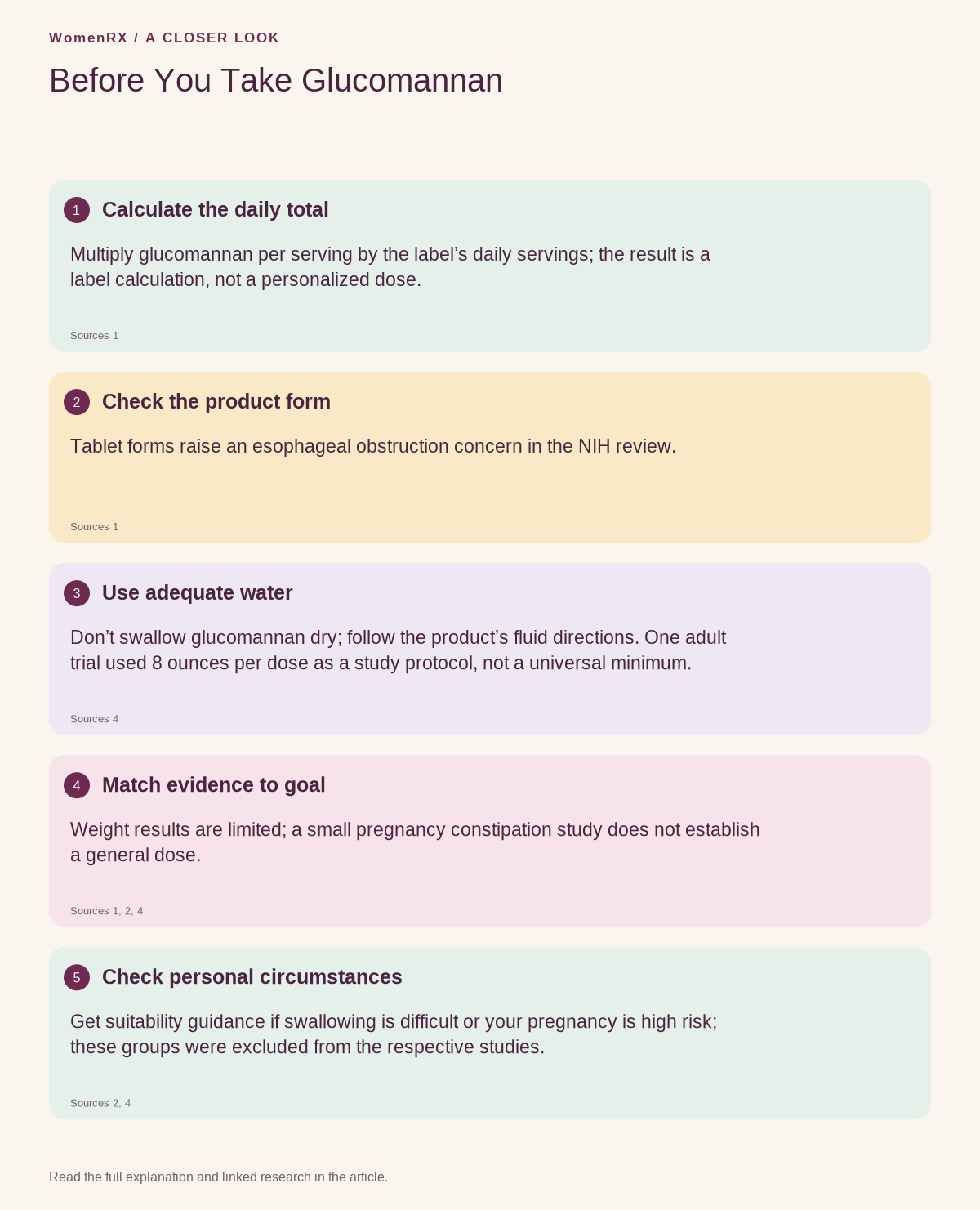
Before You Take Glucomannan
Calculate the daily total: Multiply glucomannan per serving by the label’s daily servings; the result is a label calculation, not a personalized dose.1
Check the product form: Tablet forms raise an esophageal obstruction concern in the NIH review.1
Use adequate water: Don’t swallow glucomannan dry; follow the product’s fluid directions. One adult trial used 8 ounces per dose as a study protocol, not a universal minimum.4
Match evidence to goal: Weight results are limited; a small pregnancy constipation study does not establish a general dose.124
Check personal circumstances: Get suitability guidance if swallowing is difficult or your pregnancy is high risk; these groups were excluded from the respective studies.24
Read the figure as text
Check the label math, water directions, evidence for your goal, and personal circumstances before using a fiber that expands with fluid.- Calculate the daily total: Multiply glucomannan per serving by the label’s daily servings; the result is a label calculation, not a personalized dose.1
- Check the product form: Tablet forms raise an esophageal obstruction concern in the NIH review.1
- Use adequate water: Don’t swallow glucomannan dry; follow the product’s fluid directions. One adult trial used 8 ounces per dose as a study protocol, not a universal minimum.4
- Match evidence to goal: Weight results are limited; a small pregnancy constipation study does not establish a general dose.124
- Check personal circumstances: Get suitability guidance if swallowing is difficult or your pregnancy is high risk; these groups were excluded from the respective studies.24
More questions, answered
How do I calculate the daily amount from a label?
Multiply the glucomannan amount per serving by the number of servings the label calls for each day. For example, 500 mg per serving taken twice daily adds up to 1,000 mg, or 1 gram, per day. That calculation describes the label directions; it doesn’t establish that amount as right for you. 1
Does a study dose tell me what to take?
No. The adult weight-loss trial tested 1.33 grams three times daily and found no significant benefit over placebo. The small pregnancy constipation trial studied a different goal and population. Neither establishes a dose for everyone. 2 4
Is there a standard number of hours to separate glucomannan from medicines?
These trials don’t establish a universal interval or verify a specific interaction. 2 4 Ask a pharmacist to check the exact product and medicines you take rather than guessing at a time gap.
Sources you can check
- Dietary Supplements for Weight Loss - Health Professional Fact SheetAccessed 2026-09-25Return to first citation
- The effect of glucomannan on pregnancy constipation.Janani F, Changaee F. · Journal of family medicine and primary care · 2018Return to first citation
- The Impact of Glucomannan, Inulin, and Psyllium Supplementation (SolowaysTM) on Weight Loss in Adults with FTO, LEP, LEPR, and MC4R Polymorphisms: A Randomized, Double-Blind, Placebo-Controlled Trial.Pokushalov E, Ponomarenko A, Garcia C, Pak I, Shrainer E, Seryakova M, Johnson M, Miller R. · Nutrients · 2024Return to first citation
- Safety and efficacy of glucomannan for weight loss in overweight and moderately obese adults.Keithley JK, Swanson B, Mikolaitis SL, DeMeo M, Zeller JM, Fogg L, Adamji J. · Journal of obesity · 2013Return to first citation