How to Compare Cottage Cheese Protein and Sodium
Compare the serving size first, then weigh protein and sodium against your own priorities.
For a fair comparison, check each label’s serving size, then scale the listed protein and sodium to the amount you plan to eat. As a reference point, a USDA entry for 1/2 cup (113 g) of 2% cottage cheese estimates 11.8 g protein, 91.5 calories, 5.4 g carbohydrate, 2.6 g fat, and no fiber; it doesn’t give a sodium value, so check the package. 5
Start with the serving size
Two tubs can look similar but list different serving sizes. Compare the protein and sodium amounts only after checking how much cottage cheese each label calls one serving. To adjust a listed amount to the portion you’re comparing, multiply it by your portion ÷ the labeled serving size. Use the same units for both amounts.
For example, in a hypothetical label comparison, if a label lists nutrients for 1/2 cup and you want to compare a 3/4-cup portion, multiply the listed protein and sodium by 3/4 ÷ 1/2, or 1.5. Apply that same calculation to both nutrients. These example portions and numbers are only to show the math, not product-label nutrition data.
Use the same approach if you usually eat more or less than the label’s serving. The amount you actually plan to eat is what matters for your comparison.
One reference serving of 2% cottage cheese
USDA SR Legacy lists this food as cottage cheese, lowfat, 2% milkfat. Its reference serving is 1/2 cup, or 113 grams. These are food-composition estimates, not measurements of a particular brand or a requirement to eat this amount. 5
| Nutrient | Per 1/2 cup (113 g) |
|---|---|
| Energy | 91.5 calories |
| Protein | 11.8 g |
| Carbohydrate | 5.4 g |
| Fat | 2.6 g |
| Fiber | 0 g |
| Sodium | Not listed in this entry; check the package |
This gives you a concrete protein reference, but package values can differ. For sodium, use the current product label and compare equal portions rather than assuming all cottage cheese has the same amount. 5
Weigh protein against sodium
Protein helps the body build and maintain bones, muscles, and skin, but how much you need varies with factors including age, sex, health, and activity. So compare protein across products, then consider how the portion fits with the rest of your meals rather than assuming the highest number is always better. 1
Sodium is a separate tradeoff. MedlinePlus summarizes the Dietary Guidelines as saying most adults should eat less than 2,300 milligrams of sodium per day, and notes that some people may need less. Checking the label helps you see how much a prepared food contributes. If sodium is a priority for you, compare the amount in equivalent portions and choose one that fits your broader eating pattern. 2
There’s no need to treat a “high protein” or “low sodium” phrase on the front of a package as a ranking. The useful comparison is the amount per equivalent portion, alongside what you like and what fits your needs.
Fat level is a preference, not a shortcut
Compare the fat amounts listed on the products you’re considering, but don’t assume a lower-fat option is automatically better for everyone. A lower fat number alone won’t tell you which product best fits your tastes or needs. Taste, texture, and how you plan to use it can help you choose.
If lactose is a concern, look for product-specific lactose information rather than using the fat amount as a stand-in. The fat number on a label reports fat, not lactose.
Pregnancy and unpasteurized dairy
Listeria can occur in unpasteurized dairy products. Infection during pregnancy can spread from mother to fetus and lead to adverse pregnancy outcomes. 3
If you’re pregnant, check whether the cottage cheese package says it was made with pasteurized milk. If that’s unclear, ask the maker or choose one that clearly states it. This is a practical check for the identified risk from unpasteurized dairy, not a guarantee that any product is free of food-safety risks. 3 4
A quick comparison to use in the store
- Match the portions: If serving sizes differ, multiply each listed nutrient by your planned portion divided by the label’s serving size.
- Check protein: Compare the adjusted amounts and consider how the portion fits with the rest of your day’s food.
- Check sodium: Compare the adjusted amounts, especially if you’re watching sodium overall.
- Choose by preference: Compare fat amounts and taste without treating one level as best for everyone. For lactose, look for product-specific information rather than inferring from fat.
- If you’re pregnant, check the milk: Look for a clear statement that it was pasteurized; if you can’t tell, ask the maker or choose a product that states it. 3 4
This gives you a practical way to compare tubs without relying on a brand ranking or assuming that one nutrition profile suits every woman.
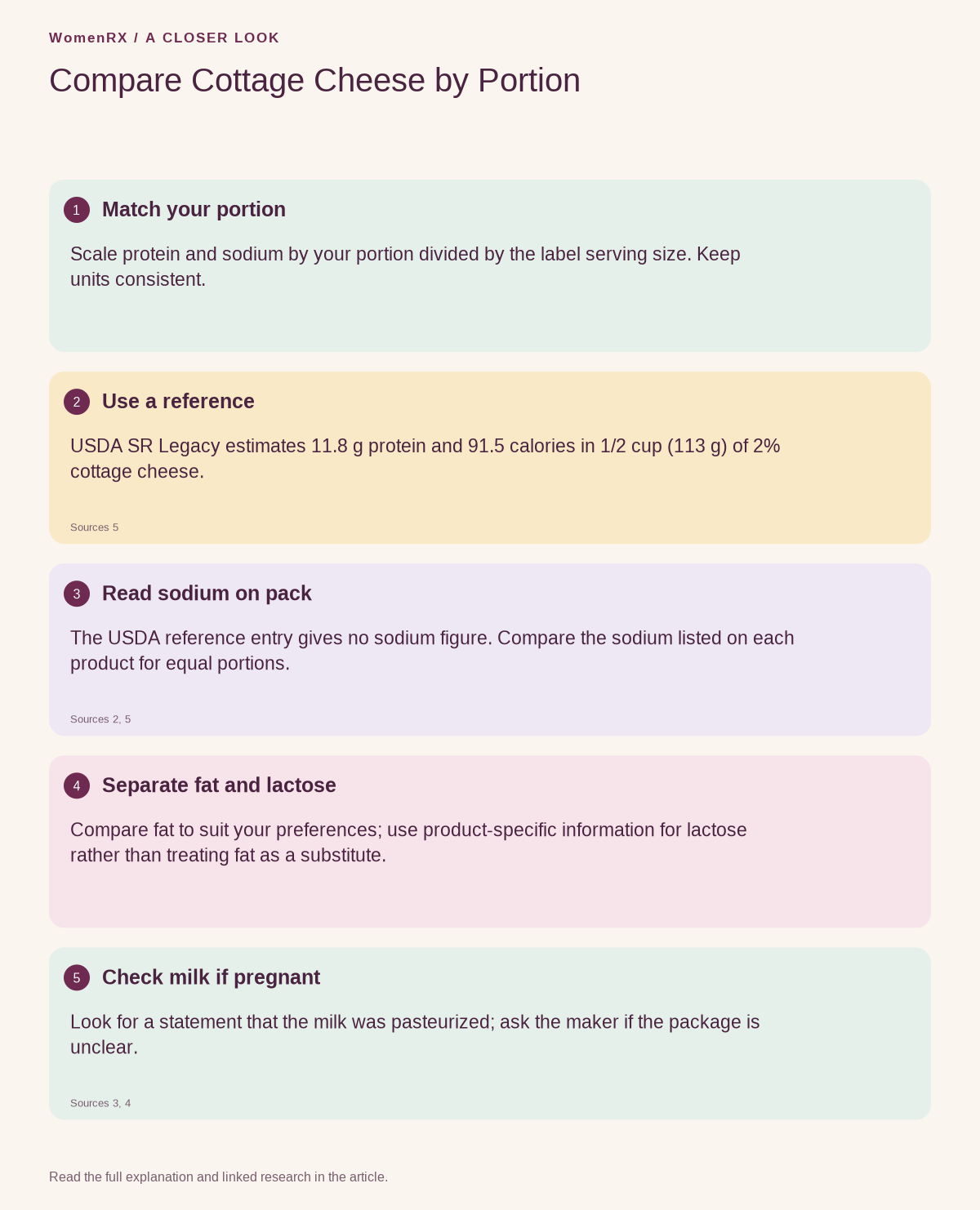
Compare Cottage Cheese by Portion
Match your portion: Scale protein and sodium by your portion divided by the label serving size. Keep units consistent.
Use a reference: USDA SR Legacy estimates 11.8 g protein and 91.5 calories in 1/2 cup (113 g) of 2% cottage cheese.5
Read sodium on pack: The USDA reference entry gives no sodium figure. Compare the sodium listed on each product for equal portions.25
Separate fat and lactose: Compare fat to suit your preferences; use product-specific information for lactose rather than treating fat as a substitute.
Check milk if pregnant: Look for a statement that the milk was pasteurized; ask the maker if the package is unclear.34
Read the figure as text
Use an equal portion to compare package values, then check the other details that may matter to your choice.- Match your portion: Scale protein and sodium by your portion divided by the label serving size. Keep units consistent.
- Use a reference: USDA SR Legacy estimates 11.8 g protein and 91.5 calories in 1/2 cup (113 g) of 2% cottage cheese.5
- Read sodium on pack: The USDA reference entry gives no sodium figure. Compare the sodium listed on each product for equal portions.25
- Separate fat and lactose: Compare fat to suit your preferences; use product-specific information for lactose rather than treating fat as a substitute.
- Check milk if pregnant: Look for a statement that the milk was pasteurized; ask the maker if the package is unclear.34
More questions, answered
Does cottage cheese have a special protein benefit for women?
Protein supports the body’s tissues, and needs vary with age, sex, health, and activity. Cottage cheese doesn’t need a women-specific benefit to be a useful protein choice. 1
How much sodium should I compare it with?
MedlinePlus summarizes the Dietary Guidelines as recommending less than 2,300 milligrams of sodium daily for most adults, while noting that some people may need less. That’s a daily context, not a cottage-cheese serving target. 2
Sources you can check
- Dietary Proteins: MedlinePlusAccessed 2026-09-25Return to first citation
- Sodium: MedlinePlusAccessed 2026-09-25Return to first citation
- Listeriosis.Disson O, Charlier C, Pérot P, Leclercq A, Paz RN, Kathariou S, Tsai YH, Lecuit M. · Nature reviews. Disease primers · 2025Return to first citation
- Outbreak of listeriosis among Mexican immigrants as a result of consumption of illicitly produced Mexican-style cheese.MacDonald PD, Whitwam RE, Boggs JD, MacCormack JN, Anderson KL, Reardon JW, Saah JR, Graves LM, Hunter SB, Sobel J. · Clinical infectious diseases : an official publication of the Infectious Diseases Society of America · 2005Return to first citation
- USDA SR Legacy: Cheese, cottage, lowfat, 2% milkfat (FDC 172182)Accessed 2026-09-25Return to first citation