Cottage Cheese Ideas and One Pancake Recipe With Macros
Blend cottage cheese into dips and sauces, bake it into a filling, or make pancakes with a published recipe that includes per-serving macros.
Cottage cheese can become a smooth dip or sauce, add moisture to a baked dish, or go into pancake batter. For a measured example, Cleveland Clinic’s cottage cheese pancakes make two servings. Each serving of four small pancakes with berries and syrup is estimated at 20 grams of protein, 58 grams of carbohydrate, and 14 grams of fat. 3 For your own dish, calculate from the ingredients and portions you use. 4
Cottage cheese is more versatile when you treat it as an ingredient, not a finished snack. Blend it for a smoother texture, stir it into a mixture for moisture, or add it to a dish where its soft curds fit. The best use depends on whether you want a dip, a creamy sauce, or something filling enough to serve as a meal.
For dips and spreads
Make a cottage cheese herb dip
This dip makes two servings. Use ½ cup cottage cheese, 1 tablespoon lemon juice, 1 tablespoon chopped parsley or dill, ¼ teaspoon garlic powder, ⅛ teaspoon black pepper, and 1 tablespoon water.
- Blend the ingredients until smooth. If the dip is too thick, blend in a little more water.
- Divide between two bowls and serve with sliced vegetables, whole-grain crackers, or toast.
For a chunkier spread, skip the blender and stir in the herbs and seasonings instead. You can also add finely diced vegetables.
If the dip tastes saltier than you’d like, try herbs, citrus, or pepper before adding salt. To estimate its sodium, check the label on the cottage cheese you use and any packaged crackers you serve with it. Nutrition Facts labels list sodium per labeled serving. 4
For creamy sauces
Blend cottage cheese with a little cooking water or milk, then stir it into warm pasta or spoon it over roasted vegetables. Start with a small amount of liquid and add more until the sauce is pourable. Take the pan off the heat before stirring the sauce in for a practical way to avoid cooking it further.
Try flavoring the sauce with black pepper, lemon zest, herbs, or a little grated cheese. Add vegetables or beans to the finished dish if you want more than a creamy topping. Cottage cheese contributes protein, a nutrient your body uses to build and maintain tissues, but the amount in your serving depends on the label value and how much you use. 1 4
For baked dishes
Stir cottage cheese into eggs before baking them in a casserole, or fold it into a vegetable filling for stuffed peppers or baked pasta. The curds will remain more noticeable if you use it straight from the container; blending first gives a smoother mixture. Because added cheese, sauces, and seasonings contribute to the finished dish, check their labels when estimating its nutrition. 4
For breakfast, sweet or savory
Blend cottage cheese into pancake batter for a soft, moist result, or serve it with fruit, oats, and nuts. For a savory breakfast, add it to scrambled eggs or pile it on toast with tomato and herbs. Fruit adds sweetness; oats, nuts, or whole-grain toast make the meal more substantial. These are flexible combinations, not a prescribed weight-loss plan. A healthy eating pattern can include a variety of foods rather than relying on one ingredient. 2
Make cottage cheese pancakes
This measured recipe is from Cleveland Clinic. It makes eight small pancakes, or two servings of four pancakes each, with berries and syrup. 3
For the pancakes: 2 large eggs, ¼ cup plain Greek yogurt, ½ teaspoon vanilla extract, 1 tablespoon sugar, ⅛ teaspoon salt, ½ cup all-purpose unbleached flour, and ½ cup 2% cottage cheese. Use 1 tablespoon canola oil for the skillet. For the topping: 1 cup berries and 2 tablespoons pure maple syrup. 3
- Briefly blend the pancake ingredients together until combined.
- Heat the oil in a nonstick skillet over medium heat. Cook the batter in small pancakes, about 2 to 3 minutes per side, working in batches.
- Mix the berries and syrup and warm them briefly in the microwave. Divide the pancakes and topping evenly between two plates. 3
Cleveland Clinic estimates per serving of four pancakes with half the topping: 430 calories, 20 grams protein, 58 grams carbohydrate, 14 grams fat, 3 grams fiber, and 420 milligrams sodium. Those are the publisher’s estimates for its recipe, not figures for every cottage cheese pancake. If you change an ingredient or portion, recalculate using what you actually use. 3 4
Calculate the nutrition for your recipe
Skip generic “cottage cheese macros” when you’re planning a specific meal. Start with the package in your refrigerator and its labeled serving size. 4
- Record the label values. Note protein, carbohydrate, fat, calories, and sodium per labeled serving for the cottage cheese and other packaged ingredients.
- Scale to the amount used. If you use half a labeled serving, count half of that label’s values. For other packaged ingredients, use their own serving information.
- Add the recipe totals. Include ingredients such as milk, cheese, beans, or seasoning blends. Fruit, oats, vegetables, and whole grains add their own nutrition, including any fiber they contribute; count those ingredients separately from the cottage cheese. 5
- Divide by the portions you serve. If the recipe makes four similar portions, divide the total values by four. If portions vary, your per-portion estimate will vary too. 4
Protein is one part of the meal, not a measure of whether it is complete or right for you. How much protein a person needs depends on factors including age, sex, health, and activity level. 1 The practical choice is to match the cottage cheese and portion to the recipe, then consider what the rest of the dish adds.
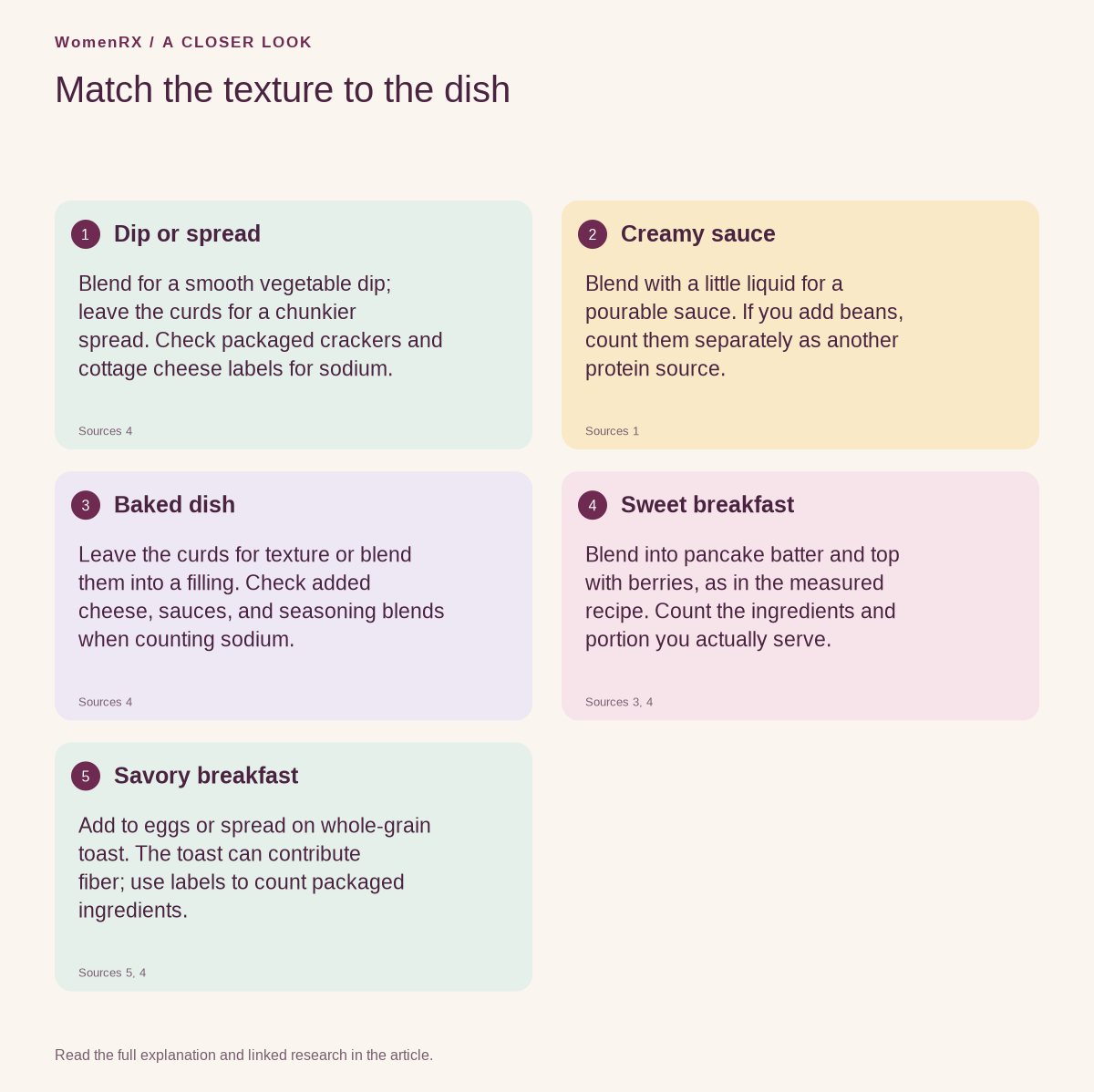
Match the texture to the dish
Dip or spread: Blend for a smooth vegetable dip; leave the curds for a chunkier spread. Check packaged crackers and cottage cheese labels for sodium.4
Creamy sauce: Blend with a little liquid for a pourable sauce. If you add beans, count them separately as another protein source.1
Baked dish: Leave the curds for texture or blend them into a filling. Check added cheese, sauces, and seasoning blends when counting sodium.4
Sweet breakfast: Blend into pancake batter and top with berries, as in the measured recipe. Count the ingredients and portion you actually serve.34
Savory breakfast: Add to eggs or spread on whole-grain toast. The toast can contribute fiber; use labels to count packaged ingredients.54
Read the figure as text
Compare ways to use cottage cheese and see which accompanying ingredients to count for protein, fiber, or sodium.- Dip or spread: Blend for a smooth vegetable dip; leave the curds for a chunkier spread. Check packaged crackers and cottage cheese labels for sodium.4
- Creamy sauce: Blend with a little liquid for a pourable sauce. If you add beans, count them separately as another protein source.1
- Baked dish: Leave the curds for texture or blend them into a filling. Check added cheese, sauces, and seasoning blends when counting sodium.4
- Sweet breakfast: Blend into pancake batter and top with berries, as in the measured recipe. Count the ingredients and portion you actually serve.34
- Savory breakfast: Add to eggs or spread on whole-grain toast. The toast can contribute fiber; use labels to count packaged ingredients.54
More questions, answered
How do I count cottage cheese protein and sodium in a recipe?
Read the protein and sodium amounts per serving on the Nutrition Facts label of the cottage cheese you’re using. Scale those amounts to what goes into the recipe, then divide by the number of portions you serve. Count other ingredients separately. 4
Can cottage cheese be part of a weight-loss meal?
It can be one ingredient in a meal, but using cottage cheese does not guarantee weight loss. The recipe’s portions and other ingredients matter, and healthy eating does not require limiting yourself to one specific food. 2
Sources you can check
- Dietary Proteins: MedlinePlusAccessed 2026-09-25Return to first citation
- Nutrition: MedlinePlusAccessed 2026-09-25Return to first citation
- Recipe: Cottage Cheese PancakesAccessed 2026-09-25Return to first citation
- Food Labeling: MedlinePlusAccessed 2026-09-25Return to first citation
- Dietary Fiber: MedlinePlusAccessed 2026-09-25Return to first citation