What Should a Protein Smoothie Include After 40?
A smoothie can be a convenient way to combine protein and fiber, but turning 40 doesn’t create a special smoothie requirement.
Build a smoothie around a protein-containing food, such as milk or yogurt, then add fruit and a fiber-rich ingredient such as oats. For one serving, try milk, Greek-style yogurt, berries, and oats blended until smooth. Whether it’s useful depends on what you’d otherwise eat and how satisfied it leaves you. Turning 40 doesn’t establish a new smoothie requirement. 1 2 4 6
There’s no smoothie milestone at 40
A protein smoothie can make sense when you want a quick breakfast or snack, have trouble fitting a meal into your routine, or simply prefer drinking some of your food. It isn’t something you need to start because you turned 40. Protein needs vary with factors including age, health, and physical activity, and most Americans get enough protein overall. 1
Research on protein and muscle with aging doesn’t point to a specific birthday when everyone should change their diet. In a Norwegian study that assessed diet in middle age and later life, adjusted analyses found no longitudinal association between isocaloric substitution of dietary protein for fat and carbohydrates and later muscle mass or handgrip strength. That narrower finding doesn’t settle every question about protein or establish a smoothie prescription. 4
A separate study of adults ages 60 to 65 found an association between protein intake and muscle mass in both women and men. It was observational, so it can’t show that protein caused the difference, and it didn’t study smoothies or women in their 40s. 5
Blend one breakfast, then compare it with a bowl
For one smoothie serving, combine 1 cup milk, 6 ounces plain Greek-style yogurt, ½ cup berries, and ¼ cup rolled oats in a blender. Blend until smooth and pour the entire batch into one glass. Change the fruit or adjust the texture to suit you; this isn’t an age-based prescription.
The milk and yogurt together contribute an estimated 22-26 grams of protein: about 8 grams from the cup of milk and 14-18 grams from the 6 ounces of Greek-style yogurt, according to the VA’s food-portion guide. That’s the contribution of those two foods, not a measured protein total or complete nutrition estimate for the smoothie. Products vary, and changing the ingredients changes the nutrition. 6
The berries and oats add plant foods to the glass. Fruit and whole grains are sources of fiber, which adds bulk and can help you feel full sooner. If you don’t usually eat much fiber, increase it gradually; a sudden change can bring gas, bloating, or cramps. 2 You can change the fruit or use less milk for a thicker texture, keeping in mind that a swap also changes what’s in the serving.
You don’t have to use protein powder. Milk and yogurt are food-based protein sources, and you can check a product’s label when comparing options. 1 6
Smoothie or solid-food breakfast?
Think about what the smoothie replaces. For a direct comparison, put the same 6 ounces of yogurt, ½ cup berries, and ¼ cup oats in a bowl and have the same cup of milk alongside it. The milk and yogurt supply protein in either version, while the berries and oats contribute fiber. Blending those foods isn’t a reason to count them as more nutritious than eating them as a bowl and drink. 1 2 3 6
The practical difference may be convenience, texture, and how satisfied you feel afterward, rather than an age-specific advantage of blending. If a smoothie works well for your morning, it’s a reasonable option. If you find you’re hungry again soon, try the bowl version and see whether it suits you better. That’s a personal comparison, not a proven rule: the studies described above examined protein and muscle outcomes, not smoothie-versus-solid meals or weight loss. 4 5
Those studies also did not test whether menopause changes the benefits of smoothies or creates a need for a particular smoothie. 4 5 It’s more useful to choose a breakfast that fits your appetite and routine than to follow a recipe based on an age cutoff.
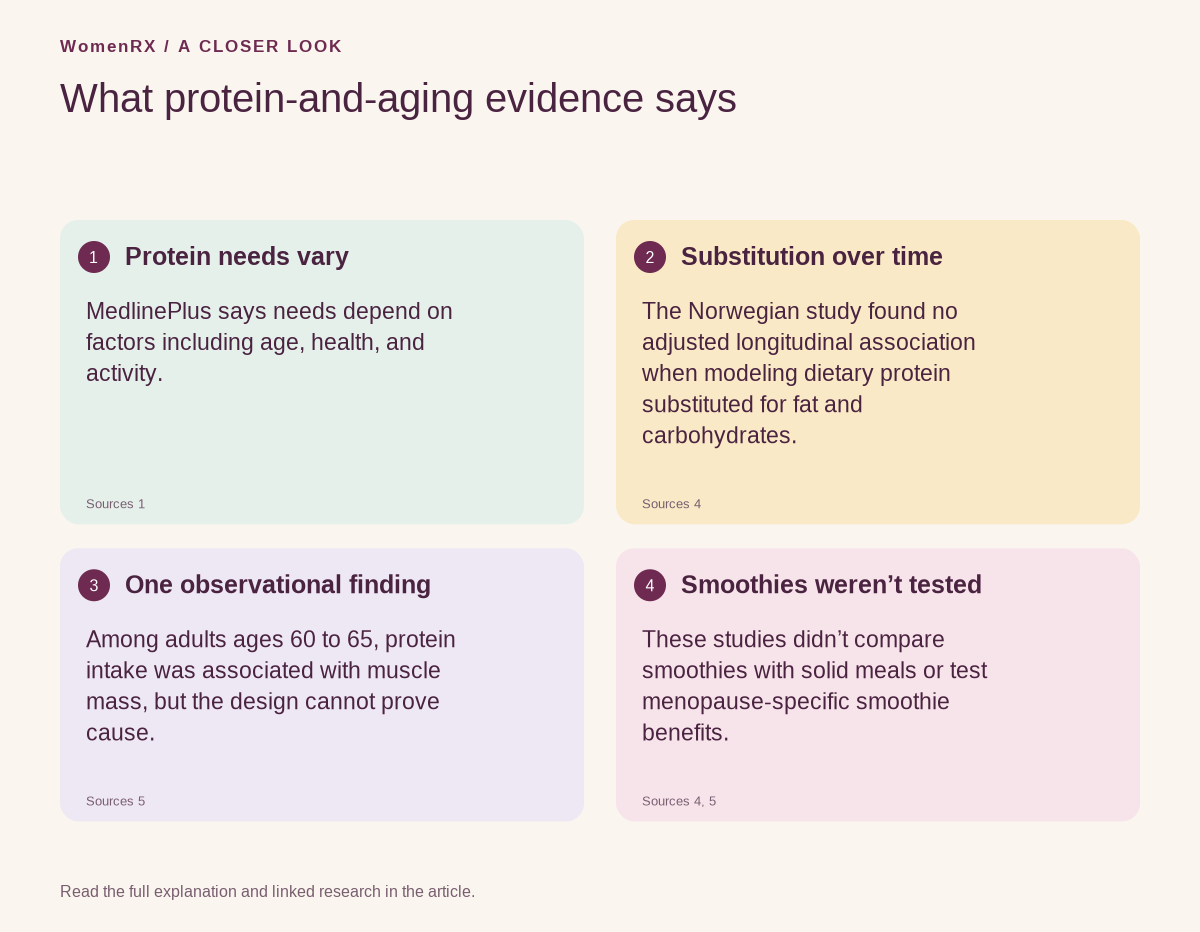
What protein-and-aging evidence says
Protein needs vary: MedlinePlus says needs depend on factors including age, health, and activity.1
Substitution over time: The Norwegian study found no adjusted longitudinal association when modeling dietary protein substituted for fat and carbohydrates.4
One observational finding: Among adults ages 60 to 65, protein intake was associated with muscle mass, but the design cannot prove cause.5
Smoothies weren’t tested: These studies didn’t compare smoothies with solid meals or test menopause-specific smoothie benefits.45
Read the figure as text
Separate findings about dietary protein and muscle from questions these studies did not test.- Protein needs vary: MedlinePlus says needs depend on factors including age, health, and activity.1
- Substitution over time: The Norwegian study found no adjusted longitudinal association when modeling dietary protein substituted for fat and carbohydrates.4
- One observational finding: Among adults ages 60 to 65, protein intake was associated with muscle mass, but the design cannot prove cause.5
- Smoothies weren’t tested: These studies didn’t compare smoothies with solid meals or test menopause-specific smoothie benefits.45
Sources you can check
- Dietary Proteins: MedlinePlusAccessed 2026-09-25Return to first citation
- Dietary Fiber: MedlinePlusAccessed 2026-09-25Return to first citation
- Nutrition: MedlinePlusAccessed 2026-09-25Return to first citation
- The Association of Isocaloric Substitution of Dietary Protein in Middle Age with Muscle Mass and Strength in Old Age: The Hordaland Health Study.Sabir Z, Hjartåker A, Dierkes J, Rosendahl-Riise H. · Current developments in nutrition · 2024Return to first citation
- Dietary and Physical Activity Correlates of Muscle Mass in 60-65-Year-Old Seniors: A Gender-Specific Analysis.Sołtysik BK, Balicki P, Kowalczyk K, Lutostańska A, Dmuchowska J, Pigłowska M, Kostka T. · Nutrients · 2025Return to first citation
- Healthy Ways to Add Protein, VA Nutrition and Food ServicesAccessed 2026-09-25Return to first citation