How to Judge Estradiol Treatment Reviews and Evidence
A personal review can tell you what one person experienced, but it can’t show whether the same result is likely for you or how treatment risks compare.
When you read an estradiol review, look for the exact product and route, dose, treatment goal, and how long the person used it. Those details matter because menopause hormone therapy’s benefits and risks vary with the regimen and the person’s circumstances. Treat a review as one person’s account, not proof of a typical benefit or a safety guarantee; compare it with evidence from studies and guidance. 1
Start with what the review can tell you
A personal review is most useful for describing an individual experience: whether a product felt convenient, what the person noticed, or what they found difficult. It can help you think of questions to ask about using a particular formulation. It cannot tell you how often a benefit or side effect happens, or establish that estradiol caused a change. For that, you need studies that systematically assess outcomes and account for factors that can affect results.
Even research that asks people to report their own symptoms is different from an online testimonial. For example, one prospective, non-interventional study followed postmenopausal women using an estradiol spray in Sweden and Finland. Participants reported improved menopause-related quality-of-life scores over 12 weeks, but the study did not compare treatment with a control group. Its results describe what participants reported while using that spray; they don’t establish how much of the change was caused by the treatment or whether it applies to other products and populations. 2
Use five details to judge a review
1. What exactly was used? Look for the product name and formulation. “Estradiol” alone isn’t enough to compare two accounts: the North American Menopause Society’s position statement says hormone therapy risks vary by route and dose, among other factors. 1
2. What was the route? A review of a spray, for example, is not automatically a good comparison for a different route. Route is one of the factors the position statement identifies as affecting the risk profile. 1
3. What dose or regimen? If the review leaves this out, it’s hard to know whether the experience applies to the treatment you’re considering. The statement identifies dose and whether a progestogen is used as factors in hormone therapy risks. 1
4. What was the goal? Was the person treating hot flashes and night sweats, vaginal or urinary symptoms, or something else? The position statement describes hormone therapy as an effective treatment for vasomotor symptoms and genitourinary syndrome of menopause, while noting that the treatment approach depends on the indication. 1
5. How long did they use it? A few days, several weeks, and longer-term use are not interchangeable experiences. Check whether the review gives a time period, and be cautious about comparing an early impression with a study that measured outcomes later. For instance, the spray study assessed participants at baseline, week 6, and week 12. 2
If several of these details are missing, the review may still be interesting, but it’s a weak basis for comparing treatments.
Check whether the evidence matches your situation
Menopause treatment isn’t one-size-fits-all. The 2022 position statement says the benefit-risk balance varies with treatment type, dose, duration, route, timing of initiation, and whether a progestogen is used. It recommends individualizing treatment and periodically reevaluating its benefits and risks. 1 That’s why a review from someone with a different treatment goal, route, or stage of life may not predict your experience.
The distinction can matter for surgical menopause too. A systematic review of 12 studies in women after surgical menopause or bilateral ovary removal examined patient-reported psychological and sexual outcomes. The authors reported a possible benefit of estradiol for depressed mood in the short term, but results were highly variable, most studies had uncertain risk of bias, and the review called for more research. Those findings describe a specific population and outcome; they shouldn’t be treated as a general prediction for everyone using estradiol during menopause. 3
Read positive and negative reviews with the same care
A glowing account doesn’t prove a treatment is effective for most people, and a bad experience doesn’t prove it will fail for you. Neither kind of review can establish how common a side effect is or rule out less common harms. A small study reporting no related adverse reactions, for example, is not the same as evidence that a treatment has no risks. The position statement emphasizes that risks differ with the regimen and individual circumstances. 12
A practical way to use reviews is to write down what they make you curious about, then compare those questions with evidence that matches your goal and treatment. If the review doesn’t identify the formulation, route, dose, goal, or time period, mark that comparison as uncertain rather than filling in the blanks yourself.
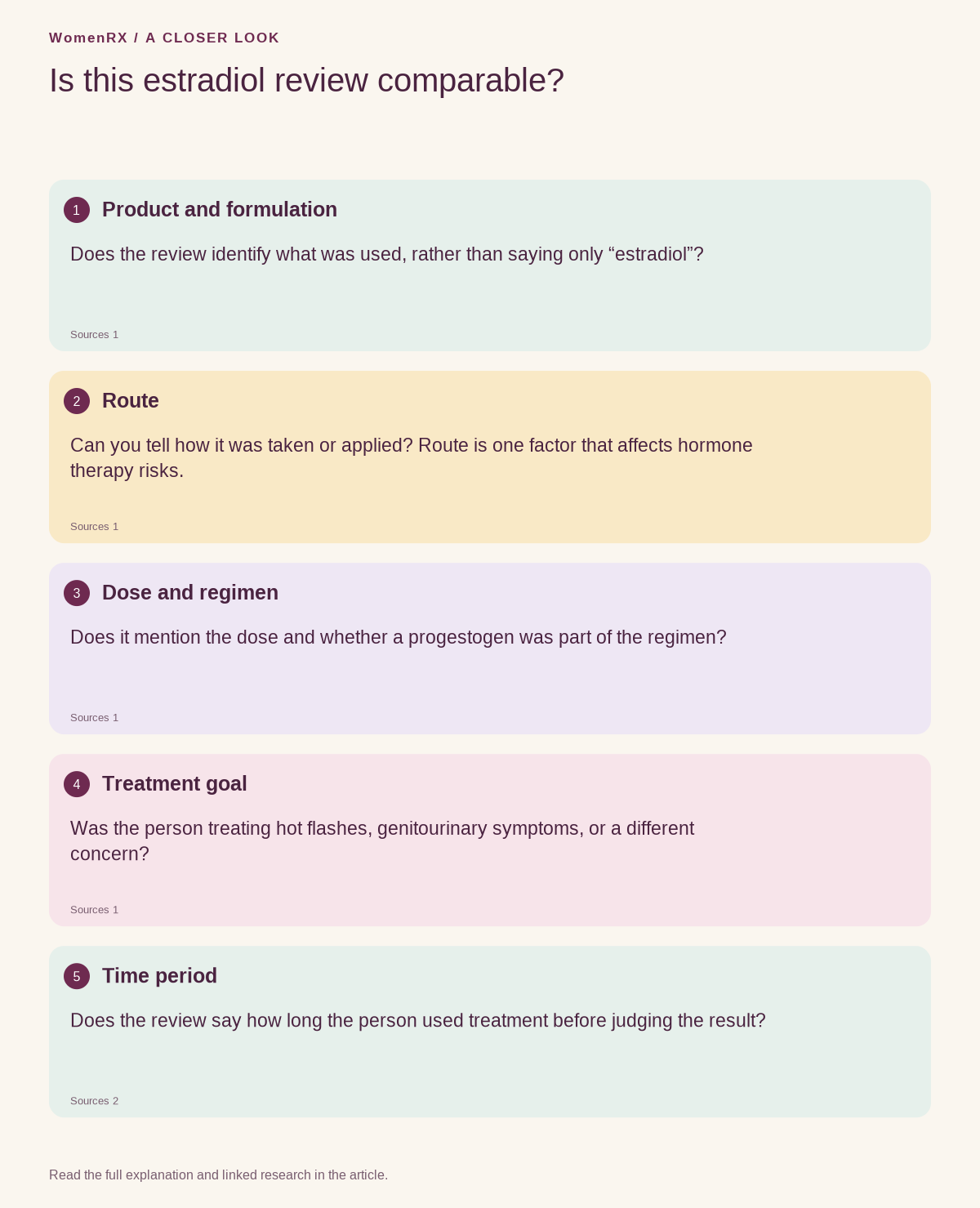
Is this estradiol review comparable?
Product and formulation: Does the review identify what was used, rather than saying only “estradiol”?1
Route: Can you tell how it was taken or applied? Route is one factor that affects hormone therapy risks.1
Dose and regimen: Does it mention the dose and whether a progestogen was part of the regimen?1
Treatment goal: Was the person treating hot flashes, genitourinary symptoms, or a different concern?1
Time period: Does the review say how long the person used treatment before judging the result?2
Read the figure as text
Check whether a personal account provides enough detail to compare its experience with your own treatment question.- Product and formulation: Does the review identify what was used, rather than saying only “estradiol”?1
- Route: Can you tell how it was taken or applied? Route is one factor that affects hormone therapy risks.1
- Dose and regimen: Does it mention the dose and whether a progestogen was part of the regimen?1
- Treatment goal: Was the person treating hot flashes, genitourinary symptoms, or a different concern?1
- Time period: Does the review say how long the person used treatment before judging the result?2
More questions, answered
If a review says estradiol made a difference quickly, should I expect the same timing?
Not necessarily. A personal account may not identify the regimen or give enough context to compare. In one non-interventional study of an estradiol spray, researchers measured outcomes at weeks 6 and 12; that study doesn’t establish a universal timeline for other formulations or individuals. 2
Sources you can check
- The 2022 hormone therapy position statement of The North American Menopause Society.“The 2022 Hormone Therapy Position Statement of The North American Menopause Society” Advisory Panel. · Menopause (New York, N.Y.) · 2022Return to first citation
- Transdermal estradiol spray in Nordic menopausal women: real-world patient outcomes.Polo-Kantola P, Lindeberg M, Hirschberg AL. · Climacteric : the journal of the International Menopause Society · 2026Return to first citation
- Surgical Menopause and Bilateral Oophorectomy: Effect of Estrogen-Progesterone and Testosterone Replacement Therapy on Psychological Well-being and Sexual Functioning; A Systematic Literature Review.Stuursma A, Lanjouw L, Idema DL, de Bock GH, Mourits MJE. · The journal of sexual medicine · 2022Return to first citation