How to Judge Testosterone Stories After Menopause
A personal account can suggest a question, but only a fair comparison can show whether testosterone added a benefit or drawback for a particular symptom.
For postmenopausal women, small randomized trials have mainly examined sexual function, and their short follow-up offers only limited clues about side effects. One short trial reported acne; another reported a low frequency of androgenic adverse events. Neither result predicts your experience or settles long-term risks. When weighing a story, match its symptom, treatment, and time frame to the evidence. 34
First, pin down what “feeling better” means
A review that says testosterone helped may refer to desire, comfort during sex, mood, energy, strength, or body composition. Those aren’t interchangeable outcomes. A change in one doesn’t establish a benefit in the others.
In postmenopausal women, the randomized trials described in the research literature have primarily measured sexual function. The studies differ, though: one enrolled women with symptoms of vaginal atrophy, another studied women reporting low desire while already using hormone therapy, and another added testosterone to estrogen. 124
That makes the details of a story matter. Someone describing more desire while using testosterone alongside estrogen isn’t reporting the same situation as someone seeking help for fatigue or weight change.
What a comparison can tell you
A testimonial records one person’s experience, but it can’t separate testosterone’s effect from other changes happening at the same time. A person may not know whether a shift came from testosterone, another treatment, changing circumstances, or several things together. And people who choose to post reviews aren’t necessarily representative of everyone who tried a treatment.
Randomized trials add a comparison. In an eight-week study of 70 postmenopausal women, sexual-function scores improved in both groups: one received estrogen plus testosterone gel, and the other received estrogen alone. The average increase was larger in the group given testosterone, but improvement in both groups shows why the comparison matters. 4
A placebo-controlled trial of 47 postmenopausal women receiving hormone therapy reported improvement in some sexual-function measures in the testosterone group. The placebo group also improved in the pain domain. A change from a person’s starting point, by itself, doesn’t reveal how much testosterone contributed. 2
These studies compare average changes between groups; they can’t say exactly how one individual will respond. If a story describes a benefit, ask whether a controlled trial measured that same benefit and found a difference between groups.
How much can side-effect reports tell you?
A story about acne or another unwanted change may be worth taking seriously as one person’s experience, but it can’t tell you how likely that effect is for you. The small trials here give limited, short-term context: in an eight-week study of 70 postmenopausal women taking testosterone with estrogen, acne was reported and no serious adverse effect was reported. A separate 24-week trial in 71 women with a history of hysterectomy described the frequency of androgenic adverse events as low. These studies don’t establish the chance of a particular side effect for an individual or settle uncommon and long-term risks. 34
Treatment details matter when comparing accounts, too. A 2026 placebo-controlled trial of 47 postmenopausal women using hormone therapy studied compounded transdermal testosterone. Its authors noted that variability in hormone concentrations made evaluating compounded medication challenging. That’s a limitation of interpreting this treatment in that study, not proof that every product varies or that variability caused a particular side effect. 2
Check whether the study matches the claim
The route and treatment context can matter too. One 12-week trial involved 80 postmenopausal women with symptoms of vaginal atrophy and compared vaginal testosterone with a lubricant control. The testosterone group improved on several self-reported measures, including desire, lubrication, satisfaction, pain during intercourse, and overall sexual-function score. Those findings concern that population, treatment, and set of outcomes. 1
For body composition and physical performance, a 24-week randomized trial enrolled 71 postmenopausal women who had previously had a hysterectomy, with or without removal of the ovaries. Participants used an estradiol regimen during a run-in period before assignment to testosterone or placebo. Some outcomes, including lean body mass and measures of power, were related to testosterone concentration; differences from placebo were reported in the highest-dose group, not the lower-dose groups. This specialized study doesn’t establish testosterone as a general weight-loss treatment. 3
The trials summarized here don’t establish that testosterone improves mood or energy in postmenopausal women. That doesn’t prove no research exists; it means a story about those outcomes shouldn’t be treated as a benefit demonstrated by these sexual-function trials.
Questions that make a claim easier to weigh
When you read a review or hear someone describe a result, ask:
- What changed? Desire, vaginal comfort, mood, energy, strength, body composition, or a side effect?
- Who was studied? Were the women postmenopausal, and did they have a similar concern and treatment context?
- What else was part of the treatment? Was testosterone used with estrogen, or was another product or approach studied?
- Was there a comparison group? Did women receiving testosterone improve more than women receiving the comparison treatment, or was a drawback measured in both groups?
- How long were outcomes followed? An improvement over weeks doesn’t establish whether it lasts or settle uncommon or long-term risks. The studies above followed participants for 8, 12, or 24 weeks. 134
A personal report may be worth paying attention to as a description of one experience. To judge whether it applies to you, keep its conclusion as specific as the evidence: which symptom or side effect changed, in whom, with what treatment, and compared with what.
What evidence says about benefits and drawbacks
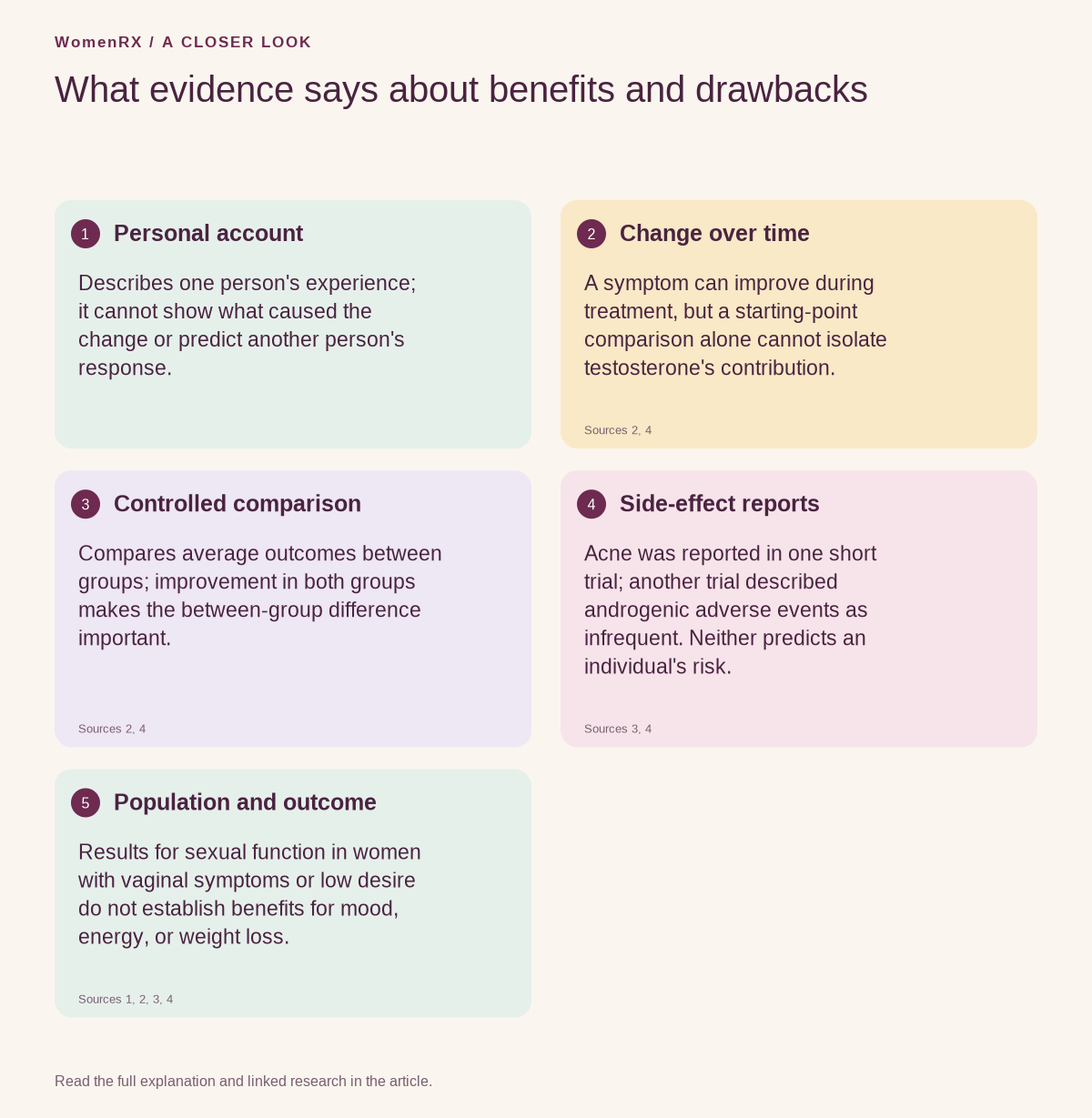
Personal account: Describes one person's experience; it cannot show what caused the change or predict another person's response.
Change over time: A symptom can improve during treatment, but a starting-point comparison alone cannot isolate testosterone's contribution.24
Controlled comparison: Compares average outcomes between groups; improvement in both groups makes the between-group difference important.24
Side-effect reports: Acne was reported in one short trial; another trial described androgenic adverse events as infrequent. Neither predicts an individual's risk.34
Population and outcome: Results for sexual function in women with vaginal symptoms or low desire do not establish benefits for mood, energy, or weight loss.1234
Read the figure as text
Personal accounts, short-term side-effect reports, and randomized comparisons answer different questions. Match the reported outcome and treatment to the study details.- Personal account: Describes one person's experience; it cannot show what caused the change or predict another person's response.
- Change over time: A symptom can improve during treatment, but a starting-point comparison alone cannot isolate testosterone's contribution.24
- Controlled comparison: Compares average outcomes between groups; improvement in both groups makes the between-group difference important.24
- Side-effect reports: Acne was reported in one short trial; another trial described androgenic adverse events as infrequent. Neither predicts an individual's risk.34
- Population and outcome: Results for sexual function in women with vaginal symptoms or low desire do not establish benefits for mood, energy, or weight loss.1234
More questions, answered
Can a testosterone story tell me whether I’ll have the same result?
No. It describes one person’s experience, not your likely response. Even randomized trials report average differences between groups, and the postmenopausal studies vary in participants, treatments, and outcomes. 124
Do reported side effects show how likely they are for me?
No. Acne was reported in one eight-week trial, while another 24-week trial described androgenic adverse events as infrequent. These small studies offer limited short-term context, not a personal prediction. 34
Do short-term studies settle long-term safety?
No. The trials described here followed participants for weeks or months. Their short-term findings can’t establish uncommon or long-term risks. 134
Sources you can check
- Efficacy of vaginally applied estrogen, testosterone, or polyacrylic acid on sexual function in postmenopausal women: a randomized controlled trial.Fernandes T, Costa-Paiva LH, Pinto-Neto AM. · The journal of sexual medicine · 2014Return to first citation
- Effect of transdermal testosterone on postmenopausal sexual desire: placebo-controlled randomized clinical trial.Ceccatto Andrade VP, Araujo Júnior E, Callado GY, Ceccatto Andrade G, Kulak Junior J. · European journal of obstetrics, gynecology, and reproductive biology · 2026Return to first citation
- Testosterone dose-response relationships in hysterectomized women with or without oophorectomy: effects on sexual function, body composition, muscle performance and physical function in a randomized trial.Huang G, Basaria S, Travison TG, Ho MH, Davda M, Mazer NA, Miciek R, Knapp PE, Zhang A, Collins L, Ursino M, Appleman E, Dzekov C, Stroh H, Ouellette M, Rundell T, Baby M, Bhatia N... · Menopause (New York, N.Y.) · 2014Return to first citation
- Efficacy of oral estrogen plus testosterone gel to improve sexual function in postmenopausal women.Chaikittisilpa S, Soimongkol K, Jaisamrarn U. · Climacteric : the journal of the International Menopause Society · 2019Return to first citation