Which Benefits of Testosterone Therapy in Women Are Supported by Evidence?
The clearest evidence in these studies is for sexual desire and function in postmenopausal women, not broad promises about energy or mood.
Small randomized trials in postmenopausal women suggest testosterone can improve measures of sexual desire or overall sexual function, but they don’t guarantee an individual response. The studies were short and used different comparisons and formulations. A separate trial in women with antidepressant-resistant depression found no added benefit for fatigue, depression, or sexual function, so those results don’t support broad energy or mood claims. 2 3 4
The strongest signal is sexual desire and function
Among the outcomes in these studies, sexual desire and function have the clearest support, particularly in postmenopausal women. In a placebo-controlled trial of 47 postmenopausal women reporting low desire while using hormone therapy, the testosterone group had higher testosterone levels and improvements in several sexual-function measures, including desire and satisfaction. The placebo group also improved in the pain domain, a reminder that not every change was specific to testosterone. 2
A second randomized trial included 70 postmenopausal women with low sexual function. Both groups received estrogen; one group also received testosterone gel. After eight weeks, sexual-function scores improved in both groups, with a larger average improvement in the group receiving testosterone plus estrogen. This suggests a possible added benefit in that study setting, but it doesn’t show that testosterone alone produces the same result or that every woman will notice a difference. 3
Taken together, these trials point to a possible benefit for postmenopausal sexual desire or function, not a guaranteed result. They were small, lasted only eight weeks in the study with a clearly reported timeframe, and tested different treatment setups. One used compounded testosterone and reported variability in hormone levels, which made those levels harder to evaluate. 2 3
A lab change isn’t the same as a felt benefit
Testosterone levels rose in the testosterone group in the 47-person trial, alongside improvements in some sexual-function measures. That doesn’t show that a particular blood level predicts who will feel better, or that raising a lab result is itself a meaningful benefit. The outcomes that matter to a person are the symptoms and changes she experiences, not the number alone. 2
Desire can also be affected by factors other than hormones. Medications and chronic health conditions are among the factors that can affect sexual health, so a change in desire doesn’t by itself establish that testosterone is the cause. 1
Energy and mood are not established benefits here
A randomized placebo-controlled trial tested testosterone as an add-on for 101 women ages 21 to 70 with antidepressant-resistant major depression. After eight weeks, depression scores improved in both groups, but testosterone was not more effective than placebo. Improvement in fatigue and sexual function also did not differ between groups. This study doesn’t settle every possible question about testosterone and energy, but it does not support promising improved fatigue or mood in this particular group. 4
The sexual-function results from that trial also shouldn’t be treated as a contradiction of the postmenopausal studies: the participants had treatment-resistant depression, the trial tested an add-on in that context, and the two menopause studies focused on postmenopausal women with sexual concerns. The reason treatment is being considered and the population studied matter. 2 3 4
What to make of broader promises
These studies don’t establish benefits for weight, muscle, memory, or bone health. That is a limit of what these particular studies show, not proof that no research exists. If a claim is being used to justify treatment, ask whether it was measured in women like you, for the reason you’re considering treatment, and whether the study compared testosterone with a control group.
A useful distinction is between a measured hormone change and an improvement in a person’s day-to-day experience. For sexual concerns, these trials measured sexual-function scores and found some improvement in postmenopausal groups. For fatigue and mood, the depression trial did not find an advantage over placebo. Those are different levels of evidence, and they shouldn’t be bundled into a promise that testosterone improves overall vitality. 2 3 4
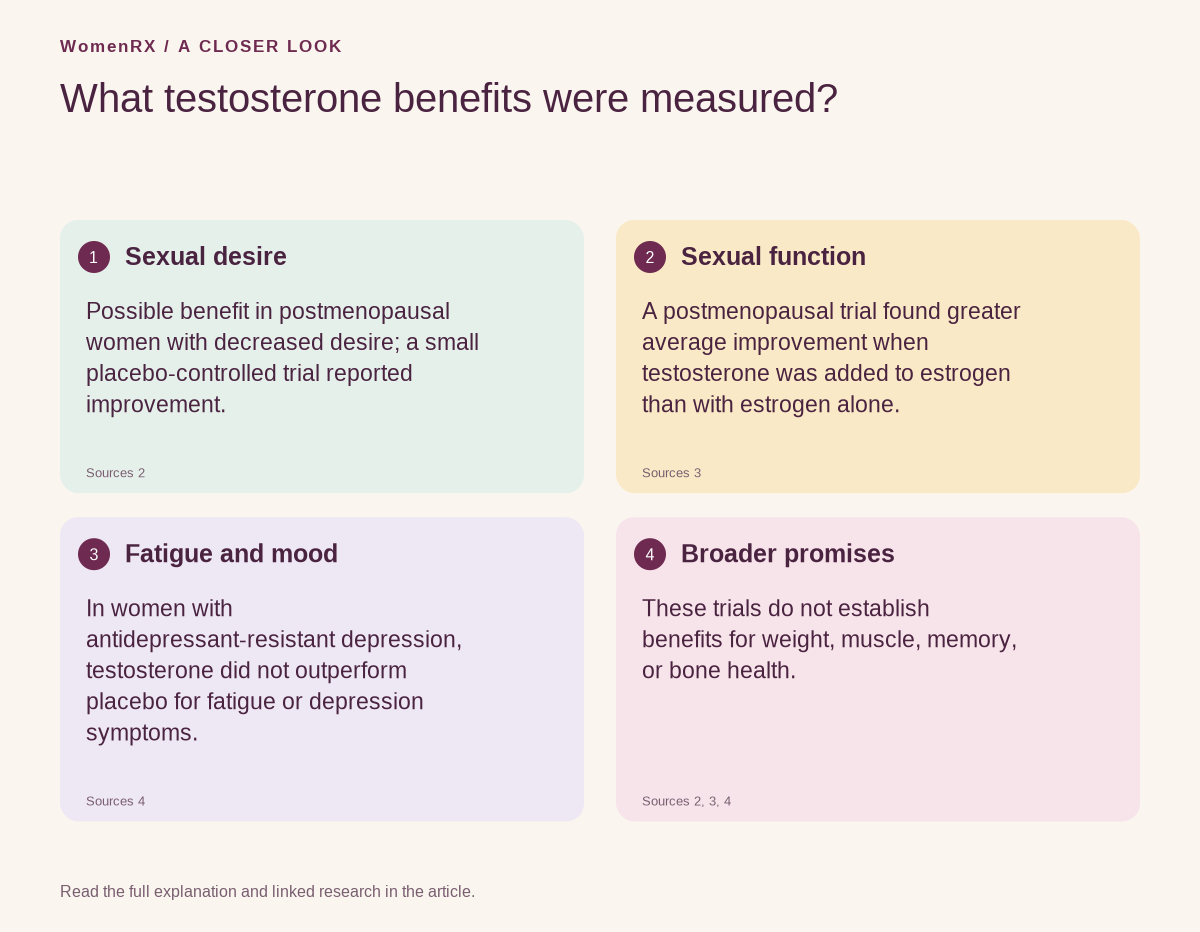
What testosterone benefits were measured?
Sexual desire: Possible benefit in postmenopausal women with decreased desire; a small placebo-controlled trial reported improvement.2
Sexual function: A postmenopausal trial found greater average improvement when testosterone was added to estrogen than with estrogen alone.3
Fatigue and mood: In women with antidepressant-resistant depression, testosterone did not outperform placebo for fatigue or depression symptoms.4
Broader promises: These trials do not establish benefits for weight, muscle, memory, or bone health.234
Read the figure as text
These categories separate outcomes with a signal in the cited trials from claims those trials did not establish.- Sexual desire: Possible benefit in postmenopausal women with decreased desire; a small placebo-controlled trial reported improvement.2
- Sexual function: A postmenopausal trial found greater average improvement when testosterone was added to estrogen than with estrogen alone.3
- Fatigue and mood: In women with antidepressant-resistant depression, testosterone did not outperform placebo for fatigue or depression symptoms.4
- Broader promises: These trials do not establish benefits for weight, muscle, memory, or bone health.234
More questions, answered
Do the sexual-function findings apply before menopause?
The two trials showing possible sexual-function benefits enrolled postmenopausal women. The depression trial included women ages 21 to 70, but studied antidepressant-resistant depression rather than a menopause-specific indication. These results don’t establish the same benefit for women who are still cycling. 2 3 4
Does a higher testosterone level mean treatment is working?
Not by itself. In one postmenopausal trial, testosterone levels rose along with improvements in some sexual-function measures, but the study doesn’t show that a lab result predicts an individual woman’s experience. 2
Sources you can check
- Sexual Health | MedlinePlusAccessed 2026-09-25Return to first citation
- Effect of transdermal testosterone on postmenopausal sexual desire: placebo-controlled randomized clinical trial.Ceccatto Andrade VP, Araujo Júnior E, Callado GY, Ceccatto Andrade G, Kulak Junior J. · European journal of obstetrics, gynecology, and reproductive biology · 2026Return to first citation
- Efficacy of oral estrogen plus testosterone gel to improve sexual function in postmenopausal women.Chaikittisilpa S, Soimongkol K, Jaisamrarn U. · Climacteric : the journal of the International Menopause Society · 2019Return to first citation
- Low-Dose Testosterone Augmentation for Antidepressant-Resistant Major Depressive Disorder in Women: An 8-Week Randomized Placebo-Controlled Study.Dichtel LE, Carpenter LL, Nyer M, Mischoulon D, Kimball A, Deckersbach T, Dougherty DD, Schoenfeld DA, Fisher L, Cusin C, Dording C, Trinh NH, Pedrelli P, Yeung A, Farabaugh A, Pap... · The American journal of psychiatry · 2020Return to first citation