Testosterone Therapy for Women: Which Side Effects Need Attention?
New acne may be worth a routine discussion, while voice deepening, vaginal bleeding, or breathing trouble calls for a faster response.
If you’re using testosterone, note new acne, facial hair, or scalp-hair thinning and bring them to your prescriber rather than changing the dose yourself. Contact the prescriber promptly about voice deepening, clitoral enlargement, or vaginal bleeding. Trouble breathing or swelling of the face, lips, or tongue needs emergency care. These distinctions draw partly on guidance for a specific testosterone cream, so your own product and symptoms matter.34
Start with what has changed
A few new spots and a newly deeper voice don’t call for the same response. Testosterone can cause androgenic effects such as acne and changes in hair growth. Clinicians who prescribe it are advised to check for these changes and monitor testosterone levels so they don’t rise above the usual premenopausal range.34
If you notice a change, tell your prescriber what it is, when it began, and whether it’s progressing. Mention the testosterone product you use and any other hormone treatment. That gives you a more useful starting point than assuming every symptom is caused by testosterone or changing the dose on your own.34
Acne and hair changes: bring them up, even if they seem small
New spots, more facial or body hair, and thinning scalp hair are possible androgenic effects. Acne can also come with oily skin.14 They’re worth discussing at a routine review, particularly if they’re increasing or troubling you. A useful question is: “Could this be an androgenic effect, and do my symptoms and testosterone level change the treatment plan?” Monitoring is meant to help identify excess exposure, not to find a blood level that guarantees a benefit.34
Acne also deserves attention on its own terms. A few mild spots may be manageable with advice from a pharmacist. Painful nodules or cysts, moderate or severe acne, or acne that isn’t responding to pharmacy treatment warrants a medical assessment, in part because more severe acne can scar. That’s a reason to arrange care, not to treat acne as an emergency simply because you use testosterone.12
Voice or genital changes: contact your prescriber promptly
A voice that is becoming deeper and enlargement of the clitoris are different from a few new spots. Guidance for AndroFeme 1, a specific Australian testosterone cream, lists them among serious effects for which users should call their doctor straight away or seek prompt care. It also warns that some masculinizing changes, including voice deepening or clitoral enlargement, may be irreversible. Don’t wait for the next routine review to raise either change, and don’t try to correct it by adjusting testosterone yourself.4
The same product guidance calls for prompt contact about vaginal bleeding, breast-tissue changes, persistent headaches, yellowing of the skin or eyes, and ankle swelling. These symptoms can have causes other than testosterone. If you’re postmenopausal, vaginal bleeding needs assessment rather than an assumption that it’s an expected hormone effect.4
Get emergency care for trouble breathing or swelling of the face, lips, or tongue. The AndroFeme 1 guidance identifies these as possible signs of a serious allergic reaction. This is a different level of urgency from arranging an acne review or calling about a gradually changing voice.4
Why the product and dose matter
The best-developed clinical guidance concerns systemic transdermal testosterone for women with hypoactive sexual desire disorder, especially after menopause. It recommends assessing symptoms alongside testosterone levels and keeping levels within the usual premenopausal range. A testosterone result alone does not diagnose the desire disorder or predict whether treatment will help.3
That guidance does not make every preparation interchangeable. It advises against compounded testosterone products because efficacy and safety data are lacking, and says that long-term safety has not been established even when treatment maintains physiologic levels. Findings from transdermal treatment at those levels should not automatically be applied to higher exposure or a different formulation.3
Other medicines can also affect the discussion. The AndroFeme 1 product information flags oral estrogens because they can affect a protein that binds testosterone; it also advises closer monitoring when testosterone is used with anticoagulants and notes possible fluid retention with corticosteroids. No interaction studies were conducted with that exact cream, so these are product-label precautions, not proof that an interaction will happen to you. If one applies, name the medicine when you contact your prescriber rather than stopping or changing it yourself.4
What to do with a new symptom
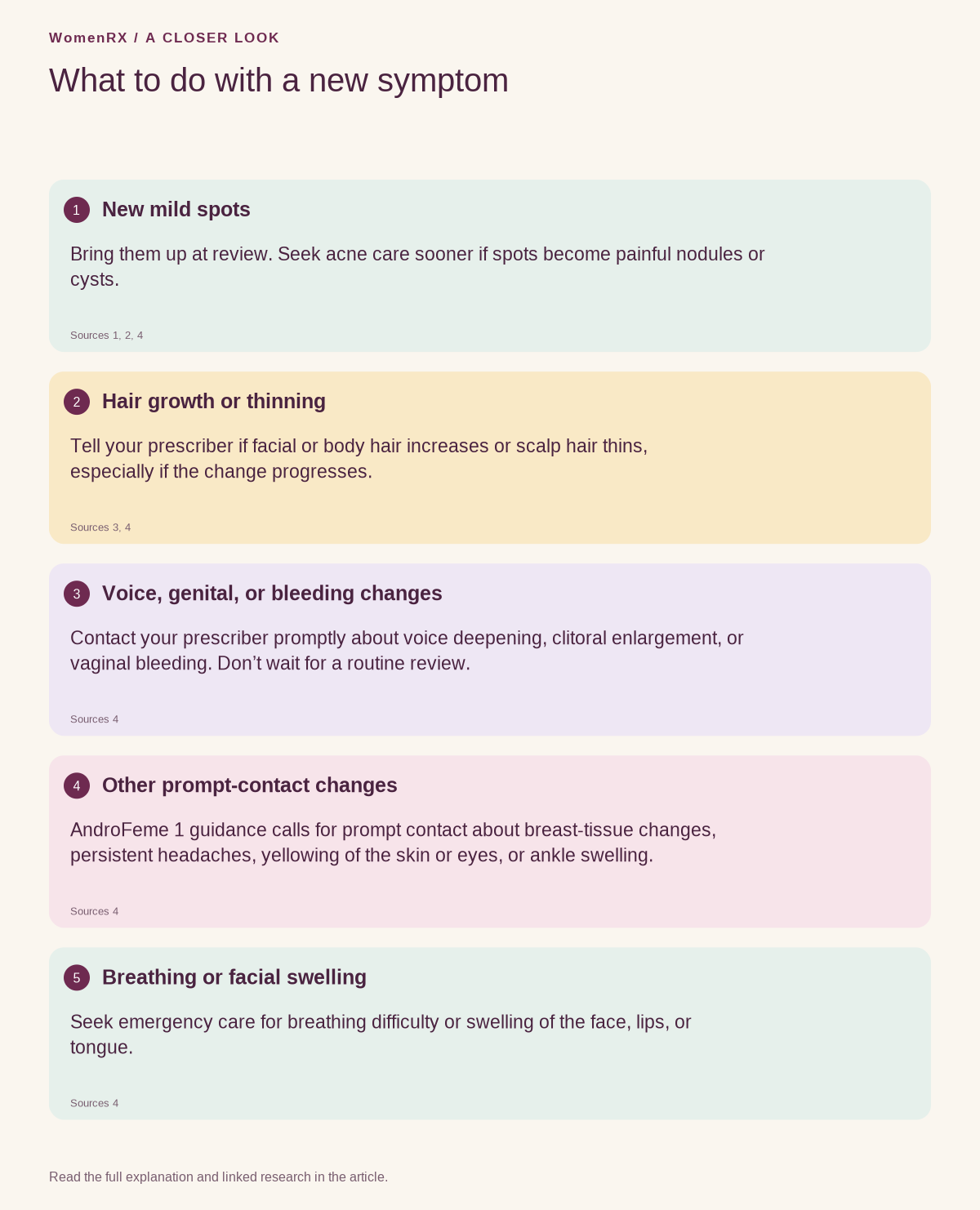
New mild spots: Bring them up at review. Seek acne care sooner if spots become painful nodules or cysts.124
Hair growth or thinning: Tell your prescriber if facial or body hair increases or scalp hair thins, especially if the change progresses.34
Voice, genital, or bleeding changes: Contact your prescriber promptly about voice deepening, clitoral enlargement, or vaginal bleeding. Don’t wait for a routine review.4
Other prompt-contact changes: AndroFeme 1 guidance calls for prompt contact about breast-tissue changes, persistent headaches, yellowing of the skin or eyes, or ankle swelling.4
Breathing or facial swelling: Seek emergency care for breathing difficulty or swelling of the face, lips, or tongue.4
Read the figure as text
These categories help separate a routine discussion from symptoms that should not wait. The prompt-care and emergency distinctions come from guidance for AndroFeme 1, a specific Australian testosterone cream.- New mild spots: Bring them up at review. Seek acne care sooner if spots become painful nodules or cysts.124
- Hair growth or thinning: Tell your prescriber if facial or body hair increases or scalp hair thins, especially if the change progresses.34
- Voice, genital, or bleeding changes: Contact your prescriber promptly about voice deepening, clitoral enlargement, or vaginal bleeding. Don’t wait for a routine review.4
- Other prompt-contact changes: AndroFeme 1 guidance calls for prompt contact about breast-tissue changes, persistent headaches, yellowing of the skin or eyes, or ankle swelling.4
- Breathing or facial swelling: Seek emergency care for breathing difficulty or swelling of the face, lips, or tongue.4
More questions, answered
Does a normal testosterone level rule out a side effect?
No single blood level can tell whether testosterone will help sexual desire. The clinical guideline uses levels alongside a review of symptoms, chiefly to guard against excessive exposure. Tell your prescriber about a new change even if you’ve had a reassuring result.3
Sources you can check
- Acne - NHSAccessed 2026-09-25Return to first citation
- Acne - Treatment - NHSAccessed 2026-09-25Return to first citation
- International Society for the Study of Women's Sexual Health Clinical Practice Guideline for the Use of Systemic Testosterone for Hypoactive Sexual Desire Disorder in Women.Parish SJ, Simon JA, Davis SR, Giraldi A, Goldstein I, Goldstein SW, Kim NN, Kingsberg SA, Morgentaler A, Nappi RE, Park K, Stuenkel CA, Traish AM, Vignozzi L. · Journal of women's health (2002) · 2021Return to first citation
- AndroFeme 1 | Australian Commission on Safety and Quality in Health CareAccessed 2026-09-26Return to first citation