Testosterone Side Effects in Women: What to Monitor
Acne and unwanted hair growth are possible effects, while the product, dose, and time on treatment help shape follow-up.
Acne and increased hair growth have been associated with testosterone treatment in postmenopausal women, though their likelihood isn’t well defined. Follow-up should consider changes you notice, whether treatment is helping, the exact product and dose, and whether a blood test could identify a higher-than-intended level. Longer-term safety remains uncertain. 1 2
Notice changes alongside any benefit
Acne and increased hair growth, sometimes called hirsutism, have been associated with testosterone therapy in postmenopausal women. The North American Menopause Society’s 2005 position statement said the actual risks were not well defined. A 2020 review described adverse effects in the trials it considered as mild, but did not provide rates that would tell you how likely an effect is with your particular product. 1 2
Mention new or worsening acne, unwanted hair growth, or another change you’ve noticed since starting treatment. Just as importantly, discuss whether treatment is helping the symptom it was prescribed for. For testosterone used to treat distressing low sexual desire, the 2005 statement recommended reviewing desire, sexual response, satisfaction, and potential adverse effects together. 1
Why the exact product and dose matter
Your follow-up conversation should include the product and dose you’re using, especially if either has changed. The 2005 statement preferred skin-applied testosterone over oral formulations because oral testosterone has first-pass effects on the liver. It also cautioned that custom-compounded products may deliver less consistent doses and that products formulated for men can pose a risk of excessive dosing in women. 1
Those distinctions make a useful question possible: Does this product make it harder to judge whether I’m getting the amount intended? Don’t treat a change in symptoms or a blood result as a stand-alone answer without considering the formulation and dose. 1
What a testosterone blood test can tell you
A blood test has a narrower job than you might expect. The 2005 position statement described testosterone testing as a way to monitor for levels above the expected physiologic range, not as a test that diagnoses testosterone insufficiency. It also noted that available assays had difficulty accurately measuring the concentrations typically found in women. If testing is part of your care, ask what the result is meant to show and how it fits with your symptoms and product details. 1
Time on treatment changes the safety conversation
The 2005 statement reported few safety and effectiveness data for use beyond six months. It also said it was not known whether testosterone therapy increased the risk of breast cancer, cardiovascular disease, or blood clots. Those are uncertainties, not a prediction that you’ll develop any of these conditions. A later review’s description of mild adverse effects in trials does not establish long-term safety for every product, dose, or reason for treatment. 1 2
Trials addressing distressing low sexual desire have primarily concerned postmenopausal women. Their findings should not automatically be applied to someone prescribed testosterone for another reason or at another stage of life. 1 2
Five useful points for follow-up
Keep the conversation anchored to your own treatment: What symptom is testosterone meant to help, and has it changed? Have you noticed acne, unwanted hair growth, or another new change? Which product and dose are you using? If a blood test is planned, what question will it answer? And how does your time on treatment affect the decision to continue or reassess? These questions bring benefits, possible side effects, and treatment details into the same discussion. 1
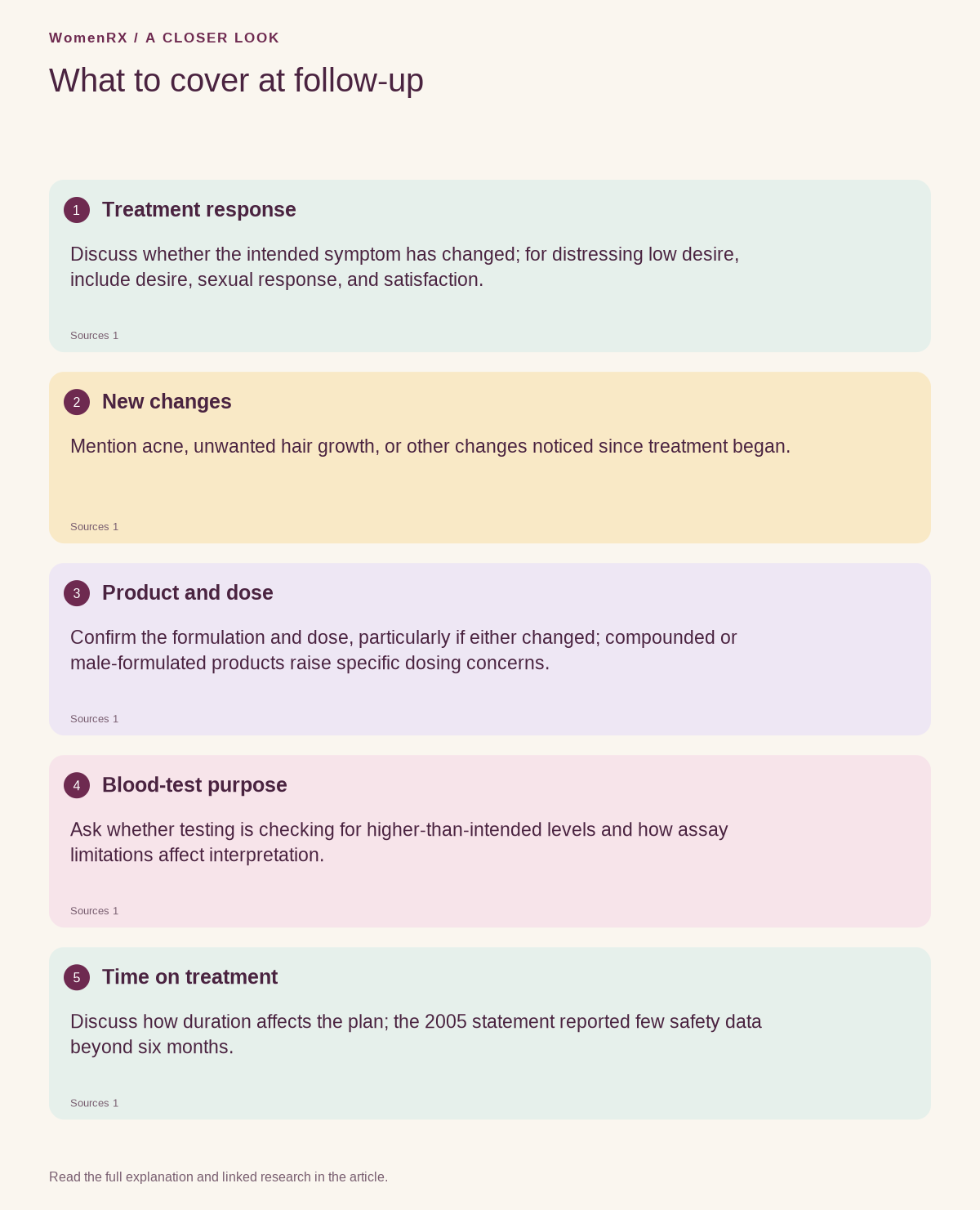
What to cover at follow-up
Treatment response: Discuss whether the intended symptom has changed; for distressing low desire, include desire, sexual response, and satisfaction.1
New changes: Mention acne, unwanted hair growth, or other changes noticed since treatment began.1
Product and dose: Confirm the formulation and dose, particularly if either changed; compounded or male-formulated products raise specific dosing concerns.1
Blood-test purpose: Ask whether testing is checking for higher-than-intended levels and how assay limitations affect interpretation.1
Time on treatment: Discuss how duration affects the plan; the 2005 statement reported few safety data beyond six months.1
Read the figure as text
Use these prompts to connect what you notice with the treatment details that shape monitoring.- Treatment response: Discuss whether the intended symptom has changed; for distressing low desire, include desire, sexual response, and satisfaction.1
- New changes: Mention acne, unwanted hair growth, or other changes noticed since treatment began.1
- Product and dose: Confirm the formulation and dose, particularly if either changed; compounded or male-formulated products raise specific dosing concerns.1
- Blood-test purpose: Ask whether testing is checking for higher-than-intended levels and how assay limitations affect interpretation.1
- Time on treatment: Discuss how duration affects the plan; the 2005 statement reported few safety data beyond six months.1
Sources you can check
- The role of testosterone therapy in postmenopausal women: position statement of The North American Menopause Society.North American Menopause Society. · Menopause (New York, N.Y.) · 2005Return to first citation
- The role of testosterone in menopausal hormone treatment. What is the evidence?Johansen N, Lindén Hirschberg A, Moen MH. · Acta obstetricia et gynecologica Scandinavica · 2020Return to first citation