Fezolinetant Side Effects: What to Monitor and When to Act
Fezolinetant has listed common side effects and a separate serious liver warning, so knowing the testing schedule and warning symptoms can help you respond appropriately.
The US prescribing information lists abdominal pain, diarrhea, insomnia, back pain, and hot flush as common adverse reactions. It also warns about possible liver injury and directs you to stop fezolinetant and seek medical attention if you develop symptoms such as jaundice, dark urine, nausea, or new fatigue. Follow-up liver tests are scheduled monthly for the first three months, then at months six and nine. 1
Separate tolerability from the liver warning
The US prescribing information lists abdominal pain, diarrhea, insomnia, back pain, and hot flush as common adverse reactions to fezolinetant. That list can help you recognize effects to discuss if they’re bothering you, but it doesn’t tell you how likely each one is for you. A side effect that interferes with sleep or daily activities is worth raising with your prescriber. 1
The liver warning is a different kind of safety issue. In three clinical trials, ALT or AST liver-enzyme levels above three times the upper limit of normal occurred in 2.3% of women receiving fezolinetant and 0.9% receiving placebo. Women with these elevations were generally without symptoms, so feeling well doesn’t replace scheduled blood tests. 1
One symptom appears in both categories: abdominal pain is listed as a common adverse reaction and also among symptoms that may suggest liver injury. Don’t try to decide on your own which explanation applies. If you have a symptom that could suggest liver injury, follow the product’s instruction to stop fezolinetant and seek medical attention. 1
Know which symptoms call for prompt action
The prescribing information says to stop fezolinetant immediately and seek medical attention, including liver blood tests, if you develop symptoms that may suggest liver injury. These include new fatigue, decreased appetite, nausea, vomiting, itching, yellowing of the skin or eyes, pale stools, dark urine, or abdominal pain. 1
These symptoms can have other causes. The point isn’t to diagnose yourself; it’s to avoid waiting for a routine appointment if one occurs. Keep the symptom list somewhere you can find it, and know how you’ll reach your prescriber or another source of medical care if you need advice. 1
Put the follow-up tests on your calendar
The US prescribing information calls for follow-up liver tests monthly during the first three months of treatment, then at six months and nine months. Ask who is arranging the tests, how you’ll hear about results, and what to do if an appointment or lab test is missed. 1
A real-world study highlights why it helps to make the plan explicit. Among 1,477 women classified as persistent users, 42% had liver-function testing in the three months after starting fezolinetant. This is a finding about testing in that study, not a measure of how often liver injury occurs. 2
Make your medication review specific
Before starting fezolinetant, and when your medicines change, give your prescriber a complete list of prescription medicines, over-the-counter products, and supplements. Include relevant health history, especially known liver problems, and ask whether anything affects whether fezolinetant is appropriate for you or what follow-up you need.
You might ask: “When are my liver tests due, and who will tell me the results?” “What should I do if I miss a test?” “Who should I contact if I notice a possible liver symptom?” Clear answers help keep routine side effects, scheduled monitoring, and warning symptoms from becoming one blurry list.
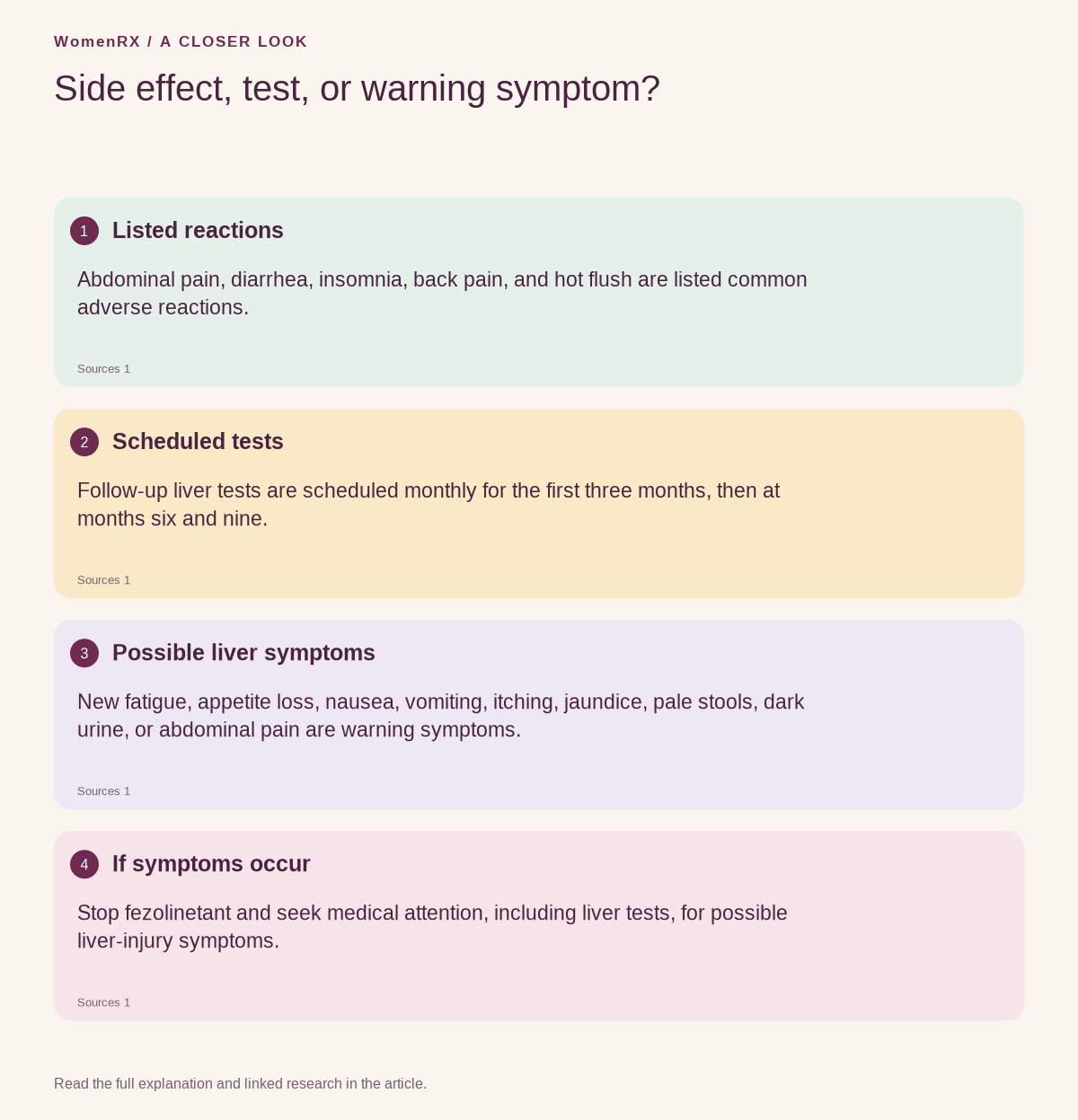
Side effect, test, or warning symptom?
Listed reactions: Abdominal pain, diarrhea, insomnia, back pain, and hot flush are listed common adverse reactions.1
Scheduled tests: Follow-up liver tests are scheduled monthly for the first three months, then at months six and nine.1
Possible liver symptoms: New fatigue, appetite loss, nausea, vomiting, itching, jaundice, pale stools, dark urine, or abdominal pain are warning symptoms.1
If symptoms occur: Stop fezolinetant and seek medical attention, including liver tests, for possible liver-injury symptoms.1
Read the figure as text
Keep everyday tolerability questions separate from scheduled liver monitoring and symptoms that call for prompt action.- Listed reactions: Abdominal pain, diarrhea, insomnia, back pain, and hot flush are listed common adverse reactions.1
- Scheduled tests: Follow-up liver tests are scheduled monthly for the first three months, then at months six and nine.1
- Possible liver symptoms: New fatigue, appetite loss, nausea, vomiting, itching, jaundice, pale stools, dark urine, or abdominal pain are warning symptoms.1
- If symptoms occur: Stop fezolinetant and seek medical attention, including liver tests, for possible liver-injury symptoms.1
More questions, answered
Can liver-enzyme changes happen without symptoms?
Yes. In the clinical trials described in the prescribing information, women with liver-enzyme elevations were generally asymptomatic. Keep the scheduled liver tests even if you feel well. 1
Are hot flushes listed as a side effect even though fezolinetant treats them?
Yes. Hot flush is among the common adverse reactions listed in the US prescribing information. A hot flush while taking the medicine doesn’t, by itself, establish its cause or show whether the treatment is helping overall. 1
Sources you can check
- VEOZAH (FEZOLINETANT) TABLET, FILM COATED [ASTELLAS PHARMA US, INC.] | US prescribing information and patient instructionsAccessed 2026-09-25Return to first citation
- Utilization of fezolinetant for the treatment of moderate-to-severe vasomotor symptoms of menopause in a real-world setting.Hsu CD, Carpenter RM, Richardson G, Guo F, Adekanmbi V, Hoang TN, Berenson AB. · Menopause (New York, N.Y.) · 2026Return to first citation