Fezolinetant and alcohol: what should you check?
Veozah has specific liver-safety precautions, so the useful question is how your drinking, liver health, and other medicines fit with your treatment.
Clinical trials report liver enzyme elevations during fezolinetant treatment, while U.S. Veozah patient information gives liver-safety precautions. Neither establishes a safe number of drinks, a waiting period, or how drinking changes liver risk with fezolinetant. Check the current U.S. Veozah information, keep up with the required liver blood tests, and tell your prescriber or pharmacist about your drinking, liver history, and medicines.12
Why the liver warning matters here
Fezolinetant, sold as Veozah, is a nonhormonal prescription treatment for moderate to severe hot flashes due to menopause. Its U.S. patient information warns that liver problems can occur. It calls for a liver blood test before treatment, monthly tests for the first three months, and further tests at months six and nine. Testing is also needed if symptoms suggest a liver problem.1
That warning doesn’t, by itself, tell you what happens when someone drinks alcohol while taking fezolinetant. The distinction matters: evidence that a medicine can affect the liver is a reason to take the question seriously, not a way to calculate a safe number of drinks.
In a 52-week randomized safety trial in postmenopausal participants seeking treatment for hot flashes, liver enzyme levels rose above three times the upper limit of normal in 12 of 589 participants assigned to fezolinetant 45 mg, 8 of 590 assigned to fezolinetant 30 mg, and 6 of 583 assigned to placebo. The trial reported no cases meeting its definition of severe drug-induced liver injury. Those results describe treatment groups, not a comparison of people who drank different amounts of alcohol. They can’t establish whether alcohol changes the risk for an individual.3
Make the alcohol question specific to you
If you drink, tell your prescriber or pharmacist what that actually looks like. For example, “I have a glass of wine with dinner a few nights a week” gives them more to work with than “I drink socially.” Mention if your pattern has changed. You’re asking for advice that accounts for your circumstances, not for a general verdict about alcohol.
Bring up any liver disease or past liver-test problems. The Veozah patient information specifically asks people to disclose liver problems and says the medicine should not be used by people with cirrhosis. Alcohol consumption is among the factors reported to be associated with liver disease, but the fezolinetant trial results do not establish how a particular drinking pattern affects medicine-related liver risk.12
Other medicines deserve the same attention. Veozah should not be used with certain medicines called CYP1A2 inhibitors, according to its U.S. patient information. Share a complete list of prescription medicines, over-the-counter products, vitamins, and herbal supplements with your prescriber or pharmacist so they can check it, rather than guessing which products count.1
A useful question is: “Given my liver history, other medicines, liver-test results, and how much I drink, what advice applies to me while I take Veozah?” If you’re looking at a label or patient leaflet you already have, ask the pharmacist to check it against the current U.S. prescribing information. Don’t use a general alcohol rule as a substitute for that review.
Know when the question becomes urgent
Don’t wait for a scheduled blood test if you develop possible signs of liver injury. The Veozah patient information says to stop taking it right away and contact your healthcare provider if you have symptoms such as unusual new tiredness, decreased appetite, nausea, vomiting, itching, yellowing of the skin or eyes, pale stools, dark urine, or abdominal pain. The prescribing information calls for prompt medical attention, including liver laboratory tests, when these symptoms appear.1
Some symptoms on that list, such as nausea or tiredness, can have many explanations. You don’t need to determine the cause yourself before acting on the medicine’s safety instructions. For an everyday drinking question, a prescriber or pharmacist can review your situation. For possible liver-injury symptoms, the label calls for action right away.1
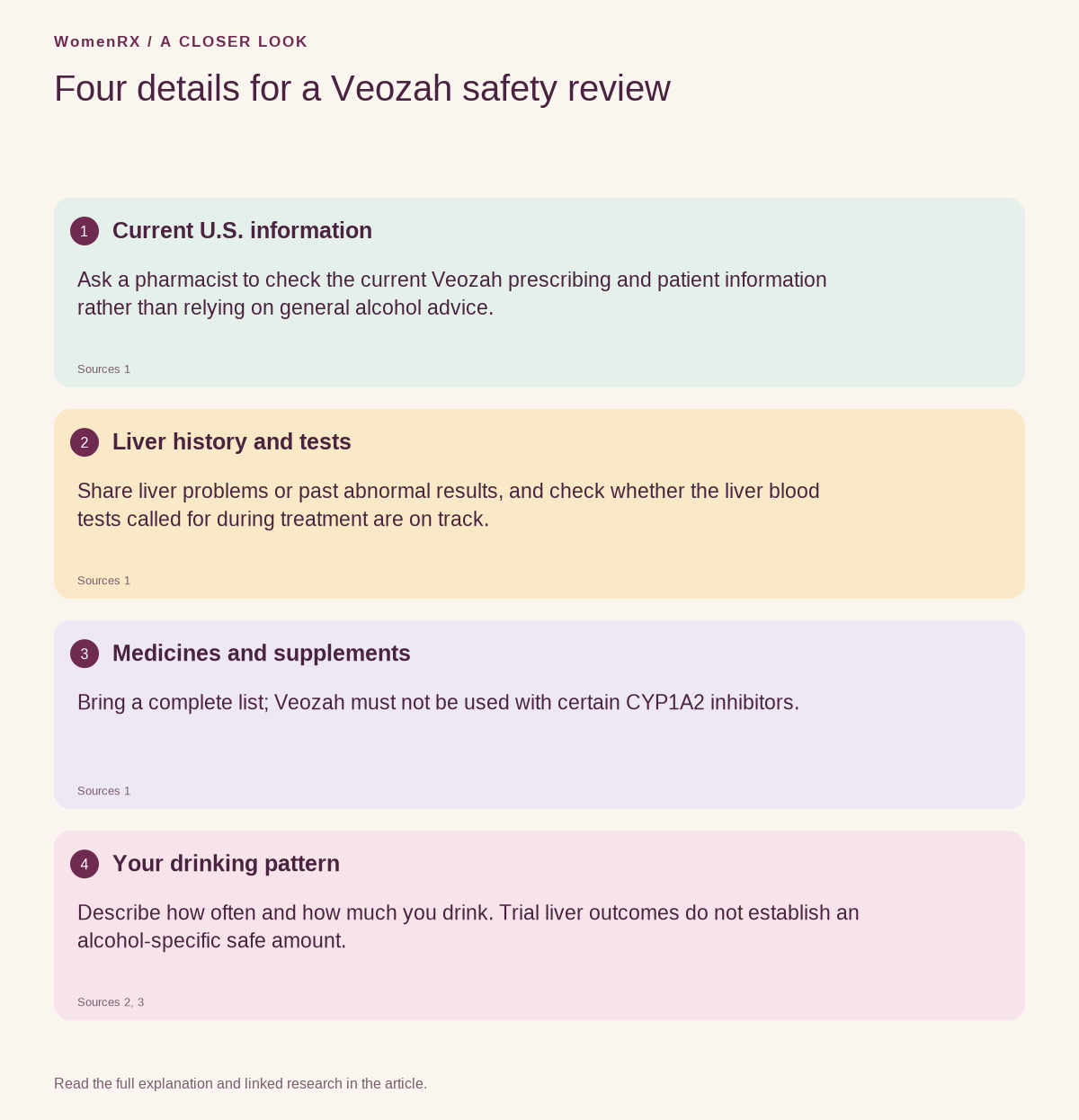
Four details for a Veozah safety review
Current U.S. information: Ask a pharmacist to check the current Veozah prescribing and patient information rather than relying on general alcohol advice.1
Liver history and tests: Share liver problems or past abnormal results, and check whether the liver blood tests called for during treatment are on track.1
Medicines and supplements: Bring a complete list; Veozah must not be used with certain CYP1A2 inhibitors.1
Your drinking pattern: Describe how often and how much you drink. Trial liver outcomes do not establish an alcohol-specific safe amount.23
Read the figure as text
A short guide to what to verify and share when asking about alcohol and fezolinetant.- Current U.S. information: Ask a pharmacist to check the current Veozah prescribing and patient information rather than relying on general alcohol advice.1
- Liver history and tests: Share liver problems or past abnormal results, and check whether the liver blood tests called for during treatment are on track.1
- Medicines and supplements: Bring a complete list; Veozah must not be used with certain CYP1A2 inhibitors.1
- Your drinking pattern: Describe how often and how much you drink. Trial liver outcomes do not establish an alcohol-specific safe amount.23
Sources you can check
- VEOZAH (FEZOLINETANT) TABLET, FILM COATED [ASTELLAS PHARMA US, INC.] | US prescribing information and patient instructionsAccessed 2026-09-25Return to first citation
- Safety of Fezolinetant for Treatment of Moderate to Severe Vasomotor Symptoms Due to Menopause: Pooled Analysis of Three Randomized Phase 3 Studies.Kagan R, Cano A, Nappi RE, English ML, Mancuso S, Wu X, Ottery FD. · Advances in therapy · 2025Return to first citation
- Safety of Fezolinetant for Vasomotor Symptoms Associated With Menopause: A Randomized Controlled Trial.Neal-Perry G, Cano A, Lederman S, Nappi RE, Santoro N, Wolfman W, English M, Franklin C, Valluri U, Ottery FD. · Obstetrics and gynecology · 2023Return to first citation