Low-Dose Naltrexone and Alcohol: What Should You Check?
A small LDN pilot included people with past-year heavy drinking, but it doesn’t settle whether drinking during treatment is safe; your exact product and health details matter.
A small pilot studied low-dose naltrexone (LDN) in people with past-year heavy drinking, but it doesn’t establish whether drinking while taking LDN is safe or define a specific alcohol-LDN interaction. 2 Before deciding what applies to you, check the exact product and dose, other medicines, liver health, and reason for treatment with your prescriber or pharmacist. 1 2
The short answer depends on more than the word “naltrexone”
A small pilot studied LDN in people with a history of heavy drinking, but it doesn’t establish whether drinking during LDN treatment is safe. 2 The key distinction is between a specific LDN regimen and other products or doses containing naltrexone. Evidence about one shouldn’t automatically be treated as evidence about another.
A small pilot trial offers a limited example: 45 people with HIV, chronic pain, and past-year heavy drinking were assigned to LDN, gabapentin, or placebo for eight weeks. The LDN group received 4.5 mg daily. The study’s primary outcomes were pain measures, and alcohol use was also among the outcomes it set out to assess. That design doesn’t establish the safety of drinking while taking LDN. Participants were mostly men, and the results don’t tell us how women specifically might fare. 2
Confirm the product, dose, and reason for treatment
Write down the medication’s full name, dose, and formulation before asking about alcohol. A compounded or low-dose product isn’t automatically equivalent to a different naltrexone product. For example, Contrave is an extended-release combination of naltrexone and bupropion, not LDN alone. Its US prescribing information warns about seizure risk in certain situations, including abruptly stopping alcohol after drinking heavily. That product-specific warning shouldn’t be copied over as if it applies to every LDN prescription, but it makes the exact medication especially important to verify. 1
The reason you’re taking naltrexone matters, too. Naltrexone is used in treatment for alcohol use disorder at standard therapeutic doses, but that does not establish that LDN has the same role or safety profile. 2 3 If you’re taking it to help with alcohol use, say so plainly. A prescriber can consider your drinking pattern, treatment goals, and whether the product you have is intended for that purpose.
Bring up liver health and other medicines
Naltrexone-containing products have been associated with reports of hepatitis and clinically significant liver dysfunction. The product information also describes other possible contributors in some cases, including pre-existing alcohol-related liver disease, viral hepatitis, and other medicines that may affect the liver. This does not mean everyone taking naltrexone will develop liver problems, but known liver disease and medicines that affect the liver are relevant details to raise. 1
Tell the prescriber or pharmacist about all your medicines, especially opioid pain medicines or medicines used to treat opioid dependence. Naltrexone blocks opioid effects; the product information warns that trying to overcome that blockade with large amounts of opioids can lead to life-threatening overdose. Don’t stop or change prescribed medicines based on this article; ask how they fit with your specific naltrexone product. 1
Include pregnancy and breastfeeding in the conversation
If you’re pregnant, trying to become pregnant, or breastfeeding, say so before making a decision about LDN and alcohol. The small LDN trial described above excluded people who were pregnant or breastfeeding, so it doesn’t establish safety for those situations. 2 That is a limitation of this study, not a conclusion about what treatment is right for you.
A practical check before you drink
Ask your prescriber or pharmacist to review these details together:
- Exact product: Is it LDN alone, a different naltrexone formulation, or a combination product such as naltrexone/bupropion?
- Dose and reason: What dose are you prescribed, and what is it intended to treat?
- Other medicines: Do any of your medicines contain opioids or affect the liver? Make sure the reviewer has your complete list.
- Liver history: Have you had liver disease, hepatitis, or abnormal liver tests?
- Alcohol pattern and reproductive context: How much and how often do you drink, and are pregnancy or breastfeeding relevant?
These details won’t turn the limited LDN research into a definitive answer, but they help someone assess your actual product and circumstances rather than relying on a blanket rule.
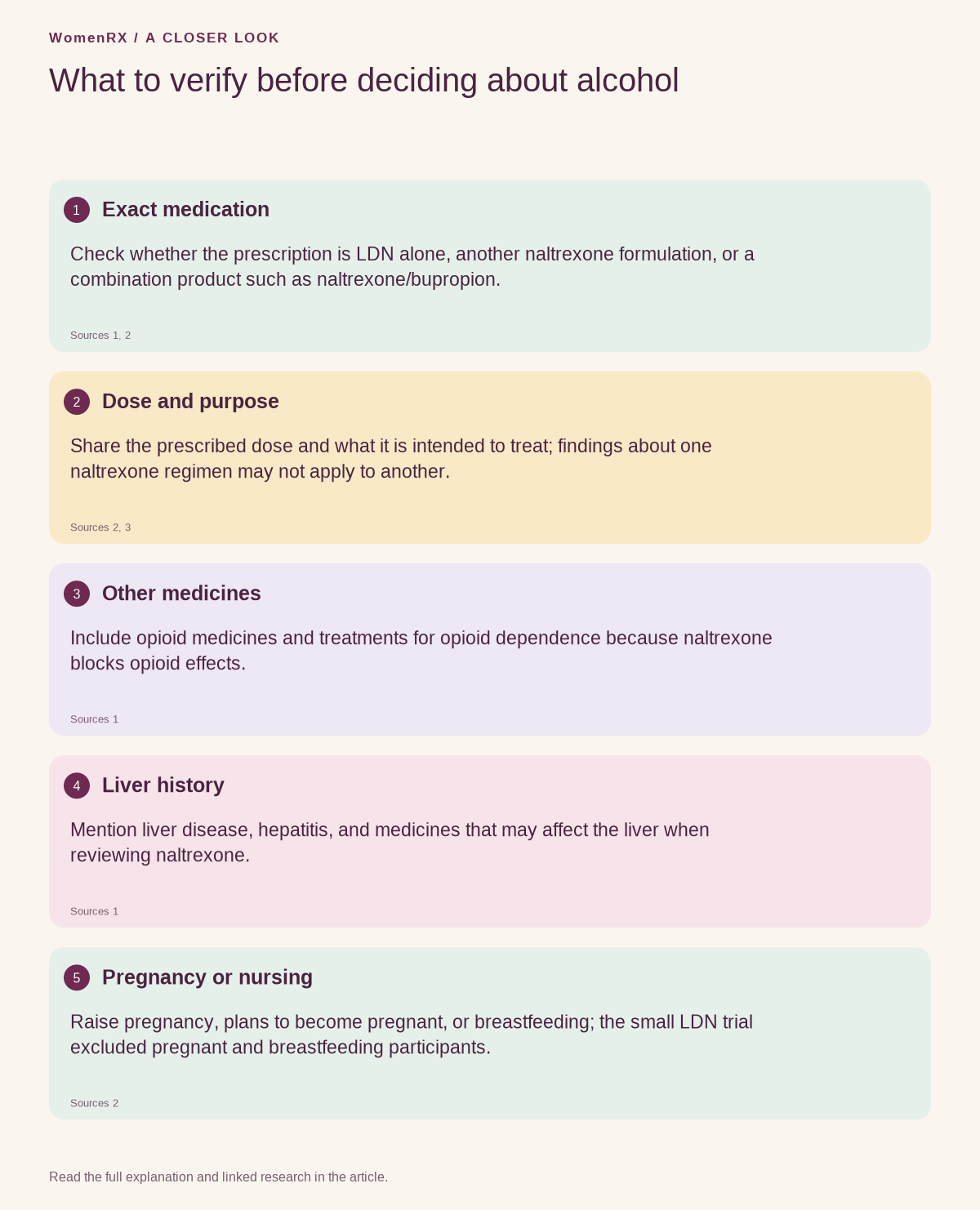
What to verify before deciding about alcohol
Exact medication: Check whether the prescription is LDN alone, another naltrexone formulation, or a combination product such as naltrexone/bupropion.12
Dose and purpose: Share the prescribed dose and what it is intended to treat; findings about one naltrexone regimen may not apply to another.23
Other medicines: Include opioid medicines and treatments for opioid dependence because naltrexone blocks opioid effects.1
Liver history: Mention liver disease, hepatitis, and medicines that may affect the liver when reviewing naltrexone.1
Pregnancy or nursing: Raise pregnancy, plans to become pregnant, or breastfeeding; the small LDN trial excluded pregnant and breastfeeding participants.2
Read the figure as text
These details help distinguish the specific medication and health context from broad assumptions about naltrexone.- Exact medication: Check whether the prescription is LDN alone, another naltrexone formulation, or a combination product such as naltrexone/bupropion.12
- Dose and purpose: Share the prescribed dose and what it is intended to treat; findings about one naltrexone regimen may not apply to another.23
- Other medicines: Include opioid medicines and treatments for opioid dependence because naltrexone blocks opioid effects.1
- Liver history: Mention liver disease, hepatitis, and medicines that may affect the liver when reviewing naltrexone.1
- Pregnancy or nursing: Raise pregnancy, plans to become pregnant, or breastfeeding; the small LDN trial excluded pregnant and breastfeeding participants.2
More questions, answered
Is low-dose naltrexone the same as Contrave?
No. Contrave is an extended-release combination of naltrexone and bupropion. Its product-specific warnings, including the warning about abruptly stopping alcohol after heavy drinking, shouldn’t be assumed to apply in exactly the same way to LDN alone. Check the name and ingredients on your prescription. 1
Does naltrexone block the effects of opioid pain medicine?
Naltrexone blocks opioid effects. Its prescribing information warns that attempting to overcome the blockade with large amounts of opioids can cause life-threatening overdose. Make sure your prescriber or pharmacist knows about opioid pain medicines and treatment for opioid dependence. 1
Sources you can check
- CONTRAVE EXTENDED-RELEASE (NALTREXONE HYDROCHLORIDE AND BUPROPION HYDROCHLORIDE) TABLET, EXTENDED RELEASE [NALPROPION PHARMACEUTICALS LLC] | US prescribing information and patient instructionsAccessed 2026-09-25Return to first citation
- Pilot RCT comparing low-dose naltrexone, gabapentin and placebo to reduce pain among people with HIV with alcohol problems.Tsui JI, Rossi SL, Cheng DM, Bendiks S, Vetrova M, Blokhina E, Winter M, Gnatienko N, Backonja M, Bryant K, Krupitsky E, Samet JH. · PloS one · 2024Return to first citation
- Potential medications for the treatment of alcohol use disorder: An evaluation of clinical efficacy and safety.Litten RZ, Wilford BB, Falk DE, Ryan ML, Fertig JB. · Substance abuse · 2016Return to first citation