Micronized Progesterone Side Effects: What to Monitor and When to Get Help
Sleepiness and dizziness can occur with oral micronized progesterone, but menopause symptoms and other parts of HRT may also affect how you feel.
Oral micronized progesterone can cause drowsiness and dizziness, but a symptom may also come from menopause, estrogen, or another cause. Record what you notice and when it happens in relation to your regimen. Contact your prescriber sooner about severe effects, heavier bleeding, or bleeding after a period-free stretch. Raise non-severe ongoing concerns at follow-up. 1 2
A symptom can have more than one explanation
Drowsiness and dizziness are reported with oral micronized progesterone. 2 But timing alone can't show that progesterone caused a symptom: menopause symptoms can resemble HRT side effects, and combined HRT effects may relate to estrogen, progestogen, or both. 1
If you use estrogen too, note whether a symptom began after a change to either part of your treatment. That timing can help describe a pattern, but it isn't proof of the cause.
Keep a short, useful record
For a short stretch, jot down:
- What you notice: For example, sleepiness, dizziness, or spotting.
- When it happens: When it began and whether it tends to occur after taking progesterone or at a particular point in your schedule.
- What changed: Any recent change to estrogen, progesterone, its route, or its schedule.
- How it affects you: Whether it interrupts daily activities, affects your balance, or disrupts sleep.
- Bleeding details, if relevant: When it happens in relation to your HRT schedule, whether it is spotting or heavier, and whether it is new or ongoing.
This record is a way to explain what you're experiencing, not a test that can identify the cause. The effects of changing progesterone's route or schedule on a particular symptom aren't clear, so ask your prescriber whether a change makes sense for you rather than changing your regimen on your own.
Bleeding patterns depend on the regimen
Some bleeding can fit the schedule of combined HRT. With sequential treatment, bleeding at the end of a progestogen course may be expected withdrawal bleeding. Irregular spotting or bleeding can also occur during the first months of HRT; with continuous combined HRT, it is common during the first four to six months. 1
If you have irregular bleeding, mention it at your first review, around three months. Contact your prescriber sooner if it becomes heavier or happens after you have gone a while without periods. Also raise bleeding that continues beyond six months after starting HRT. These general patterns don't replace advice about what to expect with your specific regimen. 1
What to ask at follow-up
For a non-severe concern, bring your notes and ask questions such as:
- Could this fit a progesterone effect, an estrogen effect, menopause, or something else?
- Does the timing fit my prescribed schedule?
- If sleepiness or dizziness is interfering with my day, should we review the timing or the overall regimen?
- What bleeding pattern should I expect with my specific HRT schedule?
HRT effects and risks can depend on factors including treatment type, dose, route, duration, and whether a progestogen is used. Menopause guidance recommends individualizing treatment and periodically reviewing its benefits and risks, so it can be useful to discuss the full regimen rather than assuming one ingredient is responsible. 3
When to contact your prescriber sooner
Don't wait for a routine appointment if a side effect is severe. Contact your prescriber sooner about heavier bleeding or bleeding after a period-free stretch. If a side effect isn't severe but continues beyond three months, raise it with your prescriber as well. 1
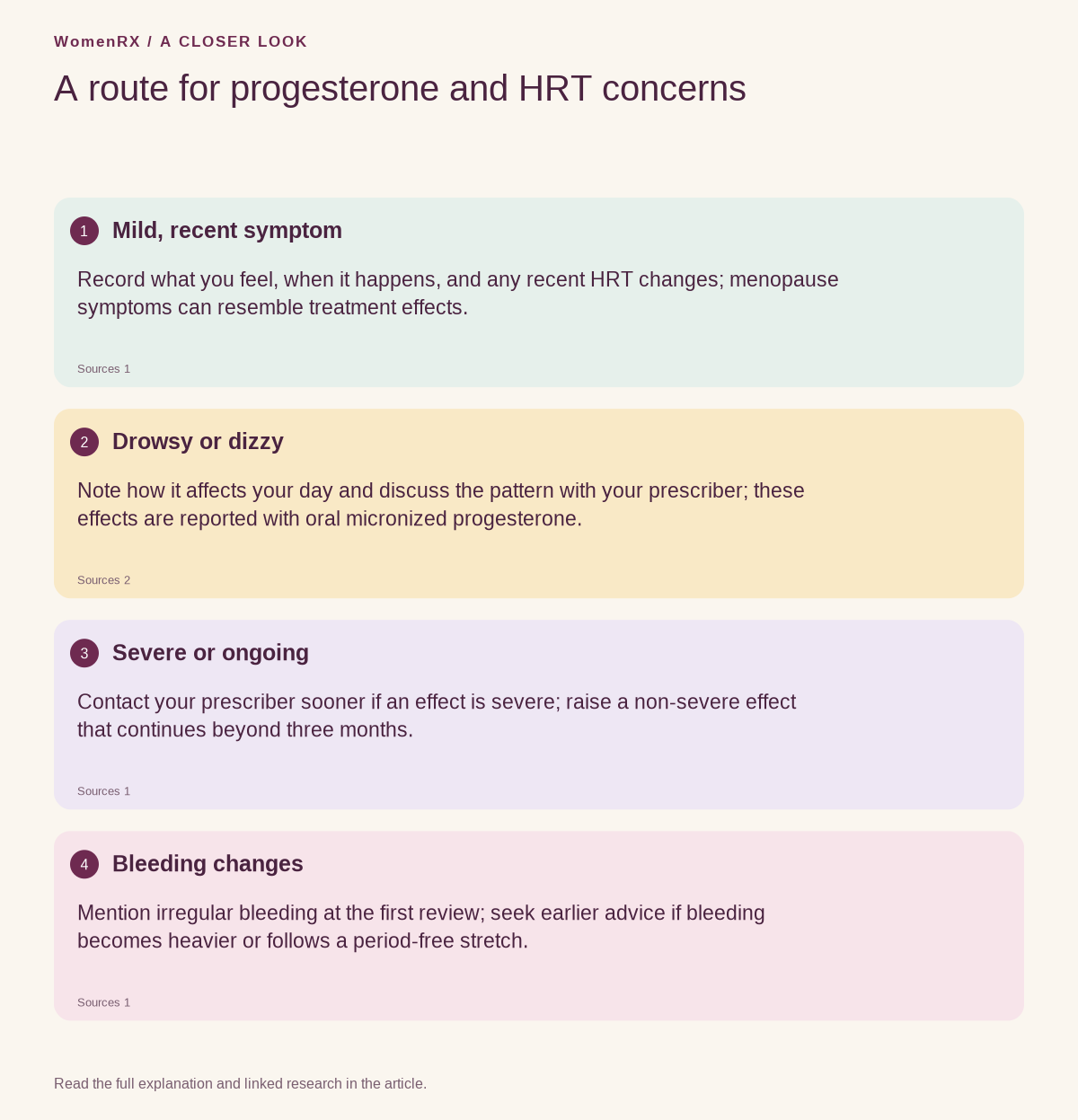
A route for progesterone and HRT concerns
Mild, recent symptom: Record what you feel, when it happens, and any recent HRT changes; menopause symptoms can resemble treatment effects.1
Drowsy or dizzy: Note how it affects your day and discuss the pattern with your prescriber; these effects are reported with oral micronized progesterone.2
Severe or ongoing: Contact your prescriber sooner if an effect is severe; raise a non-severe effect that continues beyond three months.1
Bleeding changes: Mention irregular bleeding at the first review; seek earlier advice if bleeding becomes heavier or follows a period-free stretch.1
Read the figure as text
Use the symptom's severity and any bleeding change to decide whether to keep notes for follow-up or contact your prescriber sooner. This guide cannot diagnose the cause.- Mild, recent symptom: Record what you feel, when it happens, and any recent HRT changes; menopause symptoms can resemble treatment effects.1
- Drowsy or dizzy: Note how it affects your day and discuss the pattern with your prescriber; these effects are reported with oral micronized progesterone.2
- Severe or ongoing: Contact your prescriber sooner if an effect is severe; raise a non-severe effect that continues beyond three months.1
- Bleeding changes: Mention irregular bleeding at the first review; seek earlier advice if bleeding becomes heavier or follows a period-free stretch.1
More questions, answered
Can timing tell me whether progesterone caused a symptom?
Timing can help you describe a pattern, especially after a treatment change, but it can't establish the cause. Menopause symptoms can resemble HRT side effects, and combined HRT may involve effects from estrogen, progestogen, or both. 1
Sources you can check
- Side effects of hormone replacement therapy (HRT) - NHSAccessed 2026-09-25Return to first citation
- Diagnostic and therapeutic use of oral micronized progesterone in endocrinology.Memi E, Pavli P, Papagianni M, Vrachnis N, Mastorakos G. · Reviews in endocrine & metabolic disorders · 2024Return to first citation
- The 2022 hormone therapy position statement of The North American Menopause Society.“The 2022 Hormone Therapy Position Statement of The North American Menopause Society” Advisory Panel. · Menopause (New York, N.Y.) · 2022Return to first citation