Slynd side effects: what to watch and when to act
Spotting is common when you start Slynd, but severe pain, chest symptoms, or a sudden neurological change need prompt attention.
Spotting or irregular bleeding, headache, nausea, acne, and breast tenderness can happen with Slynd. Bleeding may settle with time, but persistent bleeding deserves a prescriber call. If your skin or eyes turn yellow, stop taking Slynd and call your healthcare provider right away. Get urgent assessment for chest pain, sudden shortness of breath, an unusual sudden severe headache, or severe abdominal pain. Slynd can also raise potassium without causing symptoms.21
First, sort the symptom by what it’s doing
Slynd is a progestin-only birth control pill containing drospirenone. Its side effects fall into two practical groups: changes you can notice and discuss if they continue, and symptoms that shouldn’t wait for a routine conversation. The distinction matters because an ordinary headache and a sudden, severe headache unlike your usual headaches call for different responses.2
Notice and track: Spotting, a changed bleeding pattern, a familiar mild headache, nausea, acne, or breast tenderness may occur while taking Slynd. In four pooled clinical studies, the product information listed acne, headache, breast pain, nausea, and several types of bleeding changes among reported adverse reactions. A symptom being reported in a study doesn’t prove the pill caused it in any one person.2
Contact your prescriber about persistent changes: Bleeding that continues, returns after your cycles had become regular, or feels difficult to live with is worth discussing rather than simply waiting it out. If depression recurs to a serious degree, stop taking Slynd and contact your prescriber promptly. If you have thoughts of harming yourself, seek immediate help.2
Stop Slynd and call right away about yellowing: If your skin or eyes turn yellow, stop taking Slynd and call your healthcare provider right away. Don’t wait to bring it up at a routine visit.2
Seek urgent assessment: Don’t dismiss chest pain, sudden severe shortness of breath, a sudden severe headache unlike your usual headaches, a sudden vision change, trouble speaking, weakness or numbness in an arm or leg, or leg pain that won’t go away. The Slynd patient information directs users with these symptoms to call their healthcare provider or go to an emergency room right away. Severe abdominal pain also needs prompt assessment because pregnancy outside the uterus is a possibility if pregnancy occurs while using Slynd.2
Bleeding can be common without being something you must tolerate
Unscheduled bleeding or spotting is especially common during the first three months. Based on diaries from four Slynd trials, 64.4% of participants reported unscheduled bleeding in the first cycle, compared with 40.3% by cycle 13. Those figures describe different groups of participants at different cycles, not a promise that any individual’s bleeding will improve. Persistent bleeding, or bleeding that starts again after previously regular cycles, should be evaluated for another cause, including pregnancy.2
A simple record can make that conversation more useful: note which days involve spotting versus bleeding, whether cramps occur, and whether the pattern is changing. For example, occasional spotting early on is a different story from bleeding that keeps disrupting your day. Don’t assume that every new bleeding pattern is caused by Slynd, and don’t feel you have to wait through months of a pattern that concerns you.2
Missing a scheduled bleed can happen, too. The product information says to contact your prescriber if you miss a period after a month when you didn’t take all your pills correctly, or if you miss two periods in a row. Pregnancy symptoms, such as morning sickness or unusual breast tenderness, are another reason to make contact.2
Why potassium deserves a separate conversation
Drospirenone can reduce the body’s excretion of potassium. High potassium may cause no noticeable symptoms: in a US, single-arm trial of 1,006 women who received drospirenone-only contraception, five participants, or 0.5%, had asymptomatic hyperkalemia. That trial excluded women with several conditions that would make its findings less applicable to everyone who might ask about Slynd.1
The risk deserves particular attention if you have kidney, liver, or adrenal disease, or take another medicine that can raise potassium. Slynd’s product information says these conditions can make the pill unsuitable and calls for potassium testing in certain people receiving daily, long-term treatment with potassium-raising medicines. Tell your prescriber about new medicines or diagnoses rather than trying to judge the risk from symptoms alone. The label specifically identifies long-term use of certain strong drug-interaction inhibitors, including ketoconazole, itraconazole, voriconazole, and clarithromycin, as a reason to consider monitoring.2
Get help right away for a racing or irregular heartbeat, chest pain, shortness of breath, or weakness or numbness in an arm or leg. The patient information also lists nausea and vomiting among possible signs of high potassium. Because nausea is also a reported everyday side effect, its meaning depends on what else is happening; don’t use nausea alone to decide that your potassium is high or normal.2
If you’re breastfeeding or recently gave birth
Slynd’s product information says negligible amounts of drospirenone pass into breast milk and that effects on breastfed infants aren’t anticipated at therapeutic doses. It also says progestin-only pills generally haven’t been found to harm milk production or infant health, growth, or development. That is lactation information, not a guarantee about every individual feeding concern.2
Postpartum recovery raises a different issue: the risk of blood clots is increased after birth, and the Slynd label asks prescribers to take that into account. It does not mean that ordinary spotting is a clot symptom. It does mean that sudden shortness of breath, chest pain, or persistent leg pain deserves urgent attention after birth, just as it does at other times.2
If a symptom is new, the most useful question is not simply, “Is this on the side-effect list?” Ask whether it is mild and familiar, persistent or changing, or sudden and severe. That distinction helps you act without treating every inconvenience as an emergency or explaining away a warning sign.2
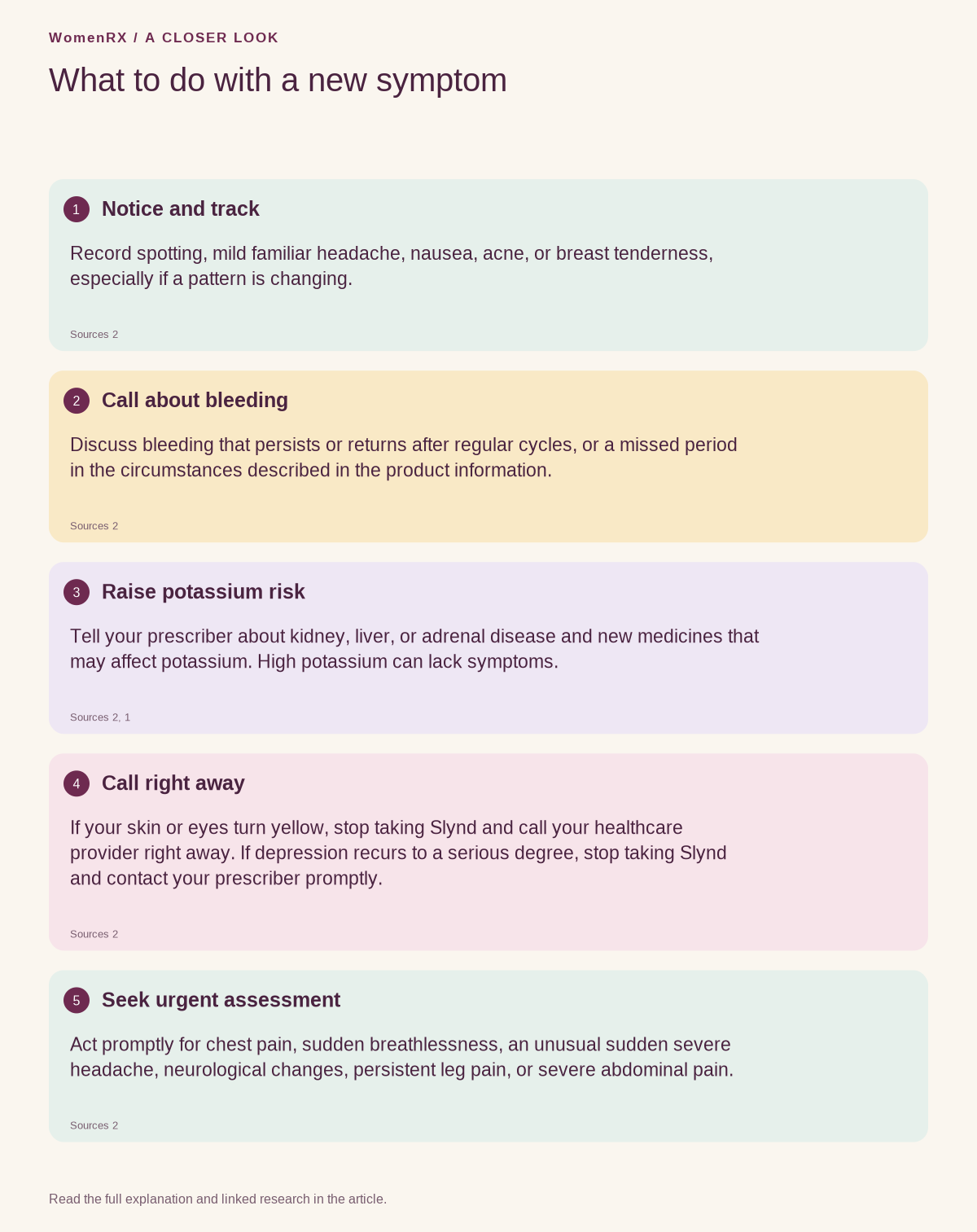
What to do with a new symptom
Notice and track: Record spotting, mild familiar headache, nausea, acne, or breast tenderness, especially if a pattern is changing.2
Call about bleeding: Discuss bleeding that persists or returns after regular cycles, or a missed period in the circumstances described in the product information.2
Raise potassium risk: Tell your prescriber about kidney, liver, or adrenal disease and new medicines that may affect potassium. High potassium can lack symptoms.21
Call right away: If your skin or eyes turn yellow, stop taking Slynd and call your healthcare provider right away. If depression recurs to a serious degree, stop taking Slynd and contact your prescriber promptly.2
Seek urgent assessment: Act promptly for chest pain, sudden breathlessness, an unusual sudden severe headache, neurological changes, persistent leg pain, or severe abdominal pain.2
Read the figure as text
Use the symptom’s pattern and severity to choose a next step. This is a sorting aid, not a diagnostic test.- Notice and track: Record spotting, mild familiar headache, nausea, acne, or breast tenderness, especially if a pattern is changing.2
- Call about bleeding: Discuss bleeding that persists or returns after regular cycles, or a missed period in the circumstances described in the product information.2
- Raise potassium risk: Tell your prescriber about kidney, liver, or adrenal disease and new medicines that may affect potassium. High potassium can lack symptoms.21
- Call right away: If your skin or eyes turn yellow, stop taking Slynd and call your healthcare provider right away. If depression recurs to a serious degree, stop taking Slynd and contact your prescriber promptly.2
- Seek urgent assessment: Act promptly for chest pain, sudden breathlessness, an unusual sudden severe headache, neurological changes, persistent leg pain, or severe abdominal pain.2
More questions, answered
Does a normal-looking day rule out high potassium?
No. The cases of hyperkalemia reported in the US drospirenone-only contraceptive trial were asymptomatic. If you have a condition or take a medicine that raises potassium risk, discuss that with your prescriber; symptoms alone can’t settle the question.12
Sources you can check
- A 1-year prospective, open-label, single-arm, multicenter, phase 3 trial of the contraceptive efficacy and safety of the oral progestin-only pill drospirenone 4 mg using a 24/4-day regimen.Kimble T, Burke AE, Barnhart KT, Archer DF, Colli E, Westhoff CL. · Contraception: X · 2020Return to first citation
- SLYND drospirenone tablets, ExeltisAccessed 2026-09-25Return to first citation