Which Magnesium Benefits Are Supported in Women?
Magnesium has some clinical support, but the case is stronger for migraine prevention than for most benefits promoted specifically to women.
Magnesium is essential, but that doesn’t mean a supplement will improve every health concern. Small trials and a professional guideline support magnesium as a likely option for migraine prevention, while evidence for bone benefits after menopause is preliminary. Pregnancy treatment with magnesium sulfate is a separate, supervised medical use. The findings discussed here don’t evaluate magnesium for PMS or menstrual cramps. 1 3
Start with the health concern, not the mineral
Magnesium helps muscles and nerves function, and it’s involved in bone formation, energy production, and other processes. Those roles explain why it’s studied, but they don’t prove that taking extra magnesium improves a symptom or prevents disease. 1
The most useful distinction is between getting enough magnesium and taking a supplement as treatment. For nonpregnant adult women, the recommended total intake is 310 mg daily for ages 19-30 and 320 mg for ages 31 and older. During pregnancy, the recommendation is 350-360 mg daily for adults, depending on age, and 400 mg for pregnant adolescents. These amounts include food, drinks, and supplements. 1
Migraine prevention: a promising, not definitive, use
The NIH Office of Dietary Supplements summarizes four small, short-term, placebo-controlled trials: three found modest reductions in migraine frequency, while one did not. An American Academy of Neurology and American Headache Society guideline concluded magnesium is probably effective for prevention. 1
That is a reason to discuss magnesium as an option, not a promise that it will work for you. The trials were small, and the evidence summarized doesn’t establish a benefit specifically for women or for menstrual-related migraine. The amounts used in migraine research can also exceed the adult upper limit for magnesium from supplements and medications, so this isn’t a reason to start a high-dose product on your own. 1
Menopause and bone health: an early signal, not proof of prevention
Magnesium contributes to bone health, and observational studies have linked higher magnesium intake with higher bone mineral density in both women and men. But an association doesn’t show that a supplement prevents fractures or treats osteoporosis. 1
One small trial enrolled 20 postmenopausal women with osteoporosis. For 30 days, participants taking magnesium citrate suppressed bone turnover compared with placebo. That is a short-term change in bone turnover, not evidence that the supplement prevents fractures or improves long-term bone health. 1
The NIH fact sheet says diets that provide recommended magnesium levels support bone health, while noting that more research is needed to determine magnesium’s role in preventing or managing osteoporosis. The trial is too small and short to settle whether supplements help postmenopausal women avoid bone loss or fractures. 1
Pregnancy: distinguish a medical treatment from a supplement
Magnesium sulfate given in hospital to women at risk of birth before 34 weeks is not the same as taking an over-the-counter magnesium supplement. A 2026 Cochrane review found that, among women at risk of birth before 34 weeks, magnesium sulfate lowered the proportion of children diagnosed with cerebral palsy by up to age two: 41 per 1,000 compared with 58 per 1,000 with placebo. The review included six randomized trials and rated the evidence high certainty for this outcome. It did not find a clear reduction in death. 3
This finding concerns a specific obstetric treatment and a specific risk, not routine pregnancy supplementation or general wellbeing. It shouldn’t be used to decide whether to take a magnesium supplement during pregnancy. 3
PMS, cramps, and PCOS: don’t overread indirect evidence
The clinical findings discussed here don’t evaluate magnesium supplements for PMS or menstrual-cramp relief. Magnesium’s role in muscle and nerve function, by itself, isn’t proof that a supplement will ease period pain. 1
PCOS research also needs careful interpretation. A 2026 meta-analysis included 11 randomized trials with 618 women with PCOS, but evaluated several minerals, including magnesium, chromium, zinc, and selenium. The pooled findings can’t show that magnesium alone improved insulin resistance or other metabolic outcomes. 2
What the evidence means for your next step
If you’re considering magnesium for a particular concern, check whether the evidence is for that outcome, in that population, and for a supplement rather than a medical treatment. Food sources include leafy greens, beans, nuts, seeds, and whole grains. 1
More isn’t automatically better. For adults, the upper limit is 350 mg per day from supplements and magnesium-containing medications; it doesn’t include magnesium naturally present in food. Higher supplemental or medication amounts can cause diarrhea, nausea, and abdominal cramps, and the risk of toxicity rises when kidney function is impaired. Magnesium can also reduce absorption of some oral antibiotics and bisphosphonates. 1
The clearest takeaway: magnesium is essential, and it may help prevent migraines, but most other claims need more direct evidence before they can be treated as established benefits for women.
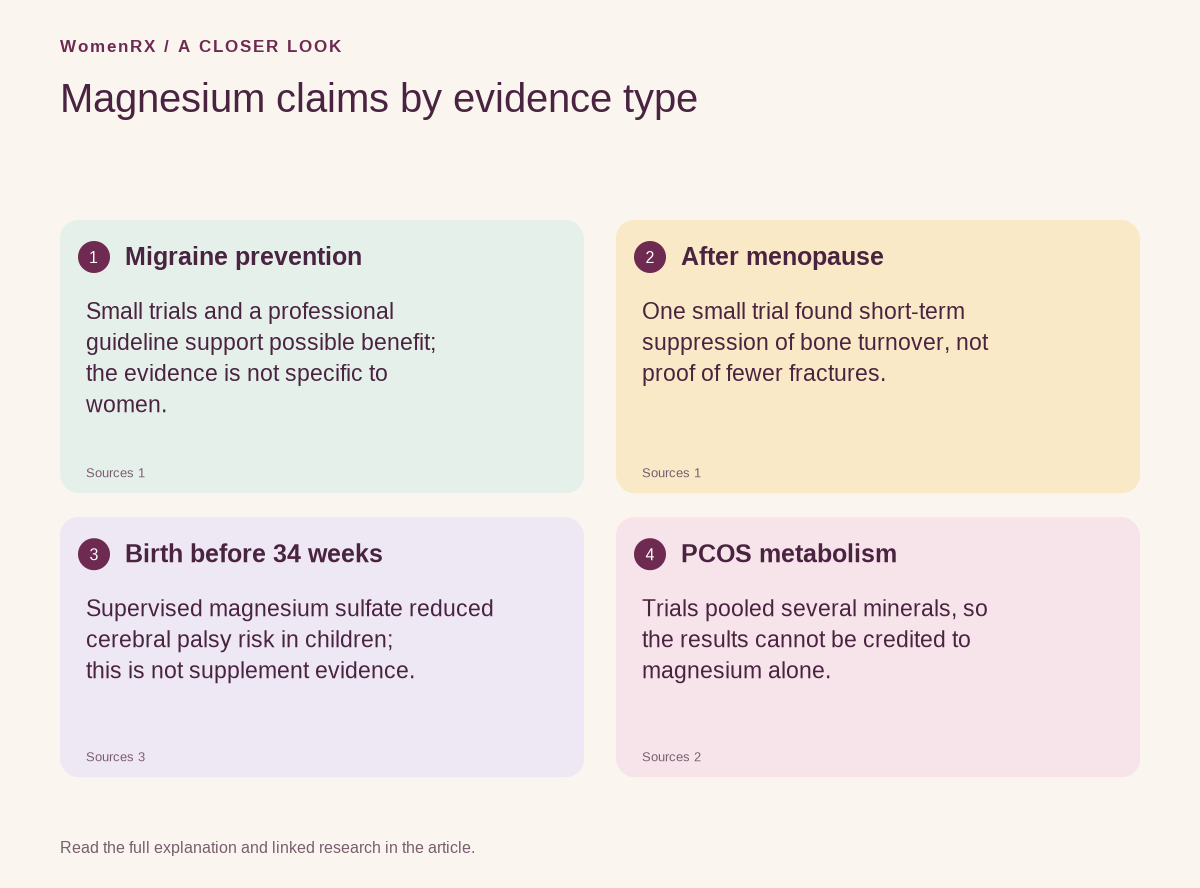
Magnesium claims by evidence type
Migraine prevention: Small trials and a professional guideline support possible benefit; the evidence is not specific to women.1
After menopause: One small trial found short-term suppression of bone turnover, not proof of fewer fractures.1
Birth before 34 weeks: Supervised magnesium sulfate reduced cerebral palsy risk in children; this is not supplement evidence.3
PCOS metabolism: Trials pooled several minerals, so the results cannot be credited to magnesium alone.2
Read the figure as text
These examples show why the health outcome, study population, and type of magnesium use matter.- Migraine prevention: Small trials and a professional guideline support possible benefit; the evidence is not specific to women.1
- After menopause: One small trial found short-term suppression of bone turnover, not proof of fewer fractures.1
- Birth before 34 weeks: Supervised magnesium sulfate reduced cerebral palsy risk in children; this is not supplement evidence.3
- PCOS metabolism: Trials pooled several minerals, so the results cannot be credited to magnesium alone.2
More questions, answered
Can a blood test tell me whether I need magnesium?
Serum magnesium is the most commonly used test, but it doesn’t closely reflect the body’s total magnesium or levels in specific tissues. A result needs to be considered alongside symptoms and clinical context. 1
Does a PCOS study of mineral supplements prove magnesium helps?
No. The review combined trials of several minerals, so its pooled results can’t isolate magnesium’s effect. 2
Sources you can check
- Magnesium - Health Professional Fact SheetAccessed 2026-09-25Return to first citation
- Effectiveness of mineral supplements (magnesium, chromium, zinc, selenium, chromium picolinate) in reducing insulin resistance in polycystic ovary syndrome: a meta-analysis of randomized controlled trials.Ye J, Cen S, Qi Q, Wang C, Wang J, Wang J, Yaping G, Wang J. · BMC endocrine disorders · 2026Return to first citation
- Magnesium sulphate for women at risk of preterm birth for neuroprotection of the fetus.Shepherd ES, Goldsmith S, Doyle LW, Middleton P, Marret S, Rouse DJ, Pryde P, Wolf HT, Crowther CA. · The Cochrane database of systematic reviews · 2026Return to first citation