What Changes Can Women Realistically Expect From Testosterone Therapy?
For women treated for distressing low sexual desire, testosterone may offer a moderate benefit, not a guaranteed change in energy, appearance, or overall vitality.
The best-supported use of testosterone in women is for hypoactive sexual desire disorder (HSDD), especially after menopause. Research and clinical guidance describe a moderate benefit, not a predictable transformation. A useful trial is judged by changes in the sexual concern that led to treatment, alongside side effects and monitoring, rather than by a testosterone number alone. 1
The clearest expectation: a possible, moderate improvement in sexual desire
Testosterone is not supported as a general-purpose treatment for feeling older, tired, or less vibrant. The evidence-backed use addressed in clinical guidance is distressing low sexual desire, primarily in postmenopausal women with HSDD. The guidance describes the average therapeutic benefit as moderate, which leaves room for a noticeable improvement for some women and little or no benefit for others. It does not promise a dramatic change. 1
The outcomes that matter are personal and practical: whether desire or interest improves, whether sex feels more satisfying, and whether the original concern feels less distressing. In one small placebo-controlled trial, 47 postmenopausal women with decreased desire who were already using hormone therapy were assigned compounded testosterone or placebo; the testosterone group improved on some sexual-function questionnaire areas, including desire and satisfaction. That study is a limited example, not a forecast for every woman or every formulation. 3
Don’t use broad vitality or appearance as the measuring stick
A claim that testosterone will reliably improve energy, mood, muscle, weight, or appearance goes beyond the outcomes supported by the guidance cited here. That doesn’t prove no woman will notice changes in those areas. It means they shouldn’t be treated as established or expected results of testosterone therapy for HSDD. If one of those concerns is your main reason for considering treatment, ask what evidence applies to that specific goal before starting.
This distinction matters because a treatment can raise a hormone level without resolving the concern you hoped it would. A total testosterone result is not a test that diagnoses HSDD; guidance describes it as a baseline for monitoring. The aim is to assess whether the treatment is helping the person, while monitoring levels and signs of excess. 1
Make the treatment trial answer a real question
Before treatment, define what “better” would look like in your life. For example, you might want sexual interest to return more often, feel less like sex is a source of strain, or experience more satisfaction when you do have sex. These are examples to help you describe your own goal, not a validated score or a promised outcome. HSDD care guidance recommends looking at potentially changeable contributors, including relationship or mental-health concerns, rather than assuming hormones explain every change in desire. 1 2
At follow-up, compare your experience with that starting point. Has the specific concern improved enough to matter to you? Has anything unwanted appeared? A lab result can help a prescriber monitor treatment, but it cannot answer those questions by itself. Guidance recommends monitoring and follow-up, including assessment for signs of androgen excess; it does not make a lab target a substitute for a meaningful benefit. 1
Agree with your prescriber on when to review the trial and what would count as enough benefit to continue. If you aren’t seeing a meaningful change by that review, or you’re experiencing unwanted effects or signs of excess, that’s a reason to reassess rather than keep going just because the number changed. Long-term safety hasn’t been established, so the decision should weigh your actual benefit against downsides and uncertainty. 1
Your life stage and the reason for treatment matter
The strongest recommendation is for postmenopausal women with HSDD after a broader assessment of relevant factors. There are limited data supporting use in late reproductive-age premenopausal women, but that is a less-established evidence base. The recommendation is not a blanket endorsement for all women with low desire, and a testosterone level alone cannot identify who has HSDD. 1
A useful starting question is: “What specific change are we treating, and how will we decide together whether it’s helping?” That keeps the trial focused on your experience, not on promises of a before-and-after transformation.
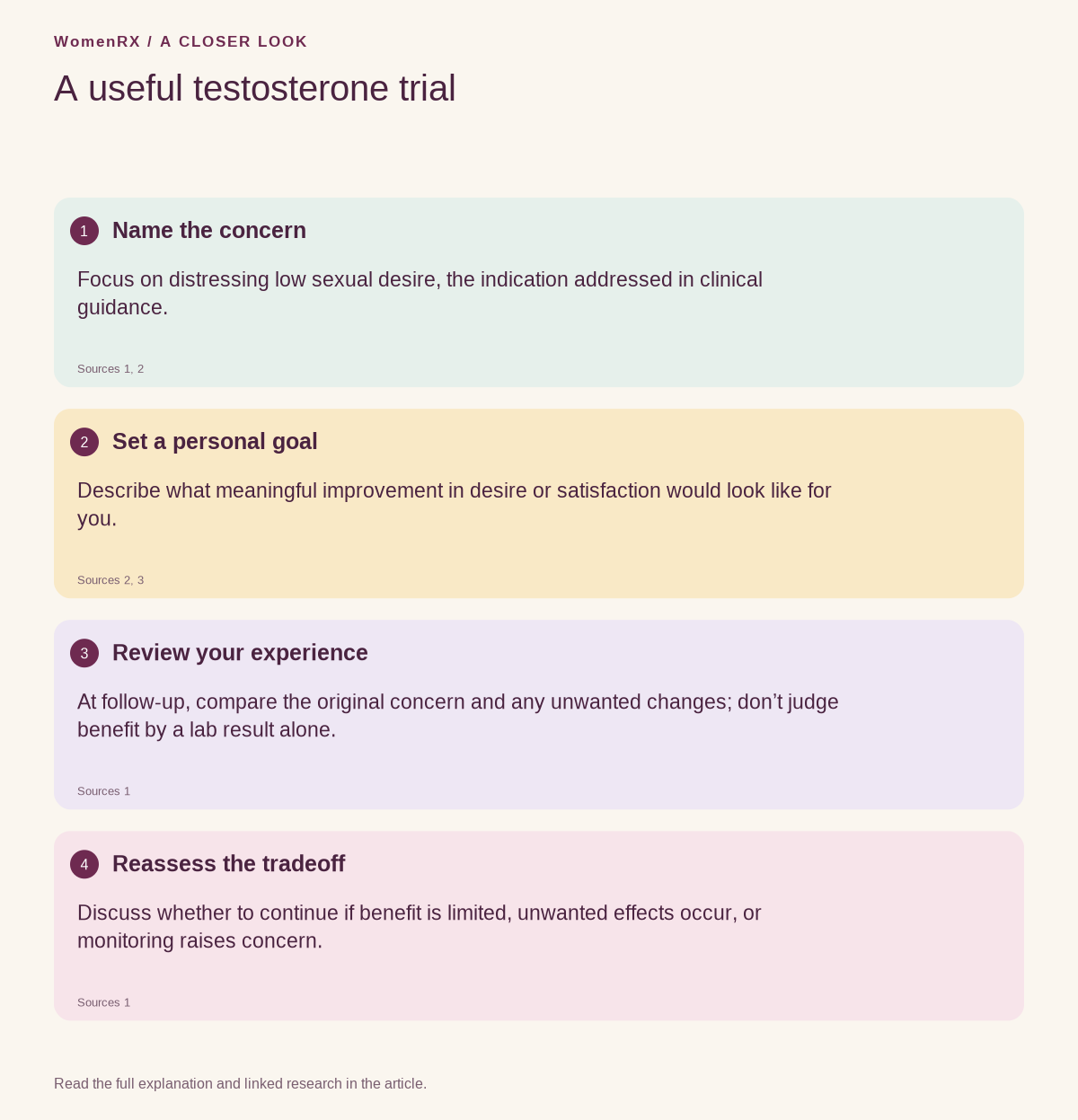
A useful testosterone trial
Name the concern: Focus on distressing low sexual desire, the indication addressed in clinical guidance.12
Set a personal goal: Describe what meaningful improvement in desire or satisfaction would look like for you.23
Review your experience: At follow-up, compare the original concern and any unwanted changes; don’t judge benefit by a lab result alone.1
Reassess the tradeoff: Discuss whether to continue if benefit is limited, unwanted effects occur, or monitoring raises concern.1
Read the figure as text
Keep the decision centered on the concern being treated, what changes in daily life, and whether benefit outweighs downsides.- Name the concern: Focus on distressing low sexual desire, the indication addressed in clinical guidance.12
- Set a personal goal: Describe what meaningful improvement in desire or satisfaction would look like for you.23
- Review your experience: At follow-up, compare the original concern and any unwanted changes; don’t judge benefit by a lab result alone.1
- Reassess the tradeoff: Discuss whether to continue if benefit is limited, unwanted effects occur, or monitoring raises concern.1
More questions, answered
Does a low testosterone test mean I have HSDD?
No. Clinical guidance says a total testosterone level should not be used to diagnose HSDD. It may be measured as a baseline for monitoring, while the treatment decision depends on the sexual concern and a broader assessment. 1
Should I expect the same results before and after menopause?
No. The clearest recommendation is for postmenopausal women with HSDD. Guidance describes the evidence in late reproductive-age premenopausal women as limited, so results should not be assumed to transfer equally across life stages. 1
Sources you can check
- International Society for the Study of Women's Sexual Health Clinical Practice Guideline for the Use of Systemic Testosterone for Hypoactive Sexual Desire Disorder in Women.Parish SJ, Simon JA, Davis SR, Giraldi A, Goldstein I, Goldstein SW, Kim NN, Kingsberg SA, Morgentaler A, Nappi RE, Park K, Stuenkel CA, Traish AM, Vignozzi L. · The journal of sexual medicine · 2021Return to first citation
- The International Society for the Study of Women's Sexual Health Process of Care for Management of Hypoactive Sexual Desire Disorder in Women.Clayton AH, Goldstein I, Kim NN, Althof SE, Faubion SS, Faught BM, Parish SJ, Simon JA, Vignozzi L, Christiansen K, Davis SR, Freedman MA, Kingsberg SA, Kirana PS, Larkin L, McCabe... · Mayo Clinic proceedings · 2018Return to first citation
- Effect of transdermal testosterone on postmenopausal sexual desire: placebo-controlled randomized clinical trial.Ceccatto Andrade VP, Araujo Júnior E, Callado GY, Ceccatto Andrade G, Kulak Junior J. · European journal of obstetrics, gynecology, and reproductive biology · 2026Return to first citation