What Changes Might Estradiol Treatment Improve?
Estradiol is most likely to help the symptoms it’s meant to treat, so judge progress against a specific goal rather than a promise of feeling different in every way.
Estradiol is an established treatment for menopause-related hot flashes and night sweats, and hormone therapy can also help genitourinary symptoms such as vaginal dryness. It helps prevent bone loss, but that doesn’t mean you’ll feel a change you can track. Results vary, and the evidence doesn’t set one response timeline for everyone. Define your target symptom and review it periodically with your clinician. 1
Start with the symptom you want to change
Estradiol isn’t a general reset for every change that can happen around menopause. Hormone therapy is the most effective treatment for vasomotor symptoms, which include hot flashes and night sweats. It can also help genitourinary symptoms of menopause, and it has been shown to prevent bone loss and fracture. Those are distinct goals: preventing bone loss may not create a noticeable day-to-day improvement, while fewer or less disruptive hot flashes may be easier to notice. 1
Before treatment, pick one or two outcomes that matter to you. For example, you might count hot flashes or note how much they interrupt sleep or daily activities. If vaginal dryness, itching, irritation, soreness, or pain with sex is the concern, rate that discomfort in a consistent way. These are practical ways to organize your own observations, not a validated test or a guarantee that treatment will work. 2
What the studies can, and can’t, tell you
In a randomized trial of 257 recently menopausal women, both oral and transdermal estradiol groups had improved menopause symptom scores after treatment. Researchers assessed symptoms at 4, 12, and 24 weeks. The study compared two treatment routes, and both groups also received progesterone, so its results don’t isolate estradiol’s effects from that combination. The study’s assessment schedule also shouldn’t be read as a promise that you’ll feel better by a particular week. 4
A pooled analysis of two controlled trials included 583 postmenopausal women treated for 12 weeks with estradiol plus dydrogesterone or placebo. Hot flashes decreased by an average of 1.5 more per day with the combination than with placebo. That result gives a sense of the difference between groups in those trials; it doesn’t predict how much any one person’s hot flashes will change, and it isn’t a result for estradiol alone. 3
For vaginal symptoms, a small open-label pilot study followed 51 menopausal women with HIV for 12 weeks. Vaginal symptom scores improved more in the estradiol group than in the no-treatment group. Because the study was small and focused on women with HIV, it offers a specific example rather than a precise forecast for everyone considering vaginal estradiol. 2
Match the treatment to the goal
The form of treatment matters. Systemic hormone therapy is used for symptoms such as hot flashes and night sweats. For bothersome genitourinary symptoms that haven’t improved with over-the-counter therapies, low-dose vaginal estrogen is one option for people who don’t have a reason to use systemic hormone therapy. The best fit depends on the symptoms being treated and individual circumstances. 1
That distinction can help if one symptom improves but another doesn’t. For example, fewer hot flashes don’t necessarily mean vaginal discomfort will also resolve. Name which symptom remains bothersome and bring that specific goal into a treatment review, rather than assuming the treatment should improve every menopause-related change.
Review progress without a promised deadline
There isn’t one response schedule that applies to everyone in this evidence. Studies measured outcomes at different points, but those research visits don’t establish a universal deadline for judging your own response. Instead, compare your chosen measure over time: Are hot flashes less frequent or less disruptive? Is the vaginal symptom you targeted changing? Is the improvement meaningful enough to you?
Menopause guidance recommends periodic reevaluation of hormone therapy’s benefits and risks, with treatment individualized to the person. If your target symptom isn’t improving, or the tradeoff no longer feels worthwhile, that’s a reason to review the goal and treatment fit with your clinician. A lack of progress on one symptom doesn’t, by itself, explain why it happened or determine what should change. 1
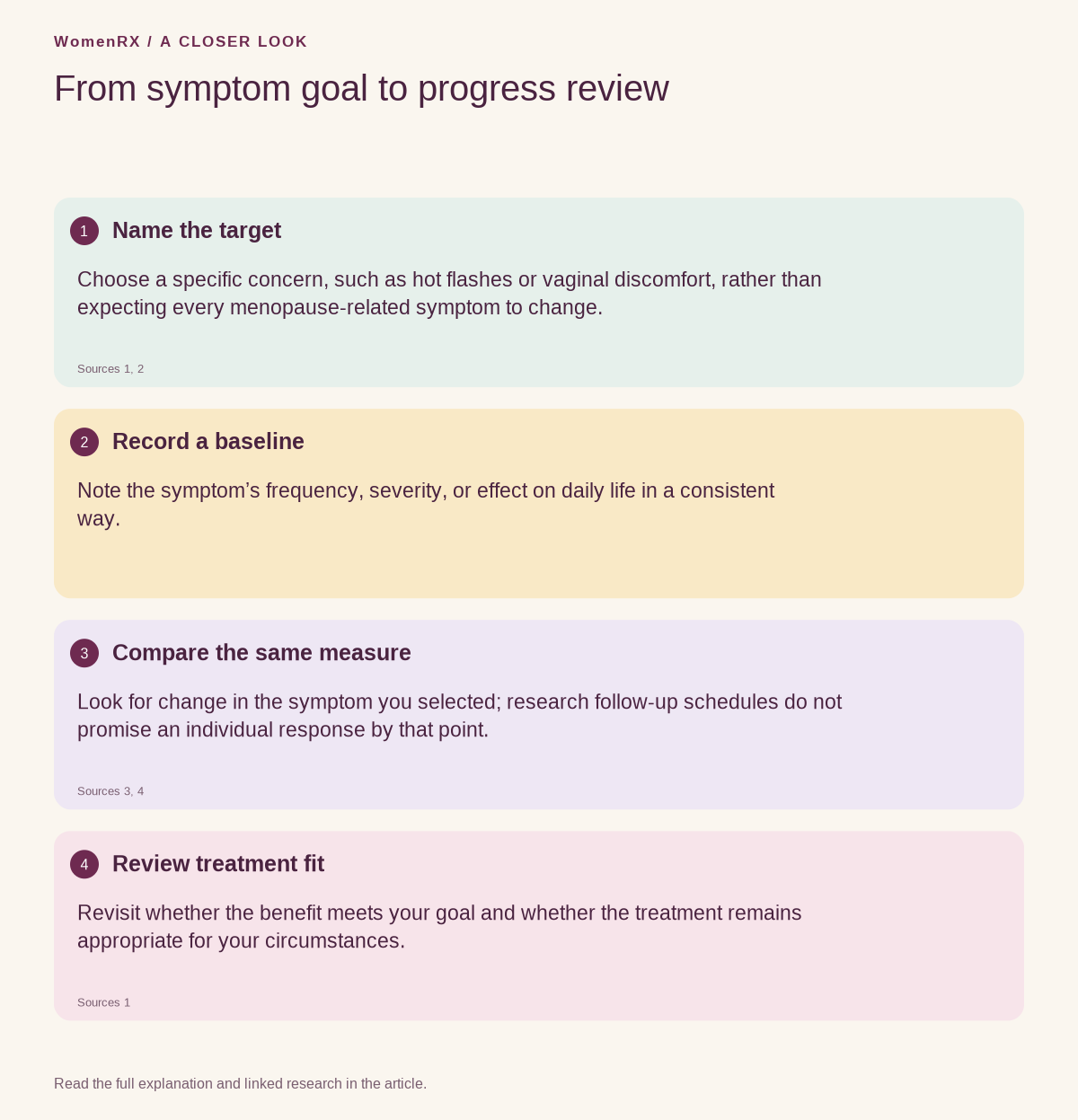
From symptom goal to progress review
Name the target: Choose a specific concern, such as hot flashes or vaginal discomfort, rather than expecting every menopause-related symptom to change.12
Record a baseline: Note the symptom’s frequency, severity, or effect on daily life in a consistent way.
Compare the same measure: Look for change in the symptom you selected; research follow-up schedules do not promise an individual response by that point.34
Review treatment fit: Revisit whether the benefit meets your goal and whether the treatment remains appropriate for your circumstances.1
Read the figure as text
A practical sequence for assessing whether estradiol is helping the symptom you chose to treat, without assuming a guaranteed result or deadline.- Name the target: Choose a specific concern, such as hot flashes or vaginal discomfort, rather than expecting every menopause-related symptom to change.12
- Record a baseline: Note the symptom’s frequency, severity, or effect on daily life in a consistent way.
- Compare the same measure: Look for change in the symptom you selected; research follow-up schedules do not promise an individual response by that point.34
- Review treatment fit: Revisit whether the benefit meets your goal and whether the treatment remains appropriate for your circumstances.1
Sources you can check
- The 2022 hormone therapy position statement of The North American Menopause Society.“The 2022 Hormone Therapy Position Statement of The North American Menopause Society” Advisory Panel. · Menopause (New York, N.Y.) · 2022Return to first citation
- Impact of Vaginal Estradiol on the Genitourinary Syndrome of Menopause, Vaginal Microbiome and Mucosal Immune Mediators in Women With HIV.Murphy K, Gromisch M, Connolly J, Wang T, McWalters J, Atrio J, Mahant AM, Gera S, Colanta A, Cajigas A, Kelly L, Estrella H, Gustafson D, Minkoff H, Anastos K, Keller MJ, Herold BC. · Clinical infectious diseases : an official publication of the Infectious Diseases Society of America · 2026Return to first citation
- Ultra-low dose estradiol and dydrogesterone for the treatment of menopausal symptoms in a pooled, multi-ethnic population.Stevenson JC, Ren M, Kahler E, Custodio MG, Nappi RE, Tatarchuk T, Simoncini T, Karpova V, Yu Q. · Maturitas · 2024Return to first citation
- Changes in menopausal symptoms comparing oral estradiol versus transdermal estradiol.Tang R, Xie Z, Ruan X, Zhang Z, Ren M, Wu J, Shu K, Shi H, Xie M, Lv S, Yang X, Chen R, Yu Q. · Climacteric : the journal of the International Menopause Society · 2024Return to first citation