Estradiol and Weight: What Changes Can You Expect?
A weight change after starting estradiol is worth understanding, but the timing alone doesn’t tell you what caused it.
Estradiol isn’t a reliable way to predict weight loss or gain. A meta-analysis in postmenopausal women found no statistically significant pooled effect on body weight, BMI, or waist-to-hip ratio for one transdermal estradiol-and-norethisterone combination. That finding can’t predict your response to estradiol alone. If your weight changes, consider the trend and what else changed around the same time. 2 1
What has actually been studied
A meta-analysis of 10 articles and 14 treatment arms looked at transdermal 17β-estradiol combined with norethisterone acetate in postmenopausal women. It found no statistically significant pooled effect on body weight, body mass index (BMI), or waist-to-hip ratio. 2
That’s useful evidence against assuming this specific combination produces a predictable weight change. It isn’t a promise that your weight will stay the same. The finding doesn’t establish what happens with estradiol alone, other formulations, or treatment during perimenopause. Nor does a nonsignificant pooled result mean that no one in the studies gained or lost weight. 2
What else could explain a change on the scale?
Weight includes fat, muscle, bone, and water. A scale adds them together; it can’t tell you which component changed. BMI has a similar limitation: it uses height and weight but doesn’t distinguish fat from muscle or bone. 1
For example, a higher reading could reflect a change in water, fat, or both. A steady reading could also conceal changes in different components that offset each other. Those are ways to interpret what a scale can’t tell you, not a diagnosis of what’s happening in your body. Diet and family history also play a role in body weight, and an unexpected change can sometimes signal a medical problem. 1
If clothes fit differently but the scale has barely moved, you’re noticing something real, just not necessarily a change in total weight. Likewise, waist-to-hip ratio describes a relationship between two measurements; it isn’t a direct measurement of fat or muscle. The meta-analysis did not report a significant pooled effect on that ratio, but its abstract does not establish how the treatment affected body composition. 2 1
Compare the trend, not just the start date
Starting estradiol gives you a memorable date, which can make every later weight change seem connected to it. To make a fairer comparison, look at more than one reading before and after treatment began, if you have them. If you choose to weigh yourself going forward, using similar conditions, such as a similar time of day and similar clothing, can make the readings easier to compare. This is a practical comparison, not a test that can prove cause and effect.
Put the numbers in context. Note which treatment you started and whether your eating habits or anything else relevant to your weight changed around the same time. Keep a change in waist measurement or clothing fit separate from a change in scale weight. That way, you can describe the concern you actually have rather than asking one number to answer several different questions.
When to bring it up
If your weight change is persistent and concerns you, a treatment review can address two questions: whether another explanation needs attention and whether estradiol is still meeting the goal you started it for. A weight change alone doesn’t answer either question. If you’re gaining or losing weight without trying, particularly if the change is sudden and unexpected, talk with a health care provider rather than assuming it’s part of menopause or a treatment effect. 1
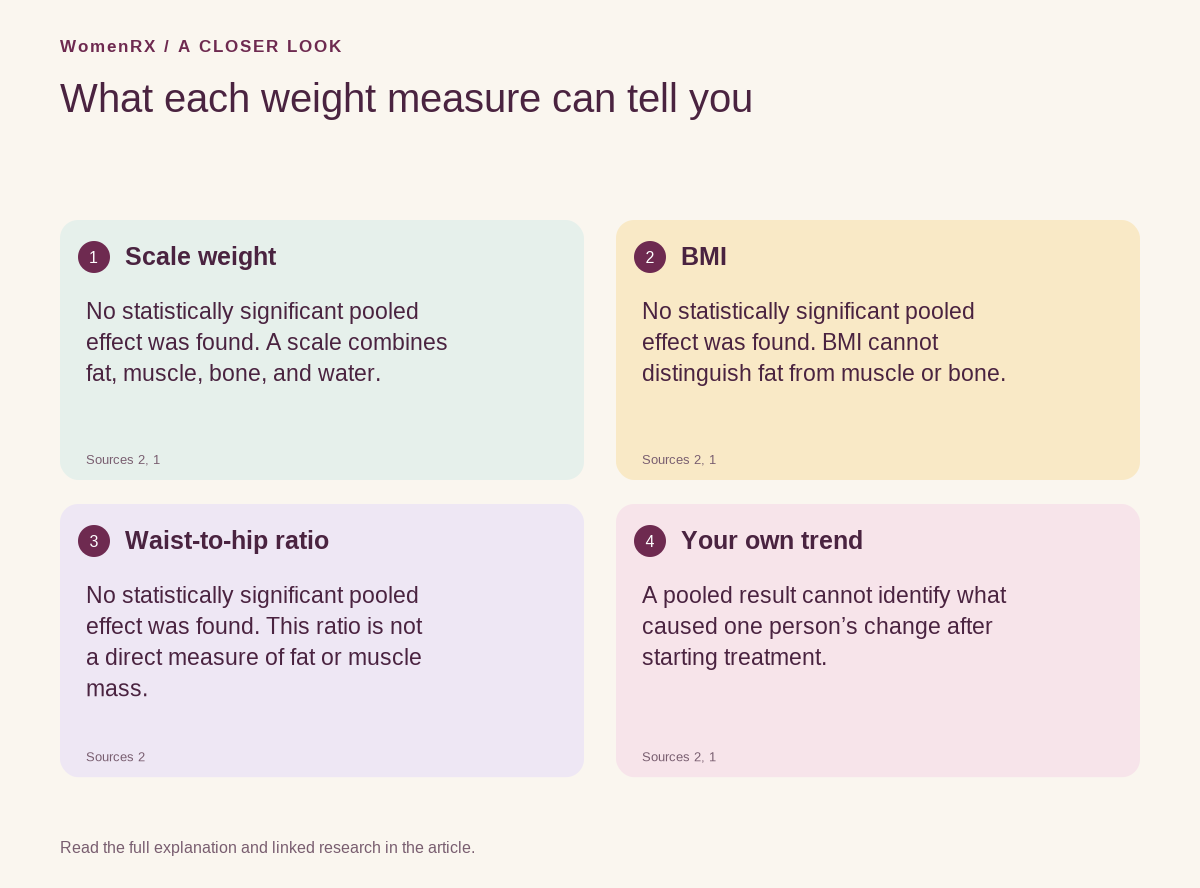
What each weight measure can tell you
Scale weight: No statistically significant pooled effect was found. A scale combines fat, muscle, bone, and water.21
BMI: No statistically significant pooled effect was found. BMI cannot distinguish fat from muscle or bone.21
Waist-to-hip ratio: No statistically significant pooled effect was found. This ratio is not a direct measure of fat or muscle mass.2
Your own trend: A pooled result cannot identify what caused one person’s change after starting treatment.21
Read the figure as text
The studied combination was assessed using three measures, none of which identifies every change in body composition.- Scale weight: No statistically significant pooled effect was found. A scale combines fat, muscle, bone, and water.21
- BMI: No statistically significant pooled effect was found. BMI cannot distinguish fat from muscle or bone.21
- Waist-to-hip ratio: No statistically significant pooled effect was found. This ratio is not a direct measure of fat or muscle mass.2
- Your own trend: A pooled result cannot identify what caused one person’s change after starting treatment.21
More questions, answered
Does this research show that estradiol helps with weight loss?
No. The meta-analysis found no statistically significant pooled effect on body weight for transdermal estradiol combined with norethisterone acetate in postmenopausal women. It does not establish estradiol as a weight-loss treatment. 2
Sources you can check
- Body Weight: MedlinePlusAccessed 2026-09-25Return to first citation
- Effects of Transdermal 17β-Estradiol + Norethisterone Acetate on Cardiovascular Disease Risk Factors in Postmenopausal Women: A Meta-analysis of Data From Randomized, Controlled Trials.Lan X, Cai S, Li G, Prabahar K, Hernández-Wolters B, Yin Y. · Clinical therapeutics · 2023Return to first citation