A Meal Can Raise Cortisol Without Making It Harmful
Cortisol can rise after eating, but a short-lived measurement is not proof that a food causes lasting harm.
Eating can produce a temporary rise in cortisol, and the timing varies across studies. One review describes levels rising after a meal and returning toward baseline within about two hours; a small study of men found a peak 20 minutes after a high-calorie meal. Neither finding shows that a particular everyday food causes chronically high cortisol or lasting health problems. 1 2
Start with what the headline actually measured
“Raises cortisol” can sound like a warning about a food. But cortisol naturally changes across the day, and eating itself can prompt a short-term response. A review of research on food and daily cortisol describes levels rising after a meal, often peaking around an hour and returning toward baseline in about two hours. That’s a response tied to eating and meal timing, not, by itself, evidence that a food is harmful. 1
The details matter. In a non-randomized study, researchers measured blood cortisol repeatedly for three hours after a high-calorie meal in 36 men: 18 lean and 18 with obesity. Cortisol peaked 20 minutes after the meal in both groups, and the researchers found no significant difference in the overall response between them. This study tells us about a measured response to one meal in men. It did not test whether a specific food causes persistently elevated cortisol or later health problems. 2
The timing reported across studies isn’t identical. That’s a reason to read the study’s actual measurement schedule and meal, not to treat one cortisol reading as a verdict on a food. 1 2
A cortisol result needs its context
Before drawing a conclusion, check four things:
- What was eaten? A response after a high-calorie meal does not establish that every food, or any named food, has the same effect. The male study tested a meal, not a list of individual foods. 2
- When was cortisol measured? A result taken shortly after eating captures a different moment from a measurement later in the day. The review describes meal-related changes against cortisol’s daily rhythm. 1
- How long did the researchers follow people? The male study followed participants for three hours after one meal. That can show a short-term pattern, but it cannot establish a lasting effect from regularly eating that food. 2
- What health outcome was measured? A change in a hormone is not the same thing as a demonstrated change in health. The meal study measured cortisol, not whether the meal caused a later illness or other lasting harm. 2
This distinction helps with headlines that leap from “cortisol increased after eating” to “avoid this food to protect your hormones.” The first statement may describe a measurement; the second needs evidence about repeated exposure and meaningful health outcomes. A brief rise alone doesn’t supply that evidence. 1 2
What the evidence says about women
The controlled meal study described above included men only, so it cannot tell us whether women have the same response. The review discusses food and cortisol rhythms, but the material on meal responses does not establish effects specific to women or explain how menstrual-cycle phase, pregnancy, or breastfeeding might change them. There’s no basis here for an avoid-list for women. 1 2
That boundary matters when a headline presents a general result as if it were tested in women. If the study didn’t include women, or didn’t report results by sex or reproductive context, its finding shouldn’t be presented as a women-specific food effect.
A more useful way to read the next claim
When you see that a food “increases cortisol,” ask: Was the result measured once or over time? Was the change still present later? Did the study compare a particular food with another food, or simply measure cortisol after a meal? Did it measure a health outcome, or only the hormone?
If the finding is a short-term response after eating, it may be a real observation without being a reason to avoid the food. To support a lasting health warning, research would need to connect a specific food or eating pattern with persistent changes and relevant health outcomes, not just a momentary rise in a biomarker. The available meal findings describe a response after eating; they don’t establish that ordinary foods are harmful because of that response. 1 2
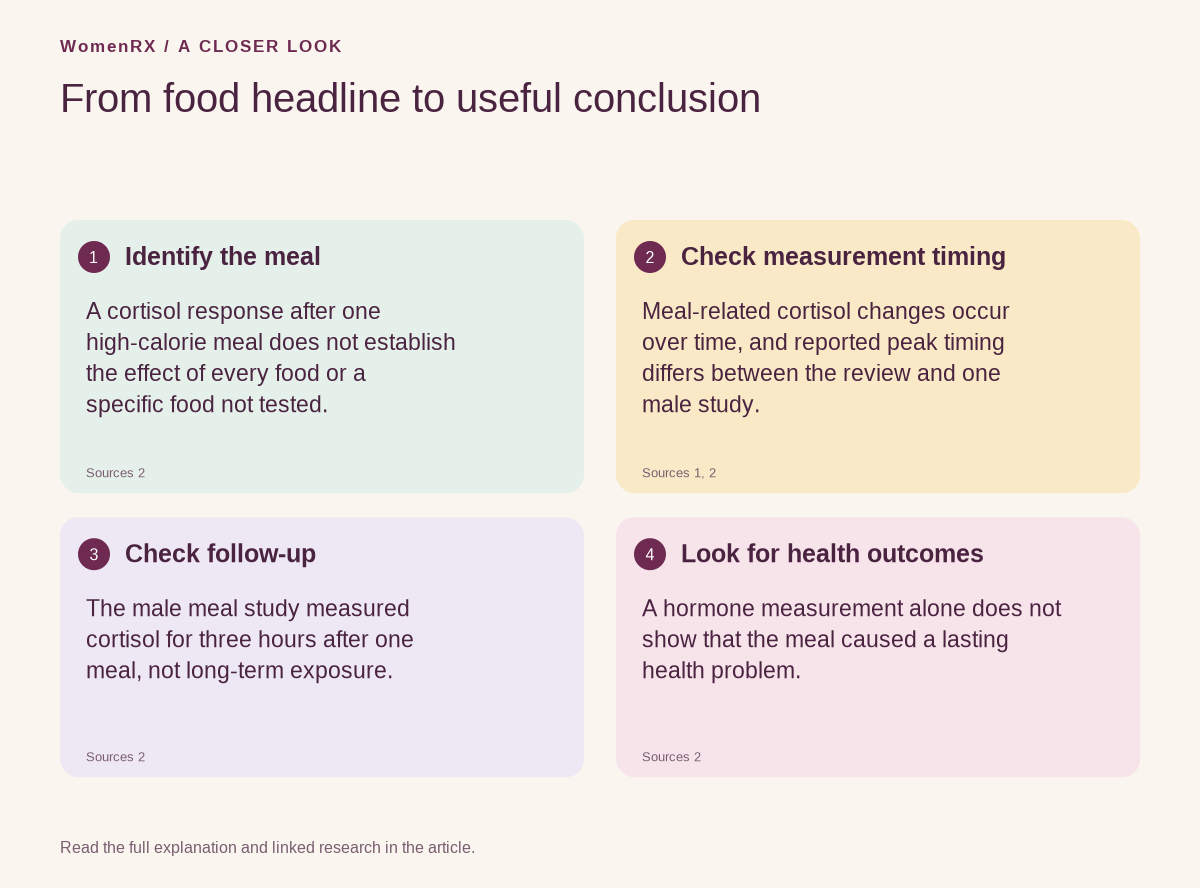
From food headline to useful conclusion
Identify the meal: A cortisol response after one high-calorie meal does not establish the effect of every food or a specific food not tested.2
Check measurement timing: Meal-related cortisol changes occur over time, and reported peak timing differs between the review and one male study.12
Check follow-up: The male meal study measured cortisol for three hours after one meal, not long-term exposure.2
Look for health outcomes: A hormone measurement alone does not show that the meal caused a lasting health problem.2
Read the figure as text
Four checks help distinguish a short-lived cortisol measurement from evidence that a food has a lasting health effect.- Identify the meal: A cortisol response after one high-calorie meal does not establish the effect of every food or a specific food not tested.2
- Check measurement timing: Meal-related cortisol changes occur over time, and reported peak timing differs between the review and one male study.12
- Check follow-up: The male meal study measured cortisol for three hours after one meal, not long-term exposure.2
- Look for health outcomes: A hormone measurement alone does not show that the meal caused a lasting health problem.2
Sources you can check
- "Feeding the Rhythm"-Effects of Food and Nutrients on Daily Cortisol Secretion: From Molecular Mechanisms to Clinical Impact.Paragliola RM, Marchetti M, Montagna C, Corsello SM, Peluso G. · International journal of molecular sciences · 2025Return to first citation
- Food-induced cortisol secretion is comparable in lean and obese male subjects.Arroyo Tardio P, Baldini G, Seelig E. · Endocrine connections · 2023Return to first citation